Saturday, June 04, 2016

Roasted Wenshan Baozhong

Before we turn to the roasted Wenshan Baozhong, let me share some feedback I received from Amy in California about my 2016 Spring Top Wenshan Baozhong:
"I brewed it in a rather unorthodox way in a travel glass thermos: toss a handful of leaves in and add some warm water.

Well, I was stopped in my rush when I opened the bag; what a wonderful aroma of these dry leaves! It was so fresh and ethereal… Aaaah! For a moment, I even forgot that I was rushing or that I had to be anywhere or that I had a “to do” list.

The brewed color is beautiful and delicate. The taste is elegant, yet it has that very special note that makes a great baozhong so distinct. I call it a caramel note. The lingering perfume on the palate is nice. It took me about 20 minutes to finish my thermos, with the leaves floating in the brew. Never did I taste any astringency.

This Top Baozhong Spring 2016 is everything I like and everything I want in a baozhong… I love this tea!

Thank you, Stéphane, for making this experience so lovely by working hard to find such good teas…and for selling these teas TO ME and not keeping “the good stuff” hidden in a back room only for your very elite customers!!!"
Thank you so much for your well-written comment, Amy! All my readers belong the elite of the tea world and I am particularly glad to share such teas when I see the happy feelings they create!
Roasted Wenshan Baozhong
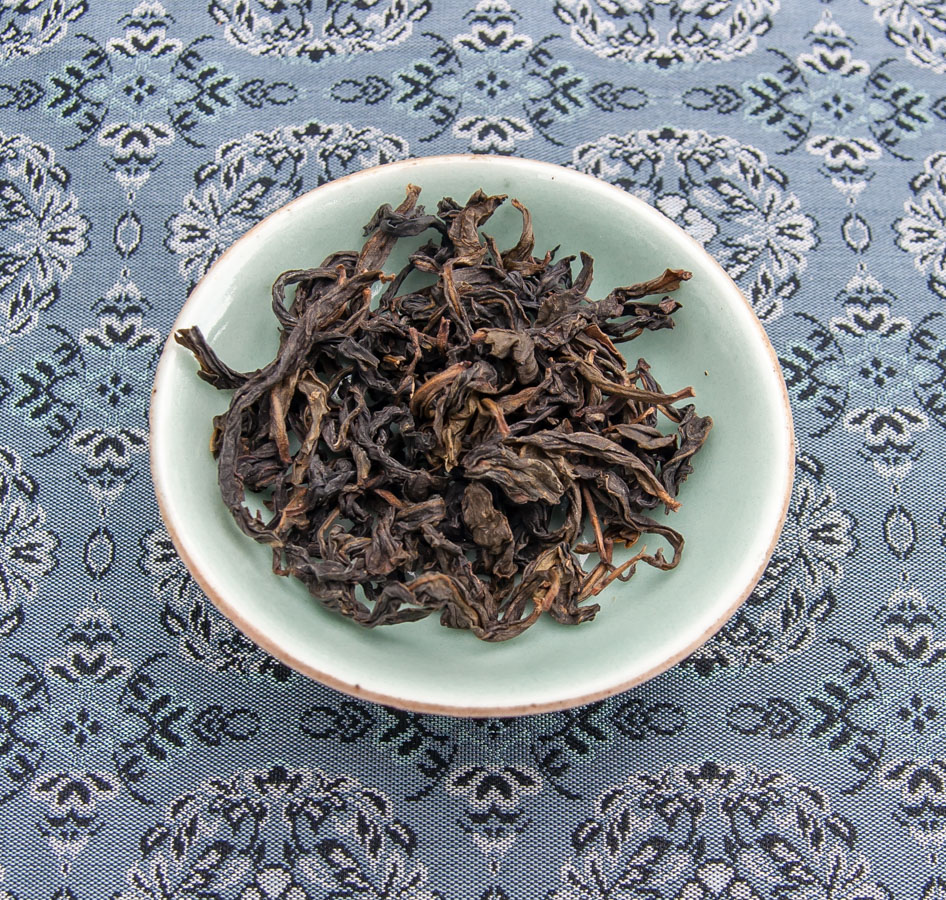
During my last trip Pinglin, I tasted some roasted Baozhong and have selected 2 new specimens. The first is very similar to the one I'm drinking in this post. It's a medium roasted 'subtropical forest' Baozhong from spring 2014. The roast was made in winter 2015 with the unsold leaves of spring 2014. Since the Baozhong competitions only involve unroasted Baozhong, there's little incentive to roast the leaves in their first year (like in Dong Ding), unless a customer makes a specific request. So, the roasting is often done after 18 months in order to dry and refreshen the Baozhong.
The roasting degree can vary widely. My preference goes to a medium roasting level to deepens and darkens the originals aromas while preserving the freshness of the leaves. They still open up fully in the gaiwan below. And even though the cultivar, the oxidation level and the roasting levels are the same as for Hung Shui Oolong (in Ding Ding), the fact that the leaves aren't rolled and come from Wenshan instead of Nantou gives them a lighter, more flowery aroma.
This year, I also selected an organic roasted Baozhong (from spring 2013). It has the same roast level, but it brews even lighter colors and scents. The explanation is that its organic leaves are thicker and the heat of the roast doesn't penetrate into the leaves as thoroughly as regular leaves.
 
The roast adds a darker and sweeter layer to the Baozhong experience. After drinking fresh, energetic Baozhongs, it provides more depth and a slower pace.
This triangular Chaxi is centered around tea. The blue and white colors echo the qinghua porcelain popular during the Qing dynasty (when roasted Oolong was invented).
At this spot, I particularly enjoy the deep connection with Wenshan's nature...

Wednesday, June 01, 2016

The calm energy of aged Oolongs

10 years ago, Chris ordered a bunch of my old Oolongs to taste with his tea friends in Sweden. Interest for Taiwanese Oolongs was rare in those days and interest in aged Oolongs was even rarer in the West. However, Chris practices Traditional Chinese Medicine (TCM) and had already recognized the virtues of aged Oolong on the body.
So, Chris' first trip to Taiwan was a great opportunity to meet and brew a few aged Hung Shui Oolongs. We started to smell various Oolongs with varying degrees of roast and age in order to choose those that appealed most to him. We started with this winter 2013 Hung Shui Oolong from Dong Ding. It hasn't changed much in terms of scents, but feels smoother and lighter than 2 years ago. It provides a good idea of what a standard Hung Shui Oolong tastes like before it starts to age.
Then, we tasted this 1999 spring Hung Shui Oolong from Dong Ding. This time, there are scents like wood, incense that appear. These tertiary fragrances need the slow work of time. The leaves's color is darker, a sign of postoxidation. But the leaves remain flexible and open up well. As Chris observed, they become green again with time. It's as if they became young and fresh again after several brews. And their chaqi is gentle, warming, but still powerful.
Spring 1999 vs. winter 2013 Hung Shui Oolong
I brewed with very few leaves and with long brewing times. The leaves you can see above are all I used for each Chaxi. This isn't necessarily the best way to enjoy them, but a good way to judge their quality. The brewing span of Hung Shui Oolong is very large. Some like it very concentrated and others (those who are more used to fresh Oolongs or greens) often prefer it on the lighter side. From Chris' expression, I think he was pretty satisfied with the tea!
The closed eyes are an accident that makes this picture perfect! Because it catches the state of near meditation that delicious tea with long aftertaste can throw you into. This is why I think that the main health benefits of such a Chaxi aren't for the body, but for the mind and the soul. And what's good for the soul will ultimately also be good for the body.
At Fuhu temple on mount Emei, Sichuan Province
Amen to that and Amituofo to Chris and you all!

Friday, May 27, 2016

Spring 2016, the legend of Lishan Oolongs

Da Yu Ling, former tea plantation
Last year, I reported about the fact that the tea plantations on Da Yu Ling are returned to the government as their leases expire. The tea trees are uprooted and the death of Da Yu Ling can only mean that its legend will continue to live on in the memory of tea drinkers. Like for great painters/sculptors, it's with their death that prices really soar, because their production is now limited, finished, but the demand continues to grow with the mystic. And since it's possible to age great high mountain Oolong for 30 years, there will still be billionaires (and patient tea lovers) enjoying a spring 2015 Da Yu Ling Oolong in 2050! 
Da Yu Ling, former tea plantation
Each high mountain produces Oolong with a different character. Da Yu Ling's power and purity explain its appeal and reputation. While the power comes mainly from the altitude, the purity probably comes from the very fact that has led to Da Yu Ling's demise: growth on public land that wasn't intended for agriculture. Since the surroundings were protected forests, each plantation could grow its tea trees in very natural conditions.
Da Yu Ling, 97K
Lishan Oolong, spring 2016
Lishan has a more typical development: lots of small parcels of plantation wherever possible, in order to take advantage of the considerable fame of the Lishan name. The better plantations are located outside the village, of course, at a slightly higher altitude and with better surroundings. This year, I have selected this Oolong from a 2400 meters high plantation, harvested on May 9th. For me, this was an experience of ultimate elegance.
Lishan village
 Tsui Luan Oolong, spring 2016
Things are pretty crowded near Lishan, but this is still not enough to provide all Taiwanese, Chinese (and a few Western) Gao Shan Cha lovers with tea. That's why nearby mountains that reach or approach the 2000 meters mark are often simply packaged and marketed as Lishan Oolong. This is the case with the Tsui Luan (翠巒) mountain. It reaches 2100 meters and is located very close by in a western direction. However, despite this proximity, these spring Tsui Luan leaves harvested on May 8th are very different. Very green. Their energy is much more similar to Da Yu Ling than to Lishan, IMO.
Lishan

Tsui Feng, spring 2016
There's another mountain that is very popular and often lumped together with Lishan: Tsui Feng, 翠峰. It is located south of Lishan, on the other side of the He Huan Shan pass, near the Cing Jing farm. At 1900-2000 m, the elevation of Tsui Feng is a little bit lower than Tsui Luan, but it produces very similar sweetness than Lishan. This year, its chaqi is particularly powerful, even though it starts very slowly and unfolds over several minutes.

Conclusion: The spring 2016 Lishan, Tsui Luan and Tsui Feng are 3 distinct top High Mountain Oolongs. Which one will be your favorite?

Friday, May 20, 2016

"The best tea autist blog"?


Spring 2016 Jinxuan Baozhong
I laughed when I read this on an Internet Forum about my blog:

"This is the best tea autist blog. He takes really nice photos while reviewing teas that 99% of his readers will never be able to afford or find. He brings his huge tea kit outside all the time and always meticulously photographs every drop of tea." (...)

Thanks for the compliments (best, nice photos). However, I would like to take this opportunity to answer the complaint that my teas are too expensive.
And just to prove that I'm not "autist", let me start to agree that there are indeed some teas in my selection that cost more than what 99% of the people would call reasonable. If I'm proposing such teas, it's not because I have a big following among the 1%. It's simply that I love those teas like I love Christmas: they are very special, once a year experiences. They also provide valuable lessons about how teas evolve with time, standards of perfection, qi...
There's always a fine line between the tea enthusiast and the tea snob. Getting used to high quality tea makes it difficult to go back to drinking simpler and cheaper teas. And since I have a direct access to truly amazing teas that continue to drive my passion, it's probably a little bit normal that such teas stand out in my selection. But, first of all, my teas are not difficult to find since anybody can order them online at my tea boutique: www.tea-masters.com !

And if you look at the prices, you'll notice that I have also listed very affordable Oolongs. The '209' Oolong costs just 12 USD for 150 gr. A Jade Oolong is at 12 USD for 100 gr. A high mountain Jinxuan Oolong costs only 25 USD for 150 gr And this Jinxuan Baozhong from this spring costs 18 USD for 150 gr (or 4 USD for 25 gr)... It's the tea that you can see in this article. I've enjoyed it very much. I used a big amount of leaves and the first 3 brews were rather short. The tea had flowery scents, a mellow taste and an elegant finish! In the later brews it didn't mind being pushed.
It shows that you can also find nice quality and pleasure in more common teas. But they are not as common as that. Consider that they are:

- fresh harvests from the finest season, spring,
- single batches from the same field and same day to ensure very distinctive and pure aromas,
- well processed in family sized plantations with long tea making traditions,
- naturally made in Taiwan, without any added scents,
- selected for their superior quality by the best autist tea blogger!
I strongly believe that good entry-level Oolong teas have many benefits:
- They are good companions to practice your brewing skills,
- A good understanding of their qualities will let you appreciate exceptional teas even more (than if you only taste such top teas),
- They teach a fundamental lesson in life: adjust your expectations. It can't be caviar every day! A key to finding pleasure in everyday tea is to understand the character of the leaves and be content when you are able to brew them to their full potential. There's actually less risk of disappointment with an every day Oolong.

Please note that you receive a free pack of Dong Pian Oolong if your order exceeds 60 USD (and a free copy of my Oolong Brewing eGuide). Airmail shipping (with tracking) is free above 100 USD. And it's free EMS shipping above 200 USD. You also find good deals with previous harvests that make good tea even more affordable!

Wednesday, May 18, 2016

Renaissance de la tradition du thé de la dynastie Sung

Taiwan est une petite ile qui joue un rôle déterminant dans l'art du thé depuis une vingtaine d'années. Ancienne colonie japonaise (1895-1945), Taiwan a gardé de nombreux liens avec le Japon après la seconde guerre mondiale. Le Japon est le pays qui a le mieux su préserver les anciennes traditions chinoises du thé: le Chado est la combinaison du chauffage de l'eau de la dynastie Tang et la préparation thé vert en poudre de la dynastie Sung. 
Ainsi, Teaparker, mon maitre de thé Taiwanais, s'est d'abord intéressé au Chado japonais avant de faire ses recherches sur les anciennes origines chinoises de cette cérémonie du thé. C'est donc grâce aux traditions du Japon que Teaparker a pu redécouvrir les traditions de la dynastie Sung! Il a notamment lu et compris le traité de thé de Sung Huizhong (宋徽宗), l'empereur chinois le plus féru de thé (1082-1135).

 "Mon maitre de thé, c'est Sung Huizhong!" aime-t-il répéter.
La renaissance de la tradition Sung s'est donc faite à Taiwan avec l'aide du Japon. Et pour rendre cette petite histoire encore plus internationale, votre blogueur franco-allemand prépare un thé vert en poudre du Brésil! (Merci Heroldo!)
En effet, une société japonaise a eu l'idée de cultiver du thé vert au Brésil! Il ne manque pas de fraicheur et d'énergie, mais il n'a naturellement pas la douceur et la finesse d'un matcha d'Uji. Néanmoins, cela montre que même l'Amérique du Sud participe désormais à l'histoire chinoise internationale du thé!

Monday, May 16, 2016

In search of Tea culture on Mount Emei, Sichuan

Fuhu temple
The tea culture on display at the Emei Shan's Tea Expo was commercial and felt artificial, shallow despite (or rather because of) the huge size of the booths. MarshalN makes a good case that most traditions you find in Chinese shops are invented and have only been very recently imported from Taiwan, Hong Kong or even Japan (here I simplify his article, but I invite you to read it all if you haven't done so, yet).

The communist (cultural) revolution (1966-1976) destroyed China's traditions. Then the recent economic boom has emphasized the modernization of the country. One of the rare place where you can still have a glimpse at the past are historical temples like those I visited on Emei Shan. They are the guardians of ancient architecture and spirituality.

Baoguo temple
Did they also preserve some tea culture? Sichuan Province has one of the oldest tea history in China: Lu Yu's tea classic already mentions its tea plantations. Look! These 2 signs mean that it's possible to get tea in these temples!
Fuhu temple
Let's have a look at how tea is prepared there!
It's very simple: inside, you'll find dispensers of boiling water. The employees of the temple (and many local visitors) use them to get boiling water.
Then the water is brought to the tea guest and the water from the thermos fills a gaiwan with green tea.
The green tea is drunk directly from the gaiwan where the leaves are brewing. When the gaiwan is empty or the tea is too strong, the drinker adds hot water from the thermos in the gaiwan. Since the water is getting less and less hot with time, this method really only fits green tea and wouldn't go very well with Oolong or puerh.
There are 2 ways of looking at this degree 0 of Chinese tea culture:

1. Sad. Over thousand years of refined tea culture are forgotten, gone. All that's left is the gaiwan, green tea leaves and an ugly, big, plastic water kettle.

2. Hopeful. These local Chinese visitors are still drinking local whole leaf tea (as opposed to coffee, tea bags with sugar&milk or soft drinks)! And they do so in a place that connects them with nature and Chinese history through the architecture of the temples.

Tea books sold at Chengdu's airport
The Tea Expo in Mount Emei and the high number of people who came to visit my booth shows that there's a big appetite to learn and practice China's forgotten tea traditions.

A Chinese tea Renaissance is in the making. Tea books are becoming popular in China. A couple of years ago, Teaparker's most recent books have been published in simplified characters on the Mainland. Such books help make the link between the past and the present.

Lost knowledge is just waiting to be dug up from old books, paintings, archeological research... As China focuses its vast resources on tea culture, it will make great progress in reclaiming its ancestral tea culture.

This next real challenge is more difficult: knowledge alone isn't sufficient to renew the link to ancient traditions. You also need a good teacher who helps to make the link between theory and practice. The knowledge of the classics must be translated into action, into Chaxi!

Each generation grows when it builds on what previous generations have discovered. The more you understand the past tea culture, the more you'll understand the present and can shape its future.

Thursday, May 12, 2016

Wenshan Baozhong du printemps 2016

Nouvelle plantation de thé au Wenshan
Le froid prolongé de cet hiver a contribué à décaller les récoltes du printemps 2016. Mais la bonne nouvelle, c'est que l'attente a permis aux théiers de mieux se reposer et leur lutte contre un court épisode de neige a concentré leurs arômes. Les pluies furent nombreuses et nous n'avons pas connu de sécheresse comme en 2015. Mais le temps fut globablement bon lors des récoltes.
 La semaine dernière, j'ai pu aller à Pinglin pour y déguster les nouvelles récoltes. Mais avant cela, pour me mettre dans l'ambiance et savourer la chance que j'ai d'être ici, j'ai dégusté quelques thés sur ce rocher.
Les lecteurs habituels du blog reconnaitront sans doute ce magnifique endroit, à quelques pas d'un temple local taoiste.
J'arrange mon Chaxi aux couleurs fraiches du printemps et du ciel bleu. Et j'en profite pour infuser mon Baozhong d'une jeune plantation de 2014. Ses senteurs sont si proches de celles qui m'entourent!
 C'est aussi l'occasion de vérifier la bonne tenue de ce Baozhong après 2 ans de conservation. La couleur jaune claire de l'infusion est éloquente!
 Sa fraicheur brille sous le soleil!
 Et les feuilles s'ouvrent harmonieusement dans le gaiwan.
Je vous invite à découvrir les 6 Baozhongs de ce printemps que je viens de mettre en ligne sur ma boutique Tea-Masters.com. Leurs arômes sont particulièrement fins et fleuris cette année. J'en profite pour rappeller que le Baozhong s'obtient avec presque tous les cultivars. L'important est sa forme sèche torsadée, son oxydation partielle et son terroir du Wenshan, du nord de Taiwan. Autrefois, il s'écrivait parfois Pouchong. Exporté vers l'Asie du Sud-Est au début du 20 ème siècle, on le parfumait avec des fleurs. Mais c'est nature, sans ajouts, que l'Europe et l'Amérique du Nord l'appréciaient déjà!
Car c'est ainsi qu'on peut ressentir toute la douceur et la beauté des forêts montagneuses du Wenshan.