Wednesday, November 06, 2019

Wenshan Baozhong in the Wenshan forest


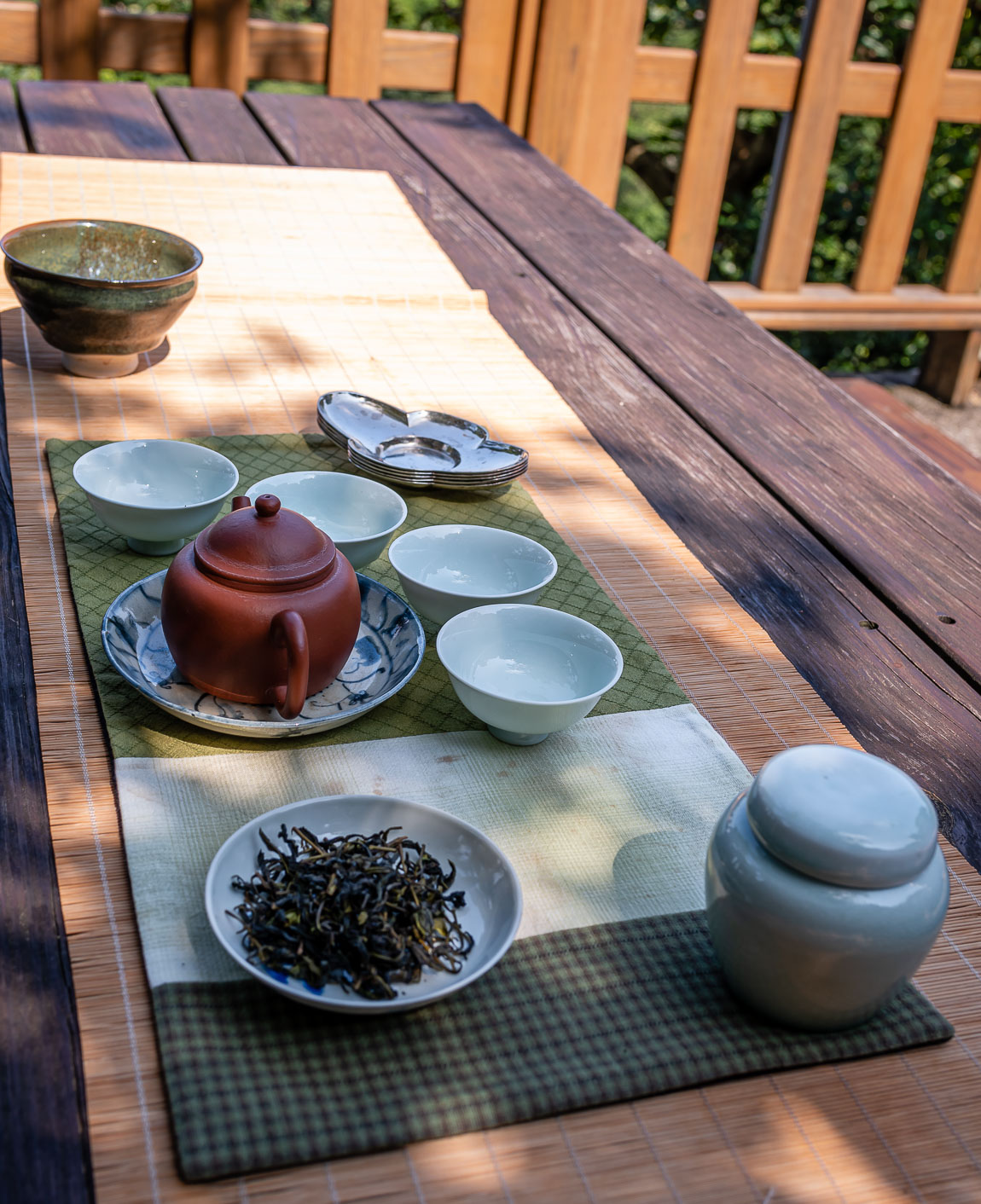
When I take tea friends to an outdoor spot in the south of Taipei, I always treat them to a brew of Wenshan Baozhong (here, the subtropical forest of spring 2019). The number 1 reason is that when you are outdoors there, you can smell the same air, experience the same environment as the Baozhong leaves. And when they release their flavors, you realize that these flavors are like a mirror of the surroundings here! That's how you connect your tea experience with nature! The explanation is that tea leaves are so sensitive that they absorb many scents that surround them.
There's a second reason why Wenshan Baozhong is such an important tea in Taiwan and it has to do with history. Wenshan Baozhong existed long before the rise of Dong Ding Oolong (the competition only started in 1976) or High Mountain Oolongs (in the early 1990s). Baozhong dates back to the end of the Qing dynasty, end of the 19th century, even before the Japanese occupation of Taiwan (1895-1945). Baozhong started in the Nangang mountains, east of Taipei, then spread all around the city and then to Shiding and Pinglin. There was easier to move the tea to DaDaoCheng (the former name of Taipei) for roasting and then to the port of Tamshui and later Keelung for export. And when the Taipei Tea Merchants Association showcased its 'Formosa Oolong Tea' at various international exhibitions (Paris, Milan) in the first part of the 20th century, it is Baozhong that the people tasted and that collected first prizes!
Baozhong tea used to be processed very much like WuYi Yan Cha. We can still partly see this from the twisted shape of the dry leaves. What has changed, though, is the roasting level. Most modern Baozhongs are not roasted, but simply dried.
And I could verify on my German friends that the fresh, unroasted Baozhong pleased my younger guest the best, while the older guest preferred the roasted version! In any case, they enjoyed drinking tea in this outdoor mountain restaurant both before and after lunch! First to open up the appetite and later to help digest the meal!
Accessories: Yixing zhuni teapot, celadon singing cup, late Qing dynasty qinghua tea boat, Michel François jar and bowl, green variation Chabu, Japanese Chatuo.

Friday, November 01, 2019

La foire aux 20! Tea Sale!

20 thés et
20 accessoires sont actuellement en PROMOTION sur tea-masters.com dans la limite de mes stocks ou jusqu'à la fin de l'année!
Do you feel the gloom of November 1st? Here's a news to cheer you up:
20 teas and 20 accessories are currently ON SALE on tea-masters.com, as long as I have inventory or until the end of the year!

This year, for the first time, there are a great number of Chabu for sale. These tea ceremony fabric are great to create a specific atmosphere, feeling for your tea. They also help you to brew and pour more carefully and slowly, because you'll want to avoid staining the fabric. And these Chabu are all made by hand and exclusive creations of tea-masters.com. You won't find them anywhere else! And here's a tip to further improve your fall Chaxi: add some dead leaves on your display! See in the above pictures how well they match my cup of aged puerh!
(By the way, did you notice that I've recently added a spring 2004 Xiaguan raw Tuo Cha for 10 USD only, and a spring 2007 raw Peacock cake for USD 40 only!)

Tuesday, October 29, 2019

Réflexions sur le thé et le chamanisme!


Oolong de haute montagne de Lishan du printemps
Cet article fait suite au podcast "Chamanisme: tous en trans?" sur France Inter au NRV à l'occasion de la sortie du film "Un Monde Plus Grand" de Fabienne Berthaud avec Cécile de France.

Le chamanisme nous vient de Sibérie, mais on le trouve pratiqué sous des formes diverses sur tous les continents. Ce sont les pratiques ancestrales pour soigner à la fois le corps et l'esprit. Le chamane est celui qui entre parfois en trans à l'aide de produits psychotropes ou de musique ou d'autres techniques d'auto-suggestion.

J'ai commencé à dresser l'oreille lorsque j'entendis qu'une fois en trans, on ressent plus intensément les énergies, qu'on entre en harmonie avec la nature et avec soi, qu'on a une vision altérée de la réalité. Bref, ce changement de perception est aussi quelque chose que je ressens lorsque je déguste un très bon thé. L'arrière-goût fin et durable a souvent le don de me transporter. C'est un peu 'une porte' qui s'ouvre sur une nouvelle réalité et un bonheur profond!
Cela n'a pas lieu à chaque fois. Ce n'est pas aussi intense qu'une ivresse induite par l'alcool (la seule trans induite dont j'ai pu faire l'expérience). Mais il arrive des moments où une certaine 'magie' opère et que l'effet du thé produise une clarté de la vision, une chaleur dans le corps jusqu'au bout des doigts, et qu'on se sente en paix et en harmonie avec la nature. (Ce fut le cas avec ce Chaxi d'un Oolong de Lishan).
Alors, peut-être que tous les dégustateurs de thé sont un peu chamanes, comme Monsieur Jourdain de Molière fait de la prose sans le savoir! Mais à la façon de Montaigne, je dirais que si voulez une expérience chamanique, allez voir le film "Un Monde Plus Grand" ou un chamane directement, et si vous voulez goûter aux plaisirs du thé, faites du thé! Les bienfaits spirituels du thé ne vont pas de soi. Ils sont dépendants d'un grand nombre de facteurs, à commencer par sa propre sensibilité aux effets du thé. Et en soi, le thé n'est pas spirituel. C'est juste un fantastique produit de la terre, du climat et des traditions comme le vin, le pain, le fromage... Le thé n'a pas besoin de dimension spirituelle pour plaire. Mais s'il peut nous aider à se sentir bien et de faire le lien entre le corps et l'esprit, alors tant mieux!

Friday, October 25, 2019

Bring the past alive

This visitor of the Lin Mansion in Banciao (New Taipei city) chose the perfect dress to visit this late Qing dynasty house and gardens! Instead of simply sightseeing this place, she's reenacting how a Chinese lady might have spent a morning there!
 Her experience of the Lin gardens is completely different than most who come in a modern dress.
And the way she let me take her picture shows that she's really enjoying her time here!
Actually, I was there doing something very similar. I didn't dress Chinese, but I was brewing tea in the old, traditional way. This is also bringing old wares, ancient traditions and aged leaves alive!

 My tea was the 2001 Xiaguan mellon shu puerh. I kept it in a late Ming dynasty jar and brewed it in a late Qing zisha teapot.

These wares seem to be part of this place lost in time. It's an oasis of beauty. But this beauty is not preserved under glass (like paintings in a museum). It's beauty you can play with, where you can become an actor!

Great tea ware is meant to be used, not just sit in a closet. And delicious teas are meant to be enjoyed.
And shared!
That's the least I could do to thank her for posing for my blog.
She told me that she doesn't drink coffee. But when I explained that the dark brew is actually shu puerh tea, she gladly tasted it.
And enjoyed it!
Well, it was a perfect experience for her. She brought the past alive with her dress, her poses, the aged tea she tasted next to the pond of lilies! I'm so glad that I could capture and share these moments on my blog. I hope they will inspire you to also bring the beautiful past alive next time you have tea or visit a historical place!
Michel François celadon cup

Thursday, October 24, 2019

Tee Kurs mit Gaiwan

Dr. H. war Heute meine Studentin. Wie Cosmin, wollte sie einen Kurs der Tee Vorbereitung mit dem Gaiwan haben, obwohl, wie Cosmin, sie seit vielen Jahren schon Tee trinkt und auch Tee Kannen benutzt. Aber beide haben recht. Ein Gaiwan ist anspruchsvoll und das ideale Instrument um zu lernen wie man Tee gut vorbereitet. Und praktisch, denn ein Gaiwan aus Porzellan kann man für alle Tees nehmen!
Der Kurs ging so: zuerst habe ich mit einem Hochland Oolong aus BiLuXi den Anfang gemacht und gezeigt wie ich es mache, und dann war H. dran den Tee zu machen. So sollen die Blätter im Gaiwan aussehen:
Harmonisch entfaltet und den ganzen Volumen des Gaiwan füllen ohne zu gekrämmt zu sein. So können die Teeblätter die selben Aromen geben. (Eine schlechte Balance im Tee kommt auf davon, daß nur ein Teil der Blätter sich geöffnet haben).
Jeder Student macht kleine Fehler die ich versuche zu identifizieren und zu korrigieren. Aber es reicht nicht immer zu wissen was man falsch macht. Man muß auch regelmäßig üben damit es gut fließt! Bei diesem sehr guten und feinen Oolong war es wichtig nicht allzu viele Blätter im Gaiwan zu packen. So kann man die Vorbereitung auch viel entspannter und langsamer angehen.
Denn bei den meisten kommen die Probleme davon, daß sie zu schnell eingießen und sich nicht die Zeit lassen das Ganze langsam und konzentriert anzugehen.
Der nächste Tee ist mein infrarot geröstete Oolong aus ShenMu Chun. Man sieht gleich, daß es viel mehr oxidiert und geröstet ist. Deshalb muß es auch ein bischen anders vorbereitet werden. Das Wasser soll beim Aufguß nicht so energisch fließen.
Wenn die Farbe dann so schön läuchtet kann es nur gut schmecken!
Solch ein süßer und fruchtiger Tee eignet sich bestimmt mit dem Stollen den ich als Geschenk bekam! Vielen Dank für die Gelegenheit mein Deutsch zu üben!

Tuesday, October 22, 2019

Les accords gastronomiques du thé

Le tout nouveau livre de Teaparker vient de sortir la semaine dernière! Il combine deux grandes passions de ce maitre de thé: la grande cuisine (occidentale) et le thé (chinois)! En effet, le premier chapitre retrace ses rencontres et expériences de grands vins et grands restaurants: Laurent Ponsot, château Yquem, l'atelier Etxanobe, Azurmendi, Eleven Madison Park, Blue Hill, Jean Georges, l'atelier de Joël Robuchon, Patrick Henriroux, Anne-Sophie Pic... A chacune de ces occasions et de ces rencontres, Teaparker a initié un dialogue entre le thé, le vin et les mets.

En tant que fidèle élève de Teaparker depuis la première heure (automne 2002!), j'ai eu le privilège d'assister et de participer à plusieurs événnements gastronomiques mentionnés dans le livre. La photo ci-dessous en fournit deux exemples et les lecteurs du blog reconnaitront facilement mes Chabu (ceux faits par ma maman, plus précisément!)
Comme de nombreux cours de thé avec Teaparker se terminaient à midi, c'était alors souvent l'occasion pour nous, ses élèves, d'aller manger au restau avec lui. Et depuis toujours, on s'arrangeait avec le restaurant pour qu'il nous apporte une grande théière remplie d'eau bouillante afin qu'on puisse y infuser notre thé et le boire avec le repas. Le choix du thé allait dépendre du type de cuisine qu'on allait manger. Et très souvent ce thé permettait de donner plus de goût et de profondeur à certains plats en particulier.

Dans 3 livres plus anciens, Teaparker avait déjà écrit sur comment cuisiner (simplement) avec du thé (puerh, Oolong et thé rouge, respectivement pour chacun des livres). Cette fois-ci, au lieu de proposer des recettes de cuisine, Teaparker conceptualise le thé comme une alternative au vin. Il ne s'agit pas de faire de la concurrence au vin, de vouloir le supplanter ou de dire que le thé est supérieur. Il s'agit plus d'une démarche de complémentarité. D'ailleurs, avec Teaparker, on accompagne souvent nos grands repas avec d'un grand vin ET de thé(s)! L'idée est qu'avec le thé on a encore plus de possibilités de faire de beaux accords qu'avec juste le vin. Et qu'il y a des moments dans la journée où la consommation d'alcool peut causer des problèmes (aux conducteurs de véhicules, par exemple).
Le but ultime de TeaParker, avec cette démarche, c'est de faire sortir le thé haut de gamme de sa niche de dégustation 'gongfu cha' et de le faire connaitre par un public nouveau et exigeant. C'est une nouvelle manière de transmettre la culture du thé, ses terroirs, les hommes qui le font et sa riche histoire. Idéalement, au travers d'un accord réussi, le thé pourra acquérir de nouvelles lettres de noblesse. D'après notre expérience, grâce à sa forte dimension culturelle et technique, le thé peut ajouter autant de raffinement qu'un grand vin.

Teaparker ne se contente pas seulement d'un livre, mais il met en place un enseignement du Tea Pairing: l'International Tea Sommelier Academy. Cette formation de 36 heures donne lieu à un test et permet l'obtention d'un diplôme reconnu par l'Etat taiwanais. (Le premier cycle d'élèves a d'ailleurs débuté sa formation hier au Landi de Taipei.) Les cours de TeaParker sont en chinois, mais je vais les bosser afin de pouvoir les proposer en anglais et en français d'ici quelques mois. Si vous êtes intéressés, faites-moi signe!

Sans spoiler le contenu du livre, je veux partager au moins un bel accord que je fis lors d'un banquet de mariage dimanche dernier. Avec ce plat de crabe cuit à la vapeur sur du riz sauté avec des fruits de mer, j'ai bu de mon puerh cru 7542 de 1999 et l'accord fut excellent. Le thé soulignait les arômes marins du crabe et rendait le riz plus léger et digeste! Accord improbable, mais tellement meilleur que le vin rouge ou le vin blanc qu'on avait sur la table!

Friday, October 18, 2019

Rainy day and aged puerh

I had hoped for sunshine. Instead, the heaviest rain of the season was upon me on that morning, a couple of weeks ago. The walk with all my tea stuff and umbrella under such a downpour was a little nightmare. What a terrible start for a tea session outdoors with a friend, I thought.
I was so wrong.
 I had chosen to brew this mid 1980s loose raw puerh. And I returned to one of my favorite spot at the Lin Family Garden of Banciao.
The bad weather meant fewer visitors and we had the spot almost to ourselves!
The dark mood of the rain was balanced by the bright light, and we fought the cold air with a warm, sweet and energetic tea. Brewed in a late Qing Yixing zisha teapot, the puerh had even more depth and a smooth taste. The last drops of that first brew were so intense, but still very much enjoyable! They were activating a fire in our belly!
 The open leaves are nicely dark brown, but open up well.
I'll soon write about Teaparker's new book about tea pairing (tea and food). But it's not because you're not eating that you are not pairing your tea! Every time you choose a tea, you are trying to pair it with your mood, with the weather, the season (or the music you're listening to...) A good pairing means you must know your teas and how they influence your mood. Here, I tried to express the beauty of nature within a dark mood (see the black Chabu). And it worked harmoniously, beautifully...

Wednesday, October 16, 2019

Aux origines du Oolong


Le thé Oolong est le thé de prédiléction à Taiwan. Il se décline en feuilles torsadées dans le Wenshan, en feuilles de 5 couleurs à Hsin Chu, en feuilles roulées dans le centre. Peu oxydé en hiver et au printemps, il est plus oxydé en été et lorsqu'on veut le torréfier.

Mais ce que tous les Oolongs de Taiwan ont en commun, c'est d'être originaire du Fujian et de WuYi plus précisément. C'est là, dans des montagnes traversées par un cours d'eau, que le processus du Oolong fut inventé au XVIIIe siècle. On lui donna le nom de thé Bohea.
Le thé de Wuyi allait devenir célèbre en Europe, en Amérique et en Chine, naturellement. A Chaoshan, le berceau de la méthode gongfu cha (= une petite théière, 3 coupes de porcelaine, 1 Nilu), les meilleures feuilles de WuYi se vendaient au prix de l'or à cette époque (1 gr de thé = 1 gr d'or!) En Europe, les maitresses de maison se faisaient confectionner des tea caddies en bois et en étain, avec serrure dont elles seules en avaient la clé!

Le thé Bohea était si apprécié et onéreux qu'il suscita des imitations dans tout le Fujian et même jusqu'à Taiwan à partir de la seconde moitié du XIXe siècle. Et les marchands, autrefois comme aujourd'hui, ne s'embarassaient pas à donner le nom de Bohea ou Yan Cha à toutes les feuilles qui lui ressemblaient!...

Un amateur de ce thé me ramena un jour plusieurs 'Wuyi' achetés dans une maison de thé renommée. C'étaient des thés qu'il appréciait énormément, mais il était curieux de les comparer avec les feuilles de ma collection personnelle. Il fut assez surpris de constater qu'il y avait un monde entre ce qu'il connaissait et ce qu'il put déguster durant ce cours.
Sur ces photos, j'ai photographié une session avec un Rougui Yan Cha du printemps 2019 de Niu Lan Keng. Ses feuilles furent torréfiées avec grand soin plusieurs fois de manière à ne pas les brûler. Ce processus est ce qui se fait de plus traditionnel et de plus technique pour la fabrication d'un thé. Aussi, on obtient des saveurs à la fois douces, florales, mais aussi minérales et très bien structurées en bouche. On est loin de la puissance d'un gushu puerh ou de la légerté d'un thé vert. On est dans le suave, l'écho des saveurs, la gorge qui salive, le palais qui ronronne de finesse et de minéralité.

Le Rougui est un cultivar relativement récent qui a une belle palette olfactive. Rougui veut dire cannelle, mais elle ne ressemble pas tant à la cannelle en poudre qu'à l'écorce de bois entier. De plus, Niu Lan Keng est l'un des endroits les plus célèbres pour le Rougui à Wuyi. Les connaisseurs parlent alors de Niu Rou au lieu de Niu Lan Keng Rougui! Cette abréviation veut aussi dire 'soupe de boeuf' en chinois! Cela correspond au 'Mouton' ou au DRC pour le vin!
Ce n'est pas un thé pour débutant, mais c'est un thé pour apprendre. Il enseigne l'excellence, le goût originel du Bohea, la minéralité du Wuyi, la magie de la torréfaction... Si sa découverte vous dit, vous en trouverez dans ce set.

Tuesday, October 01, 2019

A gaiwan tea class

For his second tea class with me, Cosmin asked to improve his gaiwan brewing! This may seem a little bit strange for someone who is passionate about tea and who first contacted me long time ago, in 2010! (In those days he used to have a blog and published an interview he did with me! Unfortunately, his blog isn't active anymore. Like many early tea bloggers, adult life is too time consuming to do more than posting pictures on Instagram...) Besides, he told me that he would fly to Taiwan specifically for this tea class (and to purchase some Oolongs from my selection)! This put a lot of pressure on my shoulders and therefore I opted for this beautiful tea house to conduct the lesson!
The idea of learning to brew with a gaiwan is to focus on the fundamentals of tea brewing. So, in this spirit, I decided to use a very basic ivory color porcelain gaiwan.
Actually, Cosmin's request was even more specific. His focus was to learn to brew roasted Oolong in a gaiwan! That's why I chose this qingxin Oolong, high mountain, roasted and jassid bitten Zhuo Yan Oolong from Shan Lin Xi. The roast on this tea is particularly strong, which makes it a real challenge to brew well in a gaiwan.
Rolled Oolong requires energy to open up. It also requires a high temperature. That's why it's so important to preheat the gaiwan well. Water near boiling also helps to unfold the leaves. Then, it's possible to pour slowly and calmly on the leaves for the first brews.
The result is a beautiful color, excellent transparency and shine. The fragrances are a nice mix of roast and ripe fruits. The taste is sweet and very long. It's complex and rich like a pure malt whisky!
After showing how to brew, it's time to let Cosmin practice the gaiwan. Because if the theory is relatively easy, the practice is much harder. There are many details to keep in mind. And the best way to remain focused is to pour in the cups instead of in a gongdaobei (pitcher).
The trick not to burn your fingers is to hold the gaiwan by the egde of the cup. Again, easier said than done. I showed him and told him several points how to improve his brewing. I think it was helpful, because this is what he wrote to me afterwards: " Just want to say thank you for sharing that knowledge with me. I learned so many years by myself and caught a bit of info from all around, but this is first time I am properly guided.

I was very excited and overly happy on Saturday so it was hard to calm down, but those tips you shared have massive effect on the way I do tea. 

Even on puerh, my smoothness is different. My consistency on oolong brewing is now very different."
Thanks for this feedback! As I explain in my Oolong Brewing Guide (which you receive for free if you a place a 60 USD+ order), "the goal of the first brew is to unfurl the leaves as evenly as possible in the gaiwan/teapot". You know your tea is well brewed if it tastes good and if you see that the leaves are evenly open in your gaiwan!