Friday, August 25, 2023

Un mariage de thé et de musique intemporels

Voici mon meilleur souvenir de thé de cet été 2023! Mais avant que je vous parle de cette cérémonie de thé, il faut que je vous donne quelques informations sur comment elle a pu avoir lieu dans l'atelier du musée Chimei à Taiwan. Les 2 personnes qui ont permis qu'elle ait lieu sont sur ces photos: en rouge, Michael Zuber, mon ami d'enfance, violoniste, collectionneur et marchand de violons et d'archets, en blanc, M. Chung est le directeur de la collection de violons (et d'instruments à corde) du musée Chimei à Tainan. Il y a 6 ans, Michael m'avait déjà permis de faire une visite dans cet atelier qui sert aussi de réception aux VIP. Cette fois-ci, en l'accompagnant, je proposai de faire quelques infusions mémorables. Et elles le furent!
Il faut surtout que vous sachiez que la collection de violons de la fondation Chimei est la première collection de violons au monde. De loin. Même en combinant les 5 prochaines collections, il n'est pas certain qu'on arrive au niveau de ce que possède Chimei (une entreprise Taiwanaise qui a fait fortune dans les écrans plats). 

Ainsi, rien que les 6 violons que M. Chung a disposé pour l'appréciation de mon ami valent plus de 100 millions de USD! Le plus célèbre d'entre eux est le "Ole Bull", du nom d'un musicien Norvégien qui l'a possédé et qui fut fabriqué en 1744 par Garneri "del Gesu". La plupart des autres sont des Stradivarius. 

Et pendant que ces messieurs parlent violon, je dispose mon Chaxi sur cette table. Mon vieux panier en osier fait le pont entre mes accessoires de thé et les violons! Mais M. Chung n'est pas confortable à l'idée d'avoir de l'eau bouillante à si grande proximité de ses précieux violons (je le comprends) et je trouve une autre table pour infuser mon thé:

Un autre groupe de visiteurs VIP Japonais arrive lorsque je commence mes infusions depuis ma nouvelle table, située à proximité d'un dispensateur d'eau bouillante.
M. Chung tient le 'Ole Bull'

M. Chung présente les pièces maitresses de la collection aux visiteurs et Michael Zuber leur offre un petit concert improvisé avec ce violon d'exception:
Il joue la sonate de JS Bach pour violon No 1 en G mineur, BWV 1001: I, Adagio.

Le son est d'une puissance incroyable. Et d'une pureté! J'en ai des frissons rien qu'au souvenir! Puis, Michael enchaine les différents violons pour les jouer chacun et apprendre à mieux connaitre leur type de son, quelle musique leur convient le mieux. Bach, Mozart, Vivaldi... le son de chaque violon lui donne envie de jouer un compositeur différent, en fonction du violon, mais aussi de l'archet! Et c'est là que je me rends compte qu'on a la même chose dans le thé avec la théière d'Yixing et les coupes de porcelaine. Il s'agit aussi de trouver l'harmonie entre ces 2 accessoires et le thé infusé!
A occasion exceptionnelle, un Chaxi exceptionnel:
1. Le thé: mon Dong Ding Oolong de Feng Huang du printemps 1980. Pourquoi ce thé? Je voulais un thé de collection qui s'est bonifié avec le temps, comme ces Stradivari. De plus, comme le fondateur de Chimei est très attaché au terroir de Taiwan, je voulais des feuilles locales.
2. Ma théière d'Yixing en glaise Duanni avec une anse difficile à réaliser et joliment décorée, des années 1930.
3. Une bouilloire en argent pour une pureté maximale de l'eau.
4. Une jarre en étain du Japon pour conserver au mieux mon thé.
5. 3 petites assiettes anciennes. La céladon (pour les feuilles), la qinghua (pour le couvercle) de la fin Qing et l'assiette en porcelaine de la dynastie Song (sous la théière). Cette dernière assiette a impressionné M. Chung, car elle est bien plus ancienne que ses violons!
6. Un Jian Shui en étain
7. Les coupes en porcelaine de DeHua du Fujian et leur socle en cuivre et argent du Japon.
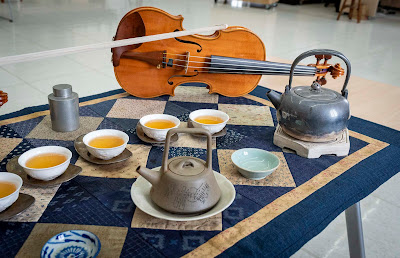
Le tout est disposé sur un Chabu réalisé à la main par ma mère avec des tissus trouvés à Taiwan!

L'infusion est magnifique. Comme Bach sur le violon Ole Bull, ce Dong Ding de 1980 résonne dans nos palais avec puissance, pureté et toute la vigueur d'un Oolong plein de vie. Michael me fait confiance et dispose 2 de ses violons et un archet sur mon Chaxi afin d'encore mieux symboliser ce mariage musical et gustatif. 
Or, avec Bach et Dong Ding, nous retrouvons la beauté intemporelle des plus grands classiques. Ils sont interprétés avec une profondeur incomparable dans ces accessoires anciens (violon Ole Bull de 1744 et Yixing Duanni des 1930s). Or, Michael m'apprend que comme une théière qu'on culotte, le son d'un violon se travaille également: à force de bien jouer avec un violon, son son s'ouvre et il sonne de mieux en mieux. Ainsi, Michael me dit qu'il avait pu jouer avec des violons de violonistes célères et le son produit ressemblait à celui de leur propriétaire. Ce n'est qu'au bout de quelques semaines que le violon va s'imprégner du son du nouveau joueur (à moins de ne pas avoir une bonne technique et alors même un très bon violon ne sert à rien, comme pour le thé!) 
Le silence après Bach fait résonner sa musique en écho en nous, tout comme la longueur en bouche du thé crée une présence dans ces arômes qui n'en finissent pas de finir et nous touchent au plus profond de nous-même. Et les notes de vieux bois du Dong Ding font justement écho à la beauté du bois laqué des Stradivarius. 

La dégustation de cette musique divine accompagné de l'écoute de cet Oolong exceptionnel bouleverse nos âmes. Nous côtoyons les sommets éternels l'espace d'une coupe d'une thé. 
 

Friday, August 18, 2023

The 7 habits of highly effective tea people #7

Shan Lin Xi

The seventh and last habit of the '7 habits of highly effective people' book is 'Sharpen the Saw'. It is about taking time to renew and refresh oneself in four areas: physical, mental, social/emotional, and spiritual. The habit emphasizes the importance of self-care and self-improvement to achieve long-term success and happiness. Sharpening the saw means preserving and enhancing the greatest asset you have–you. It means having a balanced program for self-renewal in the four areas mentioned above.

It’s interesting to note that tea can be used to improve all four areas. Tea has an impact on your body, on your mental state, on your social life and it can even have a spiritual dimension. These 4 areas (physical, mental, social/emotional, and spiritual) read like a Maslow pyramid of needs (physical, safety, love, self-esteem, self-actualization). The foundation is the physical area. This is most obvious when we are sick, because the sickness of the body makes it difficult for us to experience pleasure or true happiness. A healthy body is a prerequisite for a healthy mind and a rich social and spiritual life. 

So, to use habit #3 'Put First Things First', we should start by sharpening the physical, our body, our health. And how should we do this? I propose to use yet another habit, the #1, be proactive. Let's not wait to be sick, but let's make our body so healthy that we can fend off most ills that afflict people who don't properly take care of their body. There are lots of dangers to our health in the modern world. Smoking cigarettes is one of them. This is a bad habit that few tea lovers have, because smoking mutes your taste buds and makes tea tasteless. So, people who really love tea have a strong incentive to quit smoking (or, even better, they never start), because the smoke ruins their tea pleasure! Obesity is the other modern disease that is causing a lot of harm, because long time obesity causes a lot of cardiac problems, cancers and many more diseases. 

I know that tea can help you on the path of a healthy life, because it has helped me loose over 10 kg in the last 6 months. This weight loss has had positive consequences for me: the frequency and strength of my chronic headaches has been reduced and the pain in my left knee is gone. Besides, I never had the wish to smoke a cigarette! The subject of a healthy body is so important that I will dedicate a tea lesson per month starting this fall. Follow my YouTube channel if you don't want to miss the upcoming lessons. Please note that I'm not going to talk much about the antioxidants and polyphenols contained in tea. My approach will be mostly based on the taste of good tea! There will be no talk about miracle ingredients, but a lot of good brews and good habits!

Remember: a smart life that keeps us healthy is even more important than a smartphone or a smart TV! I will do a first tea class on Sunday August 27th to discuss the plan of the fall semester. But I will have to skip the first Sunday of September and formally start start the classes on September 10th. In the meantime, you may still order this sampler of roasted Tie Guan Yin, which we will study this semester. I recommend you also add this wonderful Hung Shui Oolong from the king of the Dong Ding competition. This latest addition to the selection is a very smart choice and I'm sure I'll dedicate a lesson (or more) to this tea.


Wednesday, August 16, 2023

The 7 habits of highly effective tea people #6

DYL104K

The sixth habit of the '7 habits of highly effective people' book is 'Synergize'. It is about creating a culture of cooperation and creativity that leverages the strengths of each individual to achieve a common goal. Synergy is the highest activity in all life, the true test and manifestation of all the other habits combined. It catalyzes, unifies, and unleashes the greatest powers within people.
Oolong from DYL104K

The tea concept that comes closest to this 'synergy' is the Chaxi. The idea of a Chaxi (tea play or tea session) is to find a harmony between all the senses and the tea being brewed. With this Da Yu Ling, for instance, I have used my best matching Yixing zhuni teapot to brew the leaves. And to convey the green freshness of the aromas, I have used a green Chabu, celadon cups and plates. I brewed it in front of a painting of a high mountain and a bamboo plant (for the connection to nature and summer). I'm also in synergy with the season, because such a tea tastes particularly thirst quenching on a hot and sunny summer afternoon. The qinghua jar also represents a mountain and has the colors of the sky. The finesse of the porcelain cups underlines the character of the tea. Besides, I used my silver kettle for maximum purity and lightness of the water. And I was accompanied musically by a solo violin concerto from Vivaldi interpreted by Rachel Podger.

Oolong from DYL 104K

Tuesday, August 15, 2023

The 7 habits of highly effective tea people #5

DYL104K

The fifth habit of the '7 habits of highly effective people' book is 'Seek First to Understand, then to be Understood'. It is a habit of empathic communication that involves a deep shift in paradigm. We typically seek first to be understood. Instead, most people listen to the reply. They’re either speaking or preparing to speak. This habit encourages us to listen with the intent to understand, not just reply.

Empathy is a crucial aspect of communication that can be applied to various aspects of life, including tea making. To apply the fifth habit of ‘The Seven Habits of Highly Effective People’ to tea making, one can start by listening to the person who is going to drink the tea. This also applies to oneself when we are making tea for ourselves. Ask the person about their preferences, such as the type of tea they like, the strength of the tea... By listening to their preferences, you can make a cup of tea that is tailored to their liking. 

Another way to apply empathy to tea making is by observing the person’s body language and facial expressions. If they seem stressed or anxious, you can make them a cup of tea with calming properties. If they seem tired or fatigued, you can make them a cup of tea with energizing properties. Finally, you can also apply empathy by sharing a cup of tea with someone. Tea drinking is often associated with socializing and building relationships.

In the context of learning (gongfu) tea from a tea master, this habit of first understand what the master meant is also a great principle to make progress.
DYL 104K

Note: The 18 products at -18% for 18 days to celebrate 18 years of tea business ends in a couple days... 

Friday, August 11, 2023

The 7 habits of highly effective tea people #4


The fourth habit of the '7 habits of highly effective people' book is 'Think Win-Win'. This habit is about seeking mutual benefit and cooperation in your relationships, instead of competing or compromising. It is part of the category of Public Victory, which involves working effectively with others.

Except for tea competitions, tea is mostly about sharing: 
- the host shares tea with his guest in order to deepen their friendship,
- small farmers in Taiwan cooperate with one another and share resources and manpower,
- tea sellers prepare tea for potential buyers, hoping for a sale,
- tea bloggers share their knowledge to better inform tea drinkers, maybe even helping them to brew their leaves better!

Wednesday, August 09, 2023

The 7 habits of highly effective tea people #3


The third habit of the '7 habits of highly effective people' book is "Put first things first". This habit is about prioritizing your most important tasks and managing your time effectively. It also involves saying no to things that are not aligned with your goals and values.

This is great advice for tea lovers. It supposes to prioritize your efforts on what will yield the most improvements to your brew. Paradoxically, this will mean that you have to alternate priorities, because after a while it takes longer to make significant progress in areas where you have become proficient, while you could make lots of progress in fields that you have not studied or practiced much, yet.

Let's look in detail what first thing first means in different tea areas:
1. Select the most suitable water, because water is the No.1 ingredient of tea.
2. Select high quality tea leaves you like, because this is the No. 2 ingredient for a good brew.
3. Select (invest) in high quality tea ware:
- a great kettle, because it has a direct impact on the quality of the water. (Tetsubin or silver kettles are top).
- a porcelain gaiwan is the most neutral and cost effective tea vessel (for beginners),
- an Yixing teapot is the ultimate teapot for Oolongs and puerhs and can help improve the brew if the teapot is well paired with the tea.
- thin celadon cups are a good match for fresh teas, and ivory color cups are a good match for teas with darker brew colors.
- a porcelain tea jar is a great tool to age or wake up a tea before brewing,
- beautiful utensils will also add pleasure to your tea sessions.
4. Spend time learning the theory of tea brewing,
5. Spend time practicing tea brewing.
6. Learn about tea history, tea production, tea customs... in order to gain new ideas, more appreciation and a better understanding of tea.
7. Repeat the process and try to improve on each point.

Another way to apply this principle is saying no to things that would lessen your tea experience:
1. Don't brew tea with water that is too hard or has a strong chlorine scent,
2. Don't brew tea bags or stale leaves that were not properly stored. (Life is too short to drink bad tea!)
3. Don't brew good tea unless you have matching tea ware.
4. Don't brew a tea before understanding its character and what to expect.
5. Don't practice with your best teas, but also don't practice with bad teas. 
6. Don't start or spend time on another hobby before you have learned a good deal about tea.


Monday, July 31, 2023

The 7 habits of highly effective tea people #2


The second habit of the '7 habits of highly effective people' book is "Begin with the End in Mind". This habit involves visualizing the principles that will guide the result. It means starting with a clear understanding of your destination, so that you can better understand where you are now and take steps in the right direction. It also involves identifying old scripts that are taking you away from what matters most, and writing new ones that are congruent with your deepest values.

This habit can also be applied to tea, especially if you wish to create a Chaxi for your tea preparation. You must have a good idea of what kind of brew, taste, flavors and colors you want to enjoy as a result of your Chaxi. Why? Because the best results come from the harmony between the senses. And since the end result of a tea is the brew, the very first question you have to start with is 'What tea do I want to taste?'

You can't choose your ware or you setting or sometimes even your water without first deciding the tea you'll brew. The tea is indeed the central subject your preparation. You have to choose everything in relationship to the tea you will be brewing. Which vessel brings the most out of these particular leaves? What cups are the best fit? What feeling do I want to achieve with my Chaxi?

Of course, we can sometimes experiment and change one piece of tea ware for another during a tea session if we feel that it is not in its place and hurts the overall harmony. However, such mistakes can often be avoided if one prepares each detail with the end result in mind. For important Chaxi, you may even want to test it first!


Note: The TeaMasters blog started to select tea and tea ware exactly 18 years ago. To celebrate this milestone, the online boutique proposes 18 products at 18% discount for 18 days!

Thursday, July 27, 2023

The 7 habits of highly effective tea people / 1

Alishan tea plantation in July

Published in 1989, 'the 7 habits of highly effective people' is a book that sold 25 million copies since. My son recently received this book and I thought it would be fun to see how these 7 habits can also apply to tea. So, let's start with the first concept for this article (and I'll do the other 6 habits) in the coming weeks.

#1 Be proactive. 

"Being proactive means taking responsibility for your life. It means recognizing that you are in charge of your own life and that you have the power to make things happen. For example, if you have a problem at work, instead of waiting for someone else to solve it for you, you take the initiative to find a solution yourself."

This is great advice and it can definitely also be applied to tea. It means that you are in charge of making good tea. In case you are not happy with the brew, you are not going to blame anybody else than yourself. You recognize that you have full control over the ingredients, how the water is boiled, the tea ware and how you are brewing the leaves. 

Most importantly, you understand that preparing tea is a skill that requires learning (in theory) and practice. So, you proactively look for a book, videos or a tea master in order to learn about the basics of tea making (and more if you are inclined to). 

Even the quality of the tea is your responsibility! It's so easy to order from a passionate tea expert in Taiwan instead of purchasing tea bags or stale leaves from your local (super)market. 

And if a tea problem arises, the most scientific way to deal with it is to change one parameter at a time. Imagine that you're not pleased with the tea you just brewed. Here's a list of things that you can change, one after the other, in order to identify the source of the problem:

1. If you forgot to pre-heat your ware, try again but pre-heat the vessel and the cups first.

2. Use a different water or a different kettle. Water is the mother of tea, since 99% of the brew is water. So the quality of water is of utmost importance.

3. Use a different vessel. In case of porcelain, the risks of failure are low, because porcelain is rather taste neutral. However, with a teapot or cups made of pottery (like Yixing clay), the vessel can have a powerful impact on the brew. This happened to me 20 years ago: I was brewing my fresh high mountain Oolong teas with a red clay teapot that wasn't suited for such teas, but was suited for roasted Oolongs.

4. Change the parameters of your brew: more leaves or longer brews if the tea was too weak or vice versa.

5. Change the leaves. I place this change at the end, because it's the most expensive. However, tea pleasure is our priority, so don't brew tea that doesn't bring joy. Life is too short to waste it on bad tea! 

to be continued...

Wednesday, July 19, 2023

Alishan summer red tea

I went back to the tea plantation I discovered for TF1, a French TV crew last year. The TV channel still hasn't aired the interview with the tea farmer and with me, or any picture they shot in Alishan, but I'm still happy that the opportunity arose, because the summer 2022 red tea I sourced on this trip got high marks from many tea friends! Indeed, this was the first high mountain red tea I selected in Taiwan, because its oxidation level stood out (usually it's too light, probably due to the cooler mountain weather and the skills of the tea makers who focus on partial oxidation).
Left (cut trees) vs right (growing leaves)
So, I returned full of great expectations to this tea field, but quickly noticed that it looked different (see above left and below). Instead of seeing lots of tea leaves ready to be harvested, the tea trees in the field where the red tea came from have been cut midsize. This is done once in a while to prevent the trees from growing too high and to entice the trees to produce more (valuable) leaves instead of (worthless) stems. This cut was done after the spring Oolong harvest and the next harvest will be in Oolong again, in fall. This means that the farmer won't be making any red tea from his plantation this year. 
This was the bad news. The good news (and it's very good) is that I met the farmer in his field again, without an appointment! When I asked about red tea, the farmer told me that he still has a few kg of last year's red tea batch and he agreed to sell it to me at the same price! So, it's available again on my online boutique

Tuesday, July 18, 2023

Le roi des Oolongs de compétition de Dong Ding

Ma rencontre avec ce 'roi du thé de compétition' a eu lieu le 14 juillet, jour du début de la fin de la royauté en France... Ce nom aristocratique, il l'a choisi lui-même et il figure sur sa carte de visite. Je l'avais rencontré lors d'une remise des prix du concours de Dong Ding, fin décembre 2016 (Il est sur la dernière photo de groupe)! Les juges du concours ne tarissaient pas d'éloges pour son savoir-faire, car à chaque concours depuis 2004, il remportait de nombreux prix. Il a tellement de plaques de victoire en bois comme sur la photo ci-dessus, qu'il en a tapissé les murs de plusieurs salles! 

A l'époque, je le sentais un peu imbu de sa personne et n'avais pas eu l'occasion de lui rendre visite. Vendredi dernier, sa carte de visite m'a intrigué et, à l'occasion d'un voyage dans le centre de l'ile, j'ai décidé de lui rendre visite pour goûter à ses thés et notamment à ses Oolongs torréfiés.

Je me rendis donc à son adresse. Sa salle de réception et l'atelier étaient désert. J'allais repartir quand un vieux monsieur me demanda ce que je cherche. "Du thé, pardi!" C'était lui, mais il a pris cher en 6 ans et demi! Je ne le reconnus pas. Je lui demandai de goûter des Oolongs torréfiés de ce printemps en lui précisant quel type de saveurs je recherchais. 

Il prépara 3 Oolongs de la compétition de Dong Ding et un Oolong plus faiblement torréfié (mais pas assez à mon goût). Une telle dégustation comparative est intéressante, car elle permet de voir des différences de styles entre les différents Oolongs, mais aussi un style chez ce producteur surtout spécialisé dans la torréfaction. Même un 'roi du thé de compétition' ne produit pas que des champions. Parfois il alterne les profils de saveurs pour répondre à des demandes variées ou parce qu'il comprend le potentiel de chaque récolte de thé. Goûter avant d'acheter est le meilleur conseil qu'on peut donner!
J'ai la joie de vous annoncer que j'ai adoré le dernier Oolong du test. La finesse de son goût mêlant douceur et fraicheur m'a rappelé les meilleurs Dong Ding Oolongs de compétition qu'on peut goûter lorsqu'on assiste à la remise des prix. Pour certains, ce n'est qu'un détail, mais pour moi cela veut dire beaucoup cette petite touche qui donne vit au thé et prolonge encore plus son plaisir. 
Ayant fait mon choix, je demande plus de renseignements sur ce thé. Les feuilles de qingxin Oolong proviennent de Shan Lin Xi et il est issu d'un surplus d'un thé primé parmi les 5% meilleurs Oolongs de la compétition. Puisque je prends tout, le producteur me fait un prix de gros bien plus avantageux que le prix officiel.
Vous remarquerez que la différence de prix avec un Oolong frais de Shan Lin Xi est très raisonnable. En effet, entre ces 2 thés on enlève beaucoup de tiges et le producteur consacre du temps, de l'énergie (et un risque) à torréfier les feuilles. 
Après cet excellent Hung Shui Oolong de 2023, je voulus goûter à ses Oolongs âgés et partageai avec lui un Oolong de 1980 de ma collection pour à la fois le remercier de m'avoir fait découvrir cet Oolong torréfié et pour lui permettre de savoir quel genre de feuilles anciennes je cherche. Il m'en proposa trois (et un Oolong concubine jeune), mais aucun ne pouvait soutenir la comparaison. Il me félicita d'avoir si bien conservé ces feuilles depuis que je les ai acquises (il y 15 ans déjà!), et il me souhaita que le Oolong torréfié devienne aussi bon que celui-ci dans 40 ans! 

Ma déception de n'avoir pas pu trouver de bon Oolong âgé était largement compensée par la joie d'en avoir sélectionné un jeune à un bon prix, et d'avoir fait briller mon savoir-faire dans les yeux de ce 'roi du thé de compétition'.