What's the point of having a fast car if you just use it to drive to work downtown at 50 km per hour most of the time? Even though I can barely watch this video, because it makes my hands sweat and I think of what could go wrong, there's a certain logic of wanting to push a fast to its limits! (Note: my son showed me this video and I forbid him to ride a scooter! I also told him that Bugatti was originally a car company founded near Strasbourg in Alsace, my home region!)
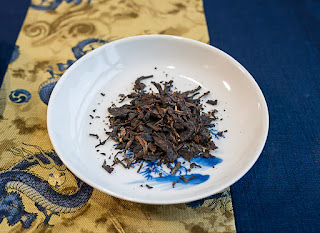
2003 wild Yiwu sheng puerh
The brewer of loose tea faces a similar situation as the owner of a Bugatti Chiron. If he wanted to brew an insipid cup, he would have purchased a cheap tea bag. But if he went through the trouble of purchasing quality loose tea, he's expecting something different, out of the ordinary.
He wonders not how fast can it go? But how good and how powerful can it taste? Unfortunately, most brewers don't realize that the Autobahn to test your tea is not an unattainable dream land, but it's easy to do at home!
The goal of this test brew is not to obtain the most comfortable cup, nor the smoothest. No, the goal of this test is to push your leaves to their limits and get the most flavors out of them. The goal is to better know your tea. How far you can push it? How strong a cup can your leaves brew? How smooth and sweet will it stay in the process? Or how bitter or astringent will it turn out to be? This is a moment of truth. Do you want to know if your leaves are a Bugatti, a Ferrari, a Porsche or simply a Toyota Prius or a Lada?! Are you ready to learn to evaluate tea quality with your own eyes, nose and taste buds? Or do you prefer to continue to believe the beautiful stories that are told by some vendors?
Here's how you can push your tea to its limits:
1. Preheat your tea vessel well. It's like an engine, it performs best after a warm-up!
2. Measure a small and consistent weight of tea leaves. The largest tea competition in the world, the Dong Ding tea competition, uses 3 grams only. It makes sense to be consistent, so that you may also compare different teas with this method.
3. The same competition uses boiling water to brew the leaves. The higher the water temperature, the more flavors come out.
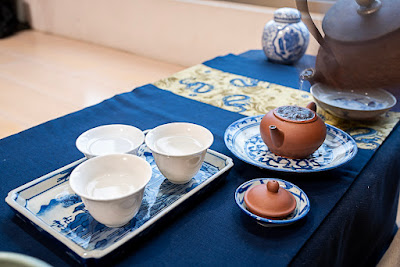
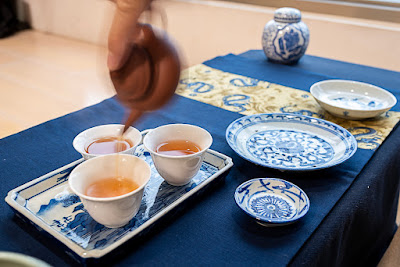
4. As for which vessel to use, the Dong Ding Oolong competition uses a porcelain competition set that has a volume of 115-120 ml. You can replace it with a porcelain gaiwan. Porcelain has the advantage of being neutral and less expensive than Yixing. It's ideal for beginners and people who don't own many Yixing teapots. However, if you can also replace it with your dedicated teapot for this kind of tea. This should help extract more flavors than porcelain.
5. Brew for a long period of time in order to extract a lot of flavors from the leaves. It's more important to be consistent and stick always to the same time. The standard of the Dong Ding competition is 6 minutes.
Le titre de cet article reprend une partie de la phrase inscrite sur la théière en porcelaine Dehua (dynastie Ming). Ces calligraphies sont finement exécutées et ne sont visibles que si l'on regarde la théière de près et que l'éclairage est bon. Sinon, on ne voit rien. Ce genre de décoration quasi invisible permet de laisser à la théière sont apparence de pureté blanche.
Une calligraphie bien réalisée est en soi une réalisation artistique. Calligraphier sur de la porcelaine est bien plus difficile que sur du papier. Il n'y a aucune place pour l'erreur. On sent ici que la calligraphie de style cursive a été réalisée en toute décontraction, en harmonie avec son propos. Il est donc d'autant plus étonnant et admirable de ne pas faire étalage de cette maitrise et cette beauté! Vous serez peut-être étonnés de savoir que la phrase complète inscrite sur cette porcelaine est "ces senteurs de vin apportent un immense bonheur" (Jiu xiang jiang hong fu). Pourquoi la calligraphie mentionne-t-elle le vin et non le thé? La raison est que dans ces temps anciens, les accessoires en porcelaine étaient polyvalents. On pouvait aussi bien s'en servir pour le vin que pour le thé. Sur certaines coupes Ming, on peut même lire les 2 caractères (thé et vin), et dès les Song, un poème de Du Lei dit que le thé remplace le vin.
Il fallait donc un thé particulièrement riche en arômes pour faire vivre cette devise. C'est pourquoi j'ai choisi cet OB ultime de l'hiver 2020 dans cette semaine froide et pluvieuse sans fin. Une de ses particularités est que c'est un lot issu d'une production unique et minuscule. Cet OB ultime de Hsin Chu, ce n'est que 3 kg de thé en tout produit le 27 octobre 2020! Et comme ses senteurs sont puissantes et mielleuses, ses feuilles ont eu de nombreuses morsures d'insectes Jacobiasa Formosana Paoli. Ceci est un gage d'absence de pesticides. Le goût est donc particulièrement pur et long en bouche, en plus de magnifiques parfums...
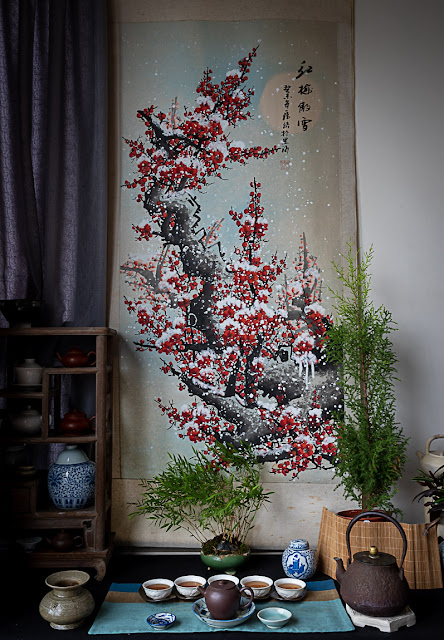
Le Chaxi ressemble à une scène de thé hivernal. La chaleur du thé contraste avec la porcelaine couleur blanche neige! Des fleurs de prunus rouge sur le tableau et sur le Chabu nous enjoignent à croire au retour prochain du printemps...
This book doesn't mention the word 'tea' once! However, first published in 2017, it provides lots of context and new, more detailed information about this period of time. Most of our new knowledge comes from the archeological research that is studying the tombs of these dynasties. But before we discuss this, I want to give you a brief introduction about these 2 dynasties and why they are so important for China, even today.
Between 230 BC and 221 BC, the kingdom of Qin managed to conquer all the kingdoms on its east (between brackets is the year of conquest). That's how it ended the Warring States period that started in 475 BC. Now, for the first time, China is a unified empire. Internally, China is mostly at peace. It only has to preserve its north western borders against attacks from the Xiongnu tribes.
To manage this large empire, the advisers of the Emperor Qin ShiHuangdi argued in favor of sending the sons of the emperor to the farthest regions, but he eventually decided against placing his family at the highest levels of power. He wanted to avoid the reformation of competing kingdoms. Instead, he decided to divide the empire in 36 smaller regions and to nominate a trio of loyal and competent public servants to head each region.
This change to previous customs was quite unusual and very much criticized. This criticism upset the emperor and he ruthlessly suppressed any dissent. He went so far as 'burning books and burying advisers' (setting hereby an example later followed by Maozedong's cultural revolution).
Another important aspect of life during this period was death! The first Qin emperor is famous for his mausoleum discovered in 1974. This 2165 m long, 940 m large and 115 m high mausoleum is not just where Qin ShiHuangdi was buried. It also contains 7000 human figurines, 15150 horses and 130 chariots made of terracotta (see the picture on the cover of the book). What is fascinating is that each figurine looks different! And the site is so huge that researchers continue to find Terracota warriors just 2 weeks ago! This work required several years of work and lots of resources.
The aim of such an underground city was to let the emperor continue to rule and live in the afterlife. In those times, life was rather short and the first emperor had spent a great deal of it fighting. He died at the age of 49 like most men of his time.
At that age, the thirst for life is still very high and it explains the quest for immortality and the attempt to continue living like before by bringing your favorite objects with you in your tomb. This custom was not limited to emperors. Rich merchants, powerful generals, court advisers... built tombs as large as they could afford for themselves. Many of these tombs have been looted over time, but archeologists continue to find new ones and their study is the main source of the additional knowledge we gain about this time. It's also interesting to read that there have been backlashes during the Han dynasty against these lavish tombs. Some argued for simpler tombs so that the riches could be inherited by the descendants instead of being buried with the dead.
The first Qin emperor paid so much attention to his afterlife that he botched his own succession in real life. Palace intrigues, murders and high taxes led to popular revolts. Liu Bang, the chief of a horse relay, emerged victorious from this civil war and established the Han dynasty in 206 BC. He took the name of Emperor Gaozu just 15 years after the start of the Qin dynasty and 5 years after the death of its first emperor Qin ShiHuangdi.
The Han dynasty would last much longer than the Qin. The Western Han lasted from 206 BC to 9 AD. Then from 9 to 23 AD, Wang Mang established the short-lived Xin dynasty. In 25, Liu Xiu was able to return the Liu family to power in what would then be called the Eastern Han dynasty, which lasted until 220 AD.
Let's go back to Liu Qi, aka Emperor Jing. He's the fourth official emperor of the Western Han. Born in 188 BC, he reigned from 157 to 141 BC. Like early monarchs, he had a large mausoleum built for himself. Its construction started in 152 BC. It is located near XiAn, Sha Anxi province and is known as the Han Yang Ling mausoleum. It's been studied since the 1990s, but it's only in 2015 that researchers figured out that a brick of plant matter was tea! This is the oldest tea found in China (and most likely in the whole world!) And from the looks of it, we can recognize that this tea is made of lots of buds, the highest quality of leaves.
It's the first time that we have found confirmation of such an old use of tea. Until know, we could only confidently go back to the Tang dynasty (618-907 AD). The Cha Jing (Classic of Tea) by Lu Yu dates back to Tang (around 760 AD). At the end of his book, Lu Yu writes that he knows about tea from the Han dynasty thanks to several people:
- The immortal Dan Qiuzi
- The prince Huangshan
- Sima Xiangru, director of the Academy of literature
- Yang Xiong, grand secretary of the imperial chancellor
What is interesting is that the last 2 persons are mentioned in the book about Han dynasty!
Sima Xiangru (179 - 117 BC) is known for his poems. In one of them, an ambassador ridicules a king thanks to his deep knowledge of the flora and fauna. He seems really likely to have known this fascinating plant that wasn't called 'Cha', yet! Unfortunately, his poems about tea may have survived until the Tang, but not until today...
Yang Xiong (53 BC to 18 AD) is not just know for his rhapsodies (fu) about sacrifices and hunting, but also for 2 books imitating 2 classics. First, there's the 'Book of the supreme mystery' (Taixuan jing), based on the 'Book of Mutations' (Yi Jing). And there's the 'Model conversation' (Fayan) based on 'The Analects of Confucius"'.
The Yi Jing is a book of divination, which is a fancy word for fortune telling. Even if you have not heard of the Yi Jing, I guess that most people have seen such trigrams composed either of a solid line (⚊) for yang a broken line (⚋) for yin. They look like this: ☳ or ☵. One may produce hexagrams by adding three more lines. With trigrams, one has 2^3=8 combinations and with hexagrams, there are 2^6=64 combinations.
Yang Xiong added a third line, broken into 3 parts as a symbol for men. In his book, the solid line is a symbol of heaven and the line broken in 2 is a symbol for earth. By taking 4 occurrences, Yang Xiong obtains 3^4=81 combinations.
This number must have had a spiritual significance even before Yang Xiong's 'Book of the supreme mystery', because Emperor Jing (the one with the tea) was buried in a tomb surrounded by 81 pits (and it's in one of those pits that the tea was found).
Finally, the Han dynasty also had an impact on tea geographically. First, in 109 BC, it conquered and annexed the kingdom of Dian (located in eastern Yunnan). The name of this kingdom remained in the name of this tea: Dianhong, a red tea from Yunnan. Second, a large portion of the Chinese population moved from the northern regions to the south. This is easy to observe when you compare the first map in 221 BC with this map in 108 BC, when the empire was at its peak.
The reason for this southward movement were the never-ending conflicts with the Xiongnu tribes at the northwestern border. The Chinese population wanted to leave this dangerous place of not so peaceful coexistence with these foreign nomadic and barbaric tribes. And since the rest of the empire was mostly at peace, many settled in southern regions. (History would repeat itself during the Song dynasty...) This southern migration had a positive impact on tea, because this plants grows best in warm and humid regions of southern China.
This was the subject of a class I made 10 days ago and that you can see here on YouTube. I wanted to make an additional observation that just struck me recently.
During the class, I explained that in winter one is rather looking for quality tea, teas with strong aftertaste that have a warming impact on the body, rather than teas that are simply fragrant and light and that have little impact on the body (or a cooling impact). The reason is that the weather is cold, and therefore we are looking for a powerful and warming effect on our body during winter.
And, what do you usually do when you want a stronger, more powerful cup of tea? You use more leaves, right? Well, this doesn't always work well. I actually had a better brew when using fewer leaves of my 2006 spring gushu puerh from Lincang than when I used more! With roasted Oolong, especially younger ones, there can also a point when more leaves means less enjoyment. With some teas, a too strong cup will feel awkward and saturated. You loose the details and the harmony.
So, what's the solution? Shorter brews will lots of leaves? This is the emergency solution after you have identified the problem and you are already brewing with too many leaves in your teapot. However, short brews tend to focus on the scents and reduce the taste of the tea. This is still not what we are aiming for in winter. So, the best solution to get your winter brew right is to use the same amount of leaves than in summer and increase the brewing time in order to get more taste and aftertaste out of the leaves. Of course, there are exceptions. Some teas can be brewed longer and with more leaves in winter. But in general, I feel that the key to adapting your tea to the winter season is to use longer brews, not more leaves. And use an Yixing teapot over porcelain! This will also help get more aftertaste.
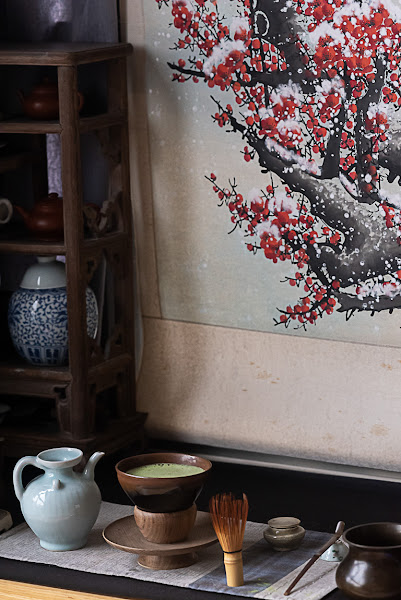
The tea of the Song dynasty (960-1279) is the finest tea in Chinese history, both literally and figuratively speaking. Its powder is ground much finer than during the Tang dynasty (618-907), and it stopped being ground at the beginning of the Ming dynasty (1368-1644). And it's fine in the sense that it's the most imperial of all teas! It's the only tea for which the reference book (Da Guan Cha Lun) was written by an emperor (Song Huizong)! Thanks to Japanese tea master Sen no Rikyu (1522-1591) who adapted this method and codified it, top grade made matcha (green powder) tea continues to be produced and practiced in Japan. For a long time, the 3 tea schools that go back to Sen no Rikyu, Urasenke, Omotesenke, and Mushanokōjisenke, were only teaching the Japanese nobility! It's only quite recently that they have opened up to the rest of Japanese society and even foreigners. To this day, top grade matcha continues to be more expensive than sencha or gyokuro, and the Chado tea ceremony is still one of the most important tradition in Japan.
So, while Rikyu was born 500 years ago this year, the Song dynasty style tea brings us back over 900 years ago, as the Song Huizong wrote his book in 1107! And if you want to study any subject, it's always best to go to the original source!
There's another good reason to learn about what may appear like ancient tea history: you can still practice it today (especially thanks to the fact that matcha continues to be produced in Japan)! Actually, it may appear easier to prepare matcha in the Song dynasty style than in the Japanese way, because it's not ceremonial at all. It's all about the technique and getting the most of the tea. That's why it feels so well linked to modern gongfu cha, even though that technique is quite different. And to help you get a better understanding of this ancient tea method, I've made this class about the secrets of Song dynasty tea:
Of course, this class doesn't teach everything there's to know about Song dynasty tea. There's much more to learn. But the points I make go to the core of the preparation. Literally!
Je suis désolé pour la mauvaise qualité du son de cette première vidéo de l'année. J'ai du oublié de remettre mon micro sans fil en marche... Mais ce qui manque à la forme, le fond le compense assez bien, selon le retour que j'ai eu.
Or, j'ai même oublié un argument que j'avais fait le jour précédent, lors du même cours en anglais. Cet argument, le voilà:
Le pin (ou sapin) est l'un des 3 symboles de l'hiver. Cet arbre est aussi le symbole de la longévité et de l'amitié. Les deux vont ensemble, car une amitié brève n'est pas une vraie amitié. L'amitié se construit sur de la confiance, une capacité à répondre présent et avec de bons souvenirs et de beaux projets.
Je crois que cela définit parfaitement ce qu'on attend d'un thé de garde. C'est un thé de bonne qualité qui ne nous déçoit jamais. On a de bons souvenirs de dégustations antérieures et on en conserve précieusement les feuilles pour les bonifier, car on s'attend à encore plus de plaisir et de finesse dans les prochaines années.
Contrairement au printemps où la nature abondante produit de nouvelles feuilles à foison, l'hiver nous inspire donc de nous concentrer sur ce qu'il y a de meilleur. Place à la qualité!
D'ailleurs, j'en ai refait l'expérience aujourd'hui avec ce puerh des années 1970! C'est tellement bon. OK, là c'est un peu triché, car je n'ai ce thé que depuis quelques années. Par contre, celui de 1973, très similaire, je l'ai depuis 2008 déjà!
Il y a un sentiment de satisfaction de constater que ce thé se bonifie encore. Il ne s'agit pas d'être misanthrope comme la devise à Washington DC: "Si tu veux un ami dans cette ville, achète un chien!" qu'on pourrait compléter par "et si tu es allergique aux poils, bois du vieux puerh!"
Bien entendu, le thé ne sera jamais comme un vrai ami, mais cette analogie entre ami et thé nous indique une voie basée sur la compréhension et la qualité. Il faut savoir parfois se concentrer sur un bon thé pour bien le connaitre. Et ce n'est qu'avec des thés de qualité qu'on trouve assez de raisons pour les boire encore et encore, car ils ne finissent pas de nous ravir.
Le bon collecteur est donc celui qui se trouve des thés pour la vie!
Here's the last post of the year you've all been waiting for. Since 2007, we are closing the year with a review of the 12 best pictures of the year, one per month.
Every year has ups and downs. Sometimes, it's better to forget about the bad and just celebrate the positive achievements. And tea is about finding happiness and contentment in a sea of frustration, stress, challenges called modern life!
So, I will also ask you to help me choose which 2 of these pictures I should turn into postcards, so that I can add them as gifts to your future tea orders! Please give a like on my FB page to the 2 pictures you like most!
Thank you very much for your support! I wish you a wonderful and healthy New Year 2022!
2021 is the year the number of my video tea classes really took off! For this, let's thank all of you who place orders on www.tea-masters.com because you are not only getting great teas and accessories, but you help sharing my tea knowledge with fellow tea lovers all over the world. In a different business model, I could limit the access to my tea classes to my customers or charge for the participation. Instead, thanks to your generous orders, I can be generous in return by letting everybody watch and learn.
If I produce so much content about learning the proper tea technique, it's because my experience tells me that skills do matter a lot. This message isn't so popular with the broad public and that's why the number of views of my classes remain relatively confidential. Of course, another reason is that I'm not a natural born public speaker and sometimes my subjects are too detailed for the average tea person. But I'm a demanding professor, because I know that tea is like life: no pain, no gain. The more you learn, the more you might enjoy your tea in the end (when everything clicks). While I try to make things look simple, I know that there are no shortcuts.
I know it's not pleasant to hear and realize that the main reason a tea doesn't taste great is because we didn't prepare it well. It's not enough to have the right tea, the right ware, the right water, even the way we brew the tea will have a large impact on our enjoyment. But taking the red pill and becoming aware of all the tea challenges is what enables you to make real progress. The is the way to becoming a tea master!!
So, from over 110 videos, here are the top 10:
10. The White Road #1 Jingdezhen, by Edmund de Waal. A review of book by a ceramist.
9. Chinese New Year traditions, those linked to tea.
8. Class about Gaiwan, Gaibei and Zhong. This class was inspired by the reading of 'The Dream of the Red Chamber' by Cao XueQin.
7. Hei Cha class. Fermented teas, including puerh.
6. Tea happiness starts with the preheating step. It's all about details!
5. The fastest way to rinse tea. A class about rinsing tea and good humour.
3. How to end a Chaxi. Like several others, I made this class to answer the question of a viewer.
2. A Free Tea Scoop for all Viewers of this video! This is the most liked video of 2021!
1. Training to become a tea master. More difficult than Navy Seal!
Wait! Where's #4? It's the same as #1, but in French!
4. 2 exercices pour devenir maitre de thé.
Vous pouvez retrouvez toutes mes vidéos en français sur ce lien YouTube.
Und deutschsprachige Teefreunde können auch meine Klassen auf deutsch hier sehen!
This weekend, I won't teach a class, but I'm organizing a 'Back to the future tea class' on Zoom (Meeting ID: 772 0292 3071 and Passcode: C8026A). I will host the event on January 1st, 2022 in Taipei, while it will still be December 31st for my North American friends (9:30 PM Eastern)!
I hope you had a wonderful Christmas! Mine was very enjoyable due to the fact that I followed my own advice: less wine and more tea! The one that stood out is my 2017 spring gushu puerh. I could use it on 3 occasions. First, as I had advised, on its own, instead of Champagne, as starter that gives you energy and appetite. Second, it paired very nicely with my home made gravlax (salted salmon). Third, it also paired wonderfully with French cheese like vacherin! And not only was the pairing a real pleasure, even my digestion felt quite normal despite the higher intake!! (This Lancang gushu is also a good, more affordable choice). Before I list the top videos of 2021 in my next post, let's recap the most viewed articles of this year.
5. Absolute Beginners. This article is about the best tool for absolute beginners, the porcelain gaiwan. It's not to be confused with a video I made lately that teaches how to make tea if you are an absolute beginner! The video was designed to be sent to your friends, after they have received a tea gift from you.
4. Hung Shui SiJiChun feedback. This short feedback is a great reminder that quality tea doesn't have to burn holes in your pocket!
3. 2003 Spring raw puerh cake feedback. This article is another feedback I received. This gives me the opportunity to thank all of you who write to me with your feedback, questions, suggestions...
2. Tea cultivar TTES #22, Qin Yu. My farmer in San Hsia harvested this new cultivar for the first time from his new plantation and turned it into an exquisite Baozhong!
1. The Reddit influence. This article is based on a reader's feedback I found on Reddit. I had been wondering why this 2003 sheng puerh cake and this 2007 sheng CNNP Peacock cake were selling so well all of a sudden. It turns out that this article helped boost the sales for these 2 puerhs. And the good news is that these 2 puerhs are still available!
In this week's tea class, I gave some advice about tea pairing at Christmas. The goal of adding tea is to make the special meal even more special and delicious! Christmas is a perfect time to experiment tea pairing for lots of reasons:
1. By using tea instead of wine, you drink less alcohol,
2. While the Christmas meal traditions stay intact, tea pairing adds a new touch that is focused on taste and quality.
3. A good tea pairing is like a good wine pairing: the pleasure is much more than the sum of tea and food. It's not so easy to achieve, but it's very satisfying.
And to help you, I've made this video with lots of Xmas tea pairing advice:









 Posts
Posts


