Monday, December 18, 2006

Petits conseils pour réussir son thé durant les Fêtes

La discussion sur la meilleure manière de préparer l'infusion, comment ajouter l'eau chaude au thé, suite à mon dernier article, me laisse à penser qu'il est opportun que je rappelle quelques 'règles' ou conseils. Ainsi, durant les fêtes de fin d'année, en guise de digestif pour les tranches de foie gras et de buche de Noël -que je vous souhaite succulentes-, vous pourrez encore mieux réussir vos thés chinois façon gongfucha pour le plaisir et l'admiration de toute votre famille.

* Esthétique visuelle:
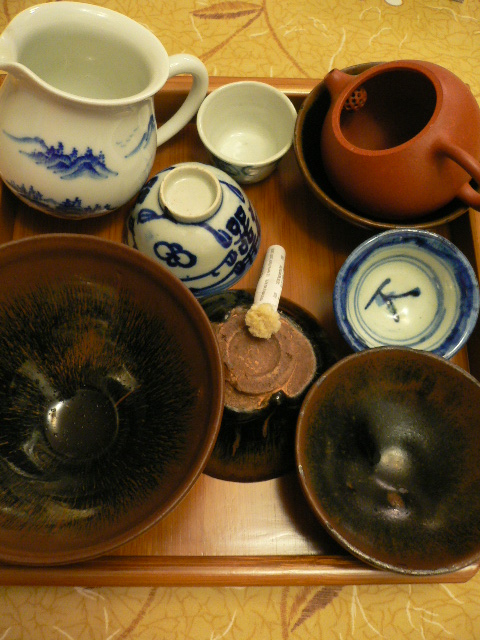
On boit aussi avec les yeux. Commencez par débarasser et nettoyer votre table. Ajoutez des petites touches de décoration personnelle (petite bougie, feuilles de houx, jolie nappe...). La décoration de Noël se marie souvent très bien avec le style chinois, notamment les couleurs rouges. Un seau caché sous la table pour recueillir les eaux usées du rinçage/préchauffage de l'équipement est pratique si vous n'utilisez pas de plateau en bambou.

* Choisir entre un zhong en porcelaine et une théière Yixing
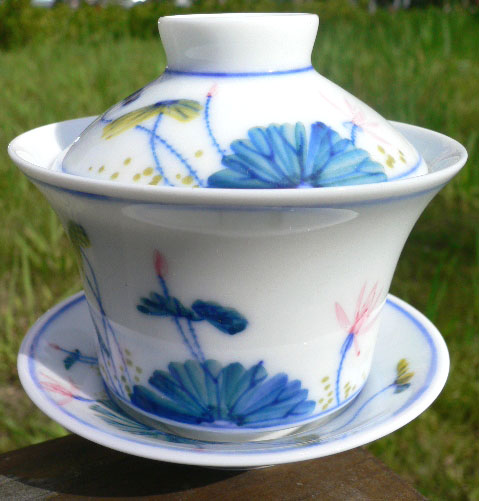
Le zhong (gaibei/gaiwan) est un instrument idéal pour découvrir et analyser un thé. Il a un rendu fidèle du goût original de chaque thé. Je le conseille pour faire des dégustations précises, pour les thés verts, blancs, jaunes et rouges. C'est l'instrument des professionnels. Sa manipulation demande une certaine pratique pour ne pas se bruler les doigts. Mais si vous êtes débutants, optez pour une petite théière en porcelaine.
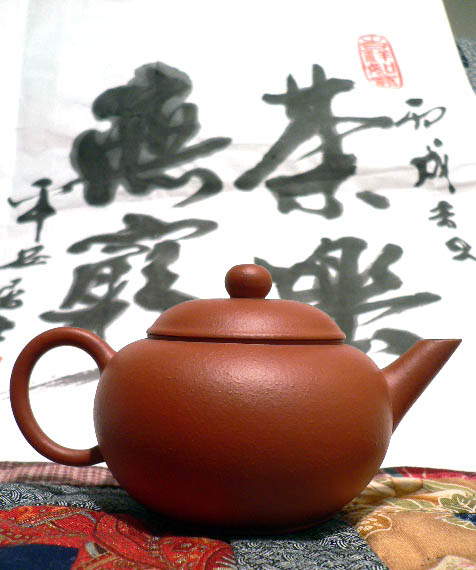

Pour les thés oolongs et les puerhs, il est possible de choisir une théière en Yixing. Plus simple à manier, gardant mieux la chaleur, elle apporte un plus estétique et gustatif au thé si on la choisit bien (cf mes leçons). Si vous n'êtes pas certain, le plus simple est de la tester en parallèle avec un zhong avant le grand jour. Si votre théière ne donne pas de meilleur résultat qu'avec le zhong, elle ne correspond pas à ce thé-ci. Prenez alors le zhong ou une autre théière qui donne de meilleurs résultats.

* L'eau
Utilisez une eau peu minéralisée et plutôt au goût moelleux, sucré que dur et acide.

L'eau doit avoir atteint l'ébullition (bulles de taille d'oeil de crabe). Notamment pour la première infusion des oolongs et des puerhs, il est indispensable que la chaleur soit maximum pour bien ouvrir ces feuilles.

Lorsque l'eau bout longtemps, elle 'vieillit' et perd de sa qualité. On ajoutera donc de l'eau froide dans la bouilloire à intervalles réguliers et l'on portera cette eau à ébullition doucement à chaque fois.

Si votre cheminée le permet, c'est peut-être le moment de faire bouillir l'eau sur un feu de bois. En théorie, c'est l'idéal (n'ayant pas de cheminée à Taiwan, je n'ai pas trop l'occasion de tester!).

* Préchauffage
Le manque de préchauffage et une vitesse d'infusion trop lente lors de la première infusion sont les raisons principales des ratés pour les thés oolongs et puerhs. Une fois bien ouverts et chauds, vous pourrez ralentir votre débit d'eau chaude. Préchauffez aussi cruche (chahai) et coupes à thé.

* Quantité de feuilles et durée d'infusion
Meilleure la qualité du thé, moins on en utilise.
Moins on utilise de feuilles, plus on le laisse infuser.
Un des arts du gongfu consiste à trouver l'optimum en terme quantité et temps. L'autre art est de savoir composer et de s'adapter aux circonstances. Ainsi, chaque thé est une nouvelle aventure et non une recette inaltérable.

* Echantillons de thés.
Je recommande de boire rapidement vos échantillons de thé. La petite quantité et l'emballage en petits paquets à zip plastiques transparents fait que le thé ne s'y conserve pas trop bien, notamment les oolongs peu oxidés et les thés verts. Mais même pour les puerhs ou les oolongs fermentés, je conseille de ne pas attendre, car le thé a pour caractéristique de facilement s'imprégner des odeurs environnantes.

Pour apprécier le thé, le mieux est d'avoir du temps, d'être relax et d'avoir envie de se faire plaisir et de faire plaisir aux autres. Bref, ces fêtes sont une bonne occasion de boire une grande variété de vos meilleures feuilles!
Bonne dégustation!

Thursday, December 14, 2006

It's a wonderful life... to blog about tea

The movie is one of my Christmas favorites. I had the opportunity to watch it again a few weeks ago. And, during this (pre) Holiday season, I have the feeling the happy end is happening to me!

I have received excellent, well written comments/e-mails from my readers. One even sent me a handwritten letter (from England). Several readers sent me samples of their best teas. I'm very touched by all this feedback. It really lets me realize that far from being a solitary act, my tea blog has connected me to passionate, sensitive, generous people around the world. I want to thank you all very much.

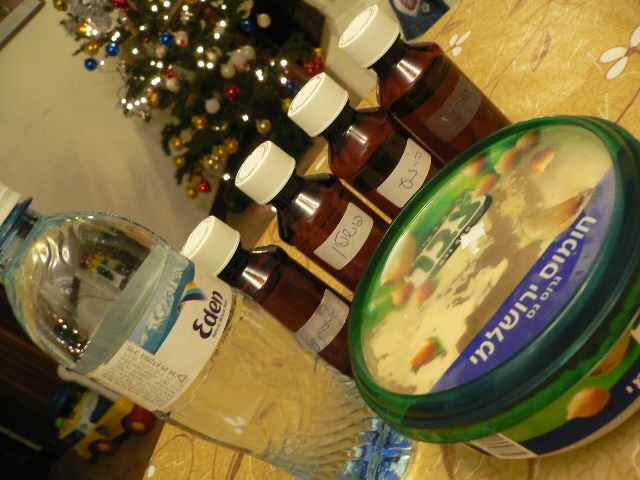
2 days ago, an overseas reader even came to my small apartment to visit me! He decided to travel to Taiwan to learn more about Chinese tea. His backpack was filled with gifts for me. Imagine, he brought me the one food I crave since I traveled to his country 12 years ago: hummus (a chickpea spread).He also brought 4 different excellent olive oils (behind the box of hummus). The taste of each is very pure. Like excellent teas, the fragrance is rather low. It slips easily down the throat. But then there is a powerful and yet well balanced aftertaste. I compared with the olive oil (first cold pressed extra virgin Spanish olive oil) from my kitchen. This one has a strong fragrance that says OLIVE and a strong, but very rough aftertaste. This made me then realize that these olive oils don't smell like olives, but more like flowers. Like good wine doesn't smell like grape or tea doesn't smell like grass.

The gifts didn't stop here. This reader also brought pita bread, Turkish coffee and mineral water from Israel. I wonder how my best tea will taste when I use water from the 'Holy Land'... I want to put it aside for a special, mystical moment. Maybe on Christmas night...

He then asked me if the way you pour water to brew tea is really that important. Does it really make a difference? Let's try, I said! I took 2 same gaiwan, preheated them. We used my semi-wild Wenshan Baozhong. He chose to use fewer leaves than me. I went first with the brew. He followed right after me with the same water from the same tetsubin. The result spoke for itself. He obtained a weak, watery tasting tea. Mine was full of fragrances, full body and mellow with a beautiful aftertaste.

"Hey, it's not fair! You had more leaves." So we switched gaiwans for the 2nd brew. Bis repetita: I was again able to get a better result! This was also verified by the leaves that had opened symmetrically in the gaiwan.

That experience was really interesting. It showed me the road I had traveled since I had started learning about tea. And I was now in a position to perform this little 'magic' and get my tea friend to believe that even the way you pour water in the gaiwan will affect the taste of a wonderful tea.

Monday, December 11, 2006

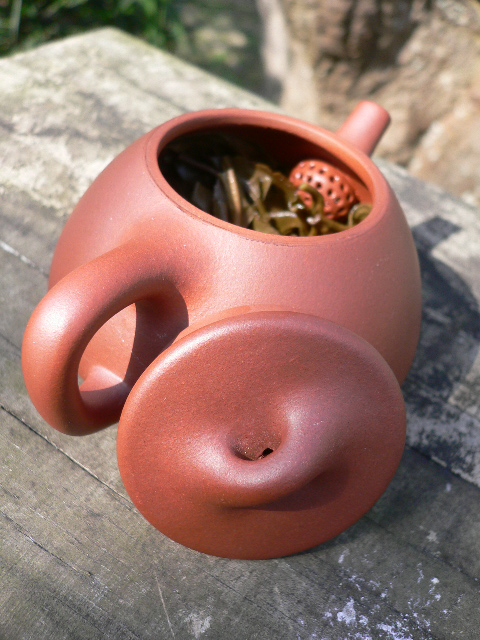
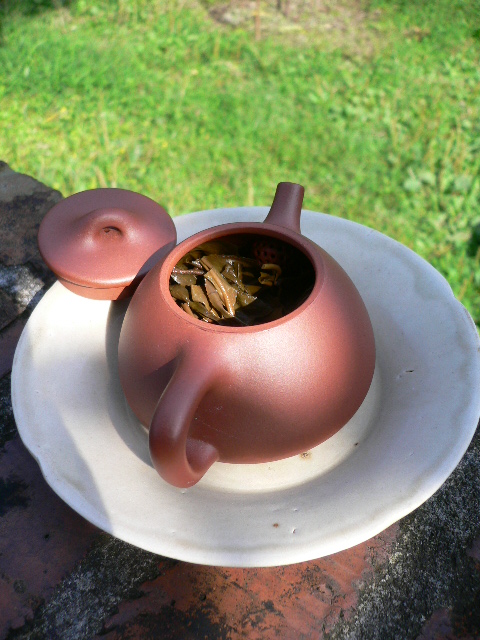
Yixing zisha Shi Piao Hu

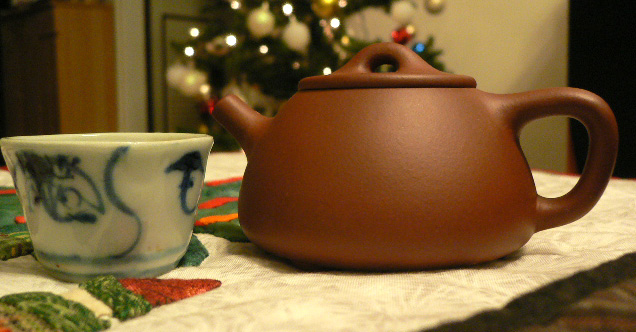
You have seen a Shi Piao teapot on the cover of the Tea Museum book on my blog before. So, this is quite a famous, classical Chinese teapot shape. My potter recently made a small batch of Shi Piao teapots (10-11 cl volume) and this gave me the opportunity to lay my hands on one.
This zisha (purple/brown) clay has a nice look of milk chocolate. The texture is a little sandy and you almost feel like wanting to bite it!

This handmade model comes with a gof ball shaped inside filter.
The flat triangle shape makes it a good teapot for non rolled leaves.

This pure zisha clay is medium to soft. Because it's pure, it's impacting the tea in a clean and clear way. Because the clay is a little soft, the pores are bigger and absorb quite a lot of fragrance and astringency.

My tests on greener Tie Guan Yin and on my 2003 raw wild Yiwu puerh have shown that such teas are not perfect for this pot. The lightest fragrances don't come out. On the other hand, I was delighted with the depth and mellow aftertaste. I then had an excellent result with my 1985 raw wild Yiwu Tuo Cha. This tea is very powerful and a little astringent in the first brews: this teapot handled it very well and rounded the angles while preserving the strong cha qi.

One characteristic of the Shi Piao is its big handle, very much part of the pot. This means that the handle will become quite hot when you pour hot water on the teapot during the infusion. I had to grab the end of the handle to avoid getting my fingers burnt while pouring the tea.
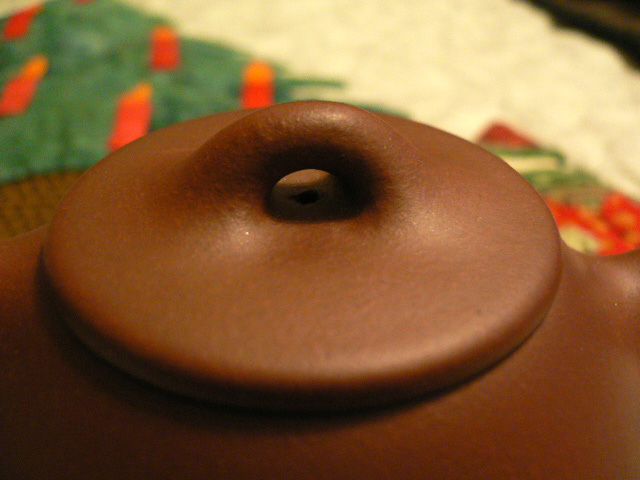
I noticed a similar 'problem' with the top of the teapot: it is also very close to the body and doesn't diffuse heat as well as a small ball does. This doesn't mean that you will burn your fingers, but you will have to be careful how to hold the teapot when pouring. It was a little annoying, but I guess that with practice, I will learn to hold it correctly without thinking. It's like a new car, I need to get used to it.
The spout is big enough for a quick and clean pour. So, this means that it would also suit cooked puerh quite well. Another tea group I think would be good for this teapot are roasted Wu Yi Oolongs.

I hope you're also enjoying the look at my Xmas decoration! Red is the color of celebration in the West and in the East!(Price for this zisha Shi Piao is the same as my other small zisha teapots.)

Thursday, December 07, 2006

Soleil de décembre


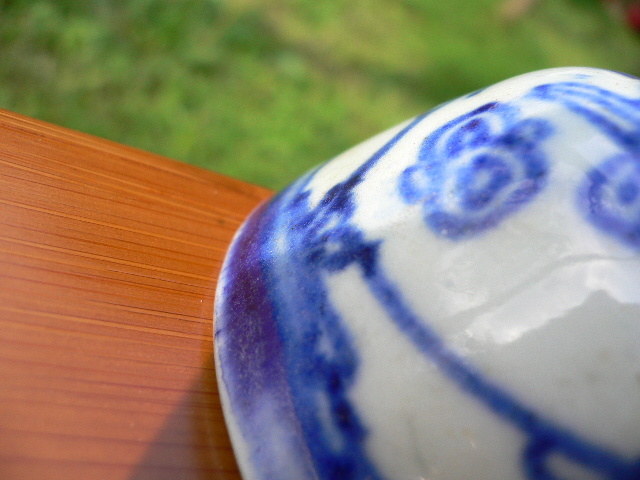
Un rayon de soleil sur une coupe (Xi) qinghua de la dynastie Qing et j'oublie les jours de mauvais temps et de froid. Noël approche...

Wednesday, December 06, 2006

Du plomb dans la céramique?

Dans l'article ci-dessous, en anglais, j'explique comment j'ai voulu savoir si mes porcelaines anciennes et nouvelles et mes théières en glaise contiennent du plomb.

Résultat négatif. L'indicateur de mon test ne tourne pas au rouge: il n'y a donc pas de plomb sur l'émaille ou dans la glaise de mes accessoires neufs ou anciens. Je peux donc boire mon thé avec l'esprit encore plus tranquille, relax, zen...

Lead Check for my ceramics

Last week, a reader asked me if I could detect lead in the glaze of my antique ceramics. Since this was not the first enquiry and I see this subject regularly coming up on tea forums/discussions, I decided to get some facts. First, I browsed the web and found this interesting article:

"Lead in Ceramics

Lead can be found all around us in dishes, fine crystal, painted walls and woodwork, toys, furniture, antique varnishes, solder, dust and soil. The effects of lead poisoning are cumulative throughout our lifetime, therefore it is important to limit our exposure to it.

In the ceramics industry, some lead glazes are still used to color or decorate and to smooth the surface of ceramic products. As long as the clay and glazes are compatible, and these glazes are properly fired (at a high enough temperature and for an appropriate amount of time), the lead is not likely to leach through the surface.

With constant use and scrubbing, ceramic products can wear down over time, and may allow lead to leach through. Hot and highly acidic foods, and prolonged time of contact, will increase lead leaching from such damaged surfaces. Antique, highly decorated ceramics are the most likely to leach lead.

You might be able to visually detect lead leaching if ceramic items show a dusty or chalky gray residue on the glaze after they are washed. When testing for lead content, be sure to test the surface that comes in contact with the food."


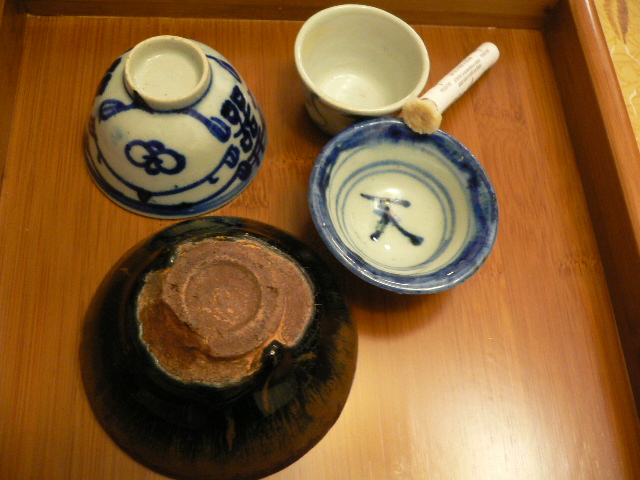
That page also provided a link to LeadCheck, a company providing lead checking swabs. So, I went ahead and purchased the kit to test my ceramics and get a scientific answer to this recurring question (urban legend?). The kit has arrived yesterday and I first started with my decorated Qing dynasty cups. Some have chips, which makes it possible to check the inside as well as the outside glaze.

Result: negative. No lead found. Excellent! There was still liquid in the swab and I then continued with my other antique ceramics: the Qing wine cup, the Xi cup, the black Tenmoku. Negative results all the way!


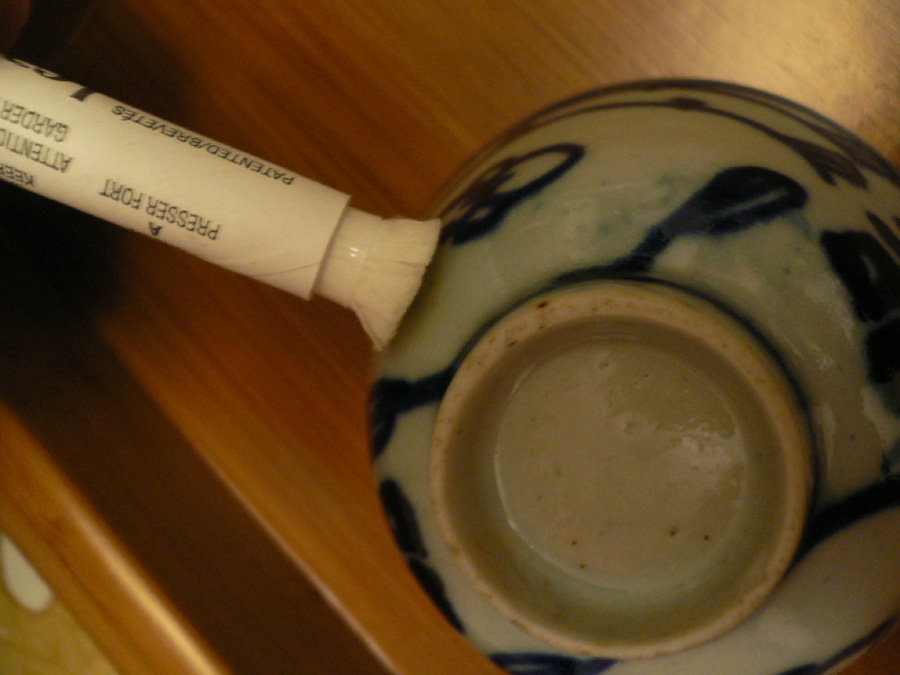
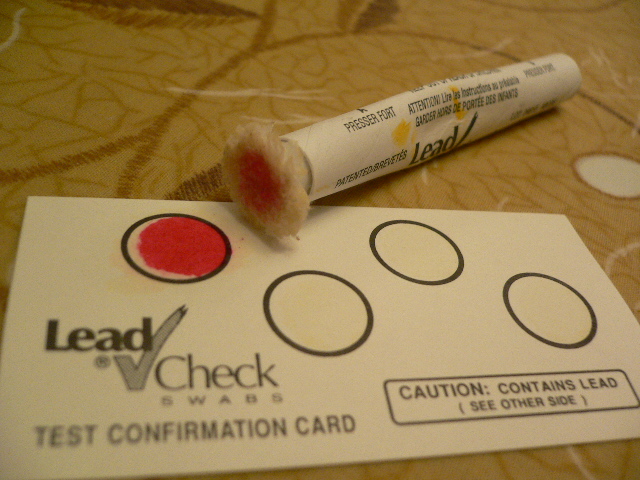
Then, I tested my new ceramics and even my Yixing teapots. As you can see below, the swab remained white (except for the dust).
The only way to make it turn red was by using the confirmation card below: Conclusion: Readers who plan to buy or bought my antique/modern teaware can drink tea in total peace of mind. The scientific Lead Check test shows no traces of lead in the tea wares I selected for their high quality and artistic design.

Monday, December 04, 2006

Zheng Shan Xiao Zhong (Lapsang Souchong)

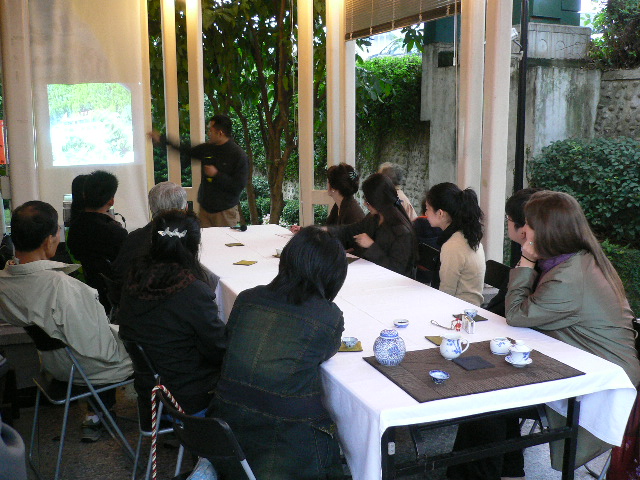
Samedi dernier, Teaparker nous présenta donc le Lapsang Souchong de Wu Yi au Taipei Story House. Il s'agit du tout premier thé rouge (oxidé). Ses origines remontent à 16-17è siècle. C'est lui qui a inspiré les Anglais à faire du thé rouge en Inde. C'est le thé d'exportation par excellence. Très peu de Chinois connaissent cette sorte de thé. Ses acheteurs traditionnels sont les maisons de la grande noblesse européenne (mais l'ancien président chinois Li Peng serait aussi un amateur, selon Teaparker).

La production du vrai Zheng Shan Xiao Zhong est très limitée. Teaparker nous montra des photos des plantations. C'est à peine si l'on voit les petits arbustes tellement la plantation est sauvage (les mauvaises herbes poussent entre les arbres et le lichens pousse sur les rochers). Les fermiers font très attention de ne pas rajouter d'engrais ou de pesticides de peur de faire baisser la qualité. Ils savent que leurs clients, noblesse oblige, demandent le maximum (et ont les moyens de payer plus d'un euro le gramme de thé). En plus, il n'y a qu'une seule récolte par an (au printemps).

Qu'a-t-il donc de tellement spécial, ce thé rouge pour être si cher? Très sauvage et pur, à la base, les fermiers lui rajoutent un goût fumé moelleux en le fumant au bois de pin. Le résultat est vraiment bon. Comme un oolong, ce thé se laisse infuser de nombreuses fois (6 à 8) et ne nécessite aucun sucre ou lait tellement il coule facilement. Au nez, j'ai senti de la barbe à papa et du caramel: pendant quelques secondes, j'étais transporté au marché de Noël de Strasbourg! D'ailleurs, ce thé allait bien avec le temps froid de ce samedi.

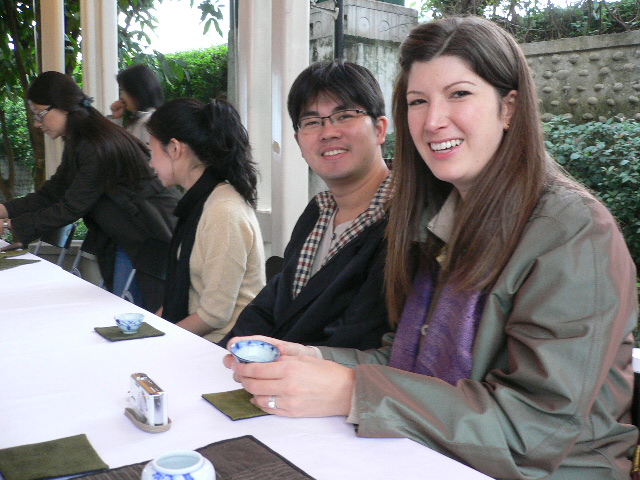
Je remercie Elise et son mari d'être venus assister à cette présentation/ dégustation. C'était très sympa de se rencontrer en vrai autour d'une coupe d'excellent thé.

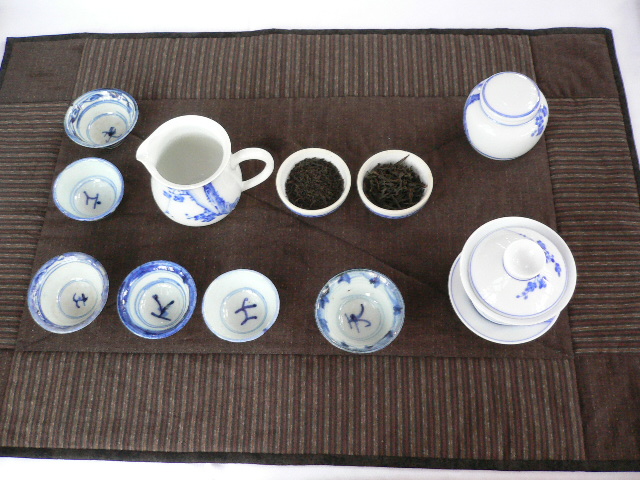
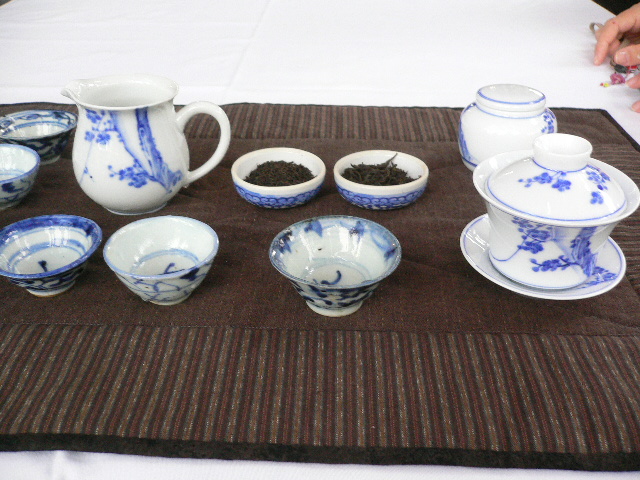
Comme il faisait froid (pour Taipei: 15 degrés environ), j'ai opté pour mon set en porcelaine de prunus mei (dont la fleur s'ouvre en hiver), et mes coupes Qing, bleues sur blanc elles aussi. Ces coupes sont pour souligner que nous buvons un thé dont l'histoire est très ancienne. Le résultat fut très harmonieux.

Nouveau: Voir l'article et les photos chez Teaparker.

Friday, December 01, 2006

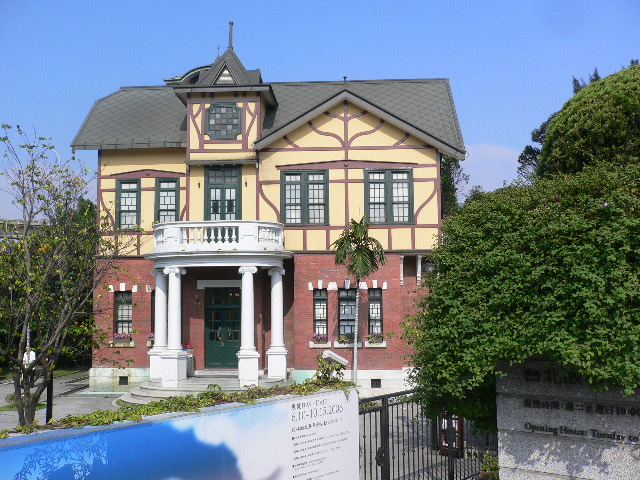
Tea Event at The Taipei Story House

When: Saturday December 2, 2006 in the afternoon (start is at 3 PM, but best is to arrive earlier for a good seat)
Where: Taipei Story House on Zhong Shan N. Road, next to the Fine Arts Museum.
Who: Teaparker and members of his Tea Association 'Cha Ren Ya Xin'
What: A presentation of 'the origins of red tea' and related tea tasting.
Note: there's a fee to access the historic site of the Taipei Story House, but there's no additional fee to attend the event.

Update: I will participate in the event. It would be fun if some of my Taipei readers would come.
Teaparker is talking about the event here and about red tea origin here (in Chinese).

Un nouveau blog

Le zhong nomade nous vient de Montréal, mais il semble qu'il a aussi fait en tour par mon Alsace natale. Aimer le thé, c'est aussi être nomade dans l'âme et voyager en Chine et à Taiwan grâce à chaque coupe de thé. Bienvenu!

Je recommande aussi cet autre blog et notamment cet article fait par un français à Taiwan.

Wednesday, November 29, 2006

Fo Shou Oolong et ses feuilles géantes

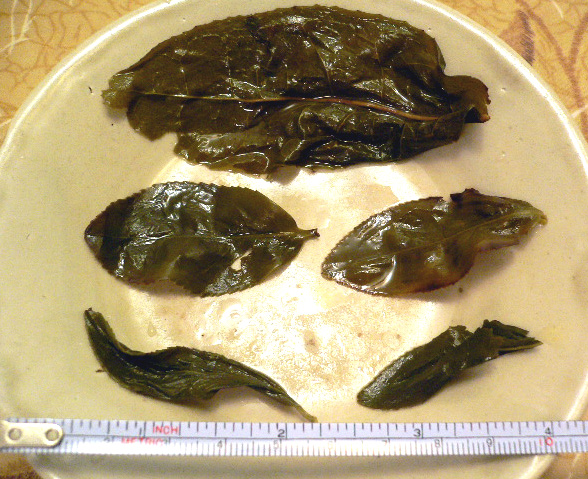
De haut en bas, 1 feuille de Fo Shou Oolong, 2 feuilles de Baozhong semi-sauvage et 2 feuilles de Baozhong 'fleur de lys'.

Vous pouvez voir que la taille des feuilles de cet oolong est vraiment impressionante. C'est la plus grande sorte d'Oolong que j'ai rencontré. Celui-ci provient donc de Pinglin (de ma récente expédition). Mais c'est un thé de l'été 2005. Bizarrement, pour Wenshan, quand il est sec il n'est pas ouvert comme le Baozhong, mais roulé en boule comme un Oolong. Mais cela a un avantage logistique: ainsi, ses grandes feuilles s'abiment moins durant le transport.

D'un point de vue du goût, il a un côté acidulé et frais qui le rend proche des Oolongs peu fermentés. Une bloggeuse taiwanaise nous montre une photo du fruit acidulé, Main de Bouddha, dont il a pris le nom. La filiation est donc double: Le goût acide et la forme des grandes feuilles qui ressemblent à des grands doigts.

Comme on est bientôt Noël, je vais ajouter un échantillons de cet Oolong géant avec tous ceux qui me passeront commande d'ici les fêtes de fin d'année (dans la limite de mon stock de 600 grammes). C'est le genre de feuille qu'on a envie de sécher dans un livre pour garder un souvenir.

Vous remarquerez aussi que le Baozhong qui pousse de manière naturelle grandit plus que celui qui est cultivé par l'homme!