Wednesday, June 04, 2014

4 High mountain Oolong Chaxi at Tatung University's Zhisheng Memorial

On Sunday June 1st, Teaparker and the association Cha Ren Ya Xin have performed 4 High Mountain Cha Xi at this historic site in Taipei: the Zhisheng Memorial in the Tatung University (on Chung Shan North Rd, Sec 3, No 40). It's a house from the Japanese era (1895-1945) that belonged to the founder of Tatung (a local industrial company). It shows how well the local Taiwanese elite adapted to the Japanese rule at that time. This place is such a natural fit for a Chaxi that I started to install mine before everybody else arrived.
 Looking at these pictures, I realize now that I instinctively faced the garden, whereas a Japanese tea ceremony would be oriented more towards inside!
The other 3 students arrive and Teaparker assigns a corner for each of us. Ms. Chang YuFang also chose very green colors as background for her spring Oolong (from Qilai Mountain).
 This looks very elegant and fresh. The red zhuni teapot is at the center, in an ancient qinghua bowl. And the cups look familiar: they are Dehua dragon cups!
Ms. Jian Toufang installs the third Chaxi next to mine. She's using a white curtain fabric as her Chabu!
From a distance, her flower arrangement looks like put in a basket. But the handle we see is actually bended grass! And when I noticed that she didn't have a stand for her kettle, I lent her my white hexagon stand. She would brew a Da Yu Ling Oolong with her zhuni teapot.
The last performer, Ms. Wu LiYing, has her own style. Her favorite color isn't hard to guess: it's black. No matter the tea, young or old, fresh or roasted, Oolong or puerh, her Chabu always looks similar.
However, for this high mountain Chaxi, she has brought this special bonsai pine tree. On the side, we see that the trunk is white where the bark has been peeled off. This not only creates a stark contrast with the other dark colors, but it reminds me of the white trunk of the often huge pine trees on Da Yu Ling. And if her bonsai can remind me of this mountain, then I can almost already feel the powerful taste of this Oolong! Well done!
The main attraction of her Chaxi that day is this golden teapot. Actually, it's technically a silver teapot that has been plated with gold! It was recently made by an old Japanese master according to a Chinese teapot design. Such a piece of teaware is very unique and precious!
During the event, except for the in-house photographer, we were not allowed to take pictures. I was nevertheless able to take these 2 shots with my phone without disturbing anybody. We performed one after another for 4 guests at a time:
The young lady in the white T-shirt tasted both Da Yu Ling from Ms Jian and Ms Wu. She felt that the tea tasted very differently with the zhuni (water from a tetsubin kettle) and the silver teapot (water from a silver kettle). The zhuni brought more unity and harmony to the taste and the scents. With the silver teapot, the temperature of the tea in the cup was higher. And then the tastes and scents were felt more clearly, each layer of flavors was experienced one by one.
With my Shanlinxi high mountain Oolong, I think that the combination of the silver kettle for very pure and hot water with a zhuni teapot for the harmony of flavors enabled me to get a very powerful, sweet and deep result!
For my Chaxi, I used my light celadon singing cups to emphasize the fresh color of the brew. The celadon bowl by Michel François has some bluish tones and symbolizes the blue sky over the mountains. My little bamboo plant with a stone is another symbol of the vegetation growing on Shanlinxi.

Monday, June 02, 2014

Bonne fête du Dragon Boat!

Cette année, nous avons préparé nos zhongzi nous-même! Le riz est enveloppé dans deux feuilles de bambou, et on y rajoute de la viande, des champignons, une moitié d'oeuf, des cacahuètes, des petites crevettes, un marron... C'est bien ficellé et c'est cuit à l'eau ou à la vapeur. Cela consititue un petit repas complet, bien borratif.

On utilise beaucoup d'échalottes et d'épices pour relever le goût du riz. Ces ingrédients sont précuits et souvent sautés à l'huile pour intensifier leur goût.

Le thé qui accompagne le mieux les zhongzi à base de viande est le puerh cru de qualité. Ses arômes sont suffisamment puissants pour tenir tête à ceux de la zhongzi et les complémenter agréablement. Non seulement le puerh donne aussi l'impression de nettoyer la sensation de gras dans la bouche, mais son aftertaste concentré prolonge l'impression de richesse de la zhongzi.

Mais attention, on dit parfois que le puerh est un thé amaigrissant. Mais dans ce cas, c'est plutôt le contraire: le thé donne une telle impression de légerté que j'arrive à manger 2 zhongzi au lieu d'une seule!

June 2004 - June 2014: 10 years of tea blogging

 
This month marks the 10th anniversary of this blog! So many memories, fine tea ware and great tea moments. As part of the celebrations for this anniversary, I would like that you nominate the best article and the best picture from my blog. To do so, please simply include a link to that article in the comment section of this article. And if your nominated article and/of picture ends up winning the poll that will follow, then the first person who made the nomination will win a pack of organic Wenshan Baozhong!

I would also like to organize a second, more personal contest: please send me your story (a short essay) about how my blog has had a special impact on the way you experience tea. Maybe it was a technique you learned and managed to reproduce, or a tea you ordered that tasted beyond your expectations, a picture that inspired you... (Send it to my e-mail: stephane_erler@yahoo.com). There will be several prizes: 150 gr of Lishan Oolong for the winner, 150 gr of Qilai shan Oolong for the runner up, 150 gr of Shanlinxi Oolong for third place and other teas for the followers.

Good luck and thanks for reading my blog!

Mon blog fête ses 10 ans ce mois-ci! J'y ai écrit plus de 1500 articles. Aussi, pour fêter ces beaux moments, toutes ces beaux Chaxi et ces rencontres, j'aimerais que vous sélectionniez votre article et/ou votre photo préférés. Pour nominer, il vous suffit de me donner le lien à l'article et/ou la photo dans un commentaire sous cet article. J'organiserai ensuite un sondage public à la mi-juin et si vous avez été le premier à nominer l'article ou la photo, vous gagnerez un paquet de 100 gr de Baozhong organique!

En second lieu, j'aimerais aussi organiser un second concours un peu plus personnel: envoyez-moi votre histoire décrivant comment le blog TeaMasters a pu avoir un impact dans votre expérience du thé. Y avez-vous appris une technique de préparation ou bien est-ce un article ou une photo qui vous ont particulièrement inspiré, ou bien un thé commandé qui a largement dépassé vos attentes?... (Envoyez-moi votre texte à: stephane_erler@yahoo.com). Je ferai une sélection et organiserai probablement un second sondage pour vous départager. Selon le nombre de participants, j'en ferai un en anglais et un français). 150 gr d'Oolong de Lishan attendent le vainqueur. Le second recevra 150 gr de Qilai et le troisième aura 150 gr d'Oolong de Shanlinxi, et plus en fonction de la participation).
 
Bonne chance et merci pour votre lecture!

Thursday, May 29, 2014

Spring 2014 Shan Lin Xi Oolong


Cultivar: Qingxin (ruanzhi) Oolong
Harvested : May 2nd, 2014
Origin: Shan Lin Xi (1500m), a new plantation
Process: Lightly oxidized, rolled Oolong


You can read my review of this tea on my Tea-Masters boutique, using 3 grams and 6 minutes brewing.

It tasted so good that way that I barely use more leaves for this Chaxi with a big, modern zhuni Lixing teapot.
One reason that allows me to use so few leaves and still get so much fresh energy is that these leaves are particularly concentrated with pure flavors. Compared with your average Shan Lin Xi Oolong, these leaves will produce a brew that has more substance and that still tastes very clean. The secret to this top quality is cracked with some simple common sense: the soil from the new plantation is naturally rich and doesn't require artificial fertilization. The trees are young, growing and full of energy.
Obviously, the tea farmers can also taste the difference and will ask a higher price for superior concentration. So, if you can get the concentration of 4 grams of regular Oolong with just 3 grams, then the price is likely to be about one third more expensive. If the price reflects this, is it still a good deal? From a tea drinker's point of view, all other things being equal, I believe so for three reasons:

1. Not only are the leaves more concentrated in good flavors, but they usually also contain less impurities in the taste. The mouth feels cleaner and the tea feels more natural and energetic. That's the second benefit of a new plantation Oolong. This benefit is more subtle, because it's not about having more concentration/flavors, but about having less (harshness in the taste, heavy tongue...)! The taste's finish of new plantation tea is much more comfortable.
 2. A clean taste is an essential quality for advanced tea lovers. As our palate becomes more demanding, we expect always better quality. But while average quality is common, higher quality is in more limited supply. This is the whole point of selecting tea: finding superior quality. That's why we (vendors and customers) sample several teas until we find the ones we consider best. Top quality is rare.

3. Teas which are more concentrated age better than lighter teas. (It's similar to wines in this regard). There's less hurry to finish the pack of tea quickly.

Monday, May 26, 2014

La préparation Gongfu Cha traditionnelle de Chaozhou

Durant la dynastie Qing (1644-1911), est née au Chaozhou la méthode dite 'gongfu cha' pour préparer le thé semi-oxydé (Oolong). Cette méthode a fortement influencée la façon dont on infuse le thé de nos jours. L'expression 'Gongfu cha' est restée, mais l'on sait rarement ce que cela recouvrait exactement à l'époque.

Cette expression est riche de sens multiples. Elle s'applique:
- à la maitrise du temps: savoir gérer son temps quotidien pour trouver un moment pour préparer son thé. Cette maitrise du temps passait aussi par la maitrise du temps pour allumer son feu de charbon et arriver à faire bouillir son eau assez rapidement, mais sans précipitation.

- au choix de feuilles de thé de bonne qualité. Les gens de Chaozhou étaient prêt à y mettre le prix: un vieil écrit mentionne que lors d'une transaction, un thé de WuYi particulièrement bon s'échangea contre son pesant d'or! Un prix élevé n'est jamais une garantie de qualité, mais il est évident aussi que la meilleure qualité est rare et a un certain coût.

- le choix des ustensiles par rapport au thé et l'harmonie entre ces ustensiles. Théière d'Yixing, coupes en porcelaine de Jingdezhen, Nilu du Fujian, jarre et soucoupes en étain de Chaozhou... Il n'était pas aisé de s'acheter un set pour gongfu cha à l'époque, car chaque ustensile venait d'un endroit différent. Les ustensiles les plus raffinés étaient souvent des commandes auprès d'artisans, et non des produits de consommation de masse.

- la maitrise du processus de l'infusion des feuilles. L'étape du préchauffage des ustensiles était primordiale. Aussi, je vous montre la technique de Teaparker et comment il fait tourner 2 coupes à la fois dans l'eau chaude:
 L'autre geste important est comment l'on verse d'eau bouillante dans la théière. A chaque infusion, les feuilles ont une disposition et un degré d'ouverture différents. Il s'agit donc d'adapter le flux de l'eau aux feuilles de thé pour en sortir le plus et le meilleur.
 Cette dernière image me permet d'illustrer une autre particularité du gongfu cha originelle: la théière baigne dans de l'eau très chaude. Cela a pour but de la maintenir plus chaude que si elle était à l'air libre. Ainsi, plus de saveurs sortent des feuilles en infusion. C'est donc pour cela qu'on se préoccupait de savoir si une théière est shuiping ou non. Shuiping signifie qu'elle est bien équilibrée et ne se retournera pas si on la fait flotter sur l'eau.

Saturday, May 24, 2014

Tea and the city

"With High Mountain Oolong, I can see far and clear!"

"Voyagez toujours plus loin avec mes Oolongs de haute montagne!"

Note: I have now completed my selection for spring 2014  Wenshan Baozhongs.

Thursday, May 22, 2014

A Feeling of Taiwan High Mountain Oolong...

3 of my tea students from the Tea Institute at Penn State University are visiting Taiwan right now. What would be a good place for them to fully enjoy and appreciate a High Mountain Oolong? Well, on a warm day in May, that would be a spot in a Taiwanese mountain, overlooking tea fields and bamboos. And that's the place where we went this Tuesday!
Outdoors, the heavy and sweet flower smells of the forest permeate the air. It's hot and we are longing for a cooling tea. This makes high mountain Oolong a perfect match for this occasion. We brewed Oolongs from 3 different mountains to taste and compare these mountains.
We started with my Qilai mountain Oolong of Spring 2013.
We used charcoal to boil the water in the silver kettle. This made our water very precious, because the Nilu only produced a limited amount. But less is often more in tea: it made us more careful in our movements and focused on the teas we brewed.
Everybody loved the Qilai and felt it had a very creamy, buttery taste with lots of freshness and sweetness. There's also dry, rocky feeling which creates a very pleasant aftertaste. It's only after the first brew that I told them that it's from 2013. Nobody had found any sign of it being old. They all felt it had the freshness they are looking for in High Mountain Oolong.

Next, Ryan brewed the Lushan Oolong. The package mentions Da Yu Ling, but this is a kind reminder that you can't trust a tea package. It's all too common for teas to be 'upgraded' by the farmers, because the famous names sell better than some obscure mountain that is just starting to be developed.
The reason for selecting this Lushan is that it has indeed certain qualities that make it very similar to a Da Yu Ling Oolong, even though it comes from an elevation at 1600 meters (only). The leaves are particularly thick and rich, because the plantation is new and the soil very rocky.
This Lushan Oolong tasted differently than the Qilai. I think the main difference was in the energy level felt in the aftertaste. This felt more powerful and direct. But it shared the same freshness and clean taste in the mouth. And that's despite the fact that we used relatively more leaves, because we're brewing outdoors where we are more easily distracted. This is a character of great quality teas: they feel stronger and more powerful, but at the same time, there's a lightness and clean feeling in the mouth.
The third tea is from Lishan, because I want to let them experience this famous mountain and a plantation above 2000 meters elevation. It's Merv's turn to brew:
The concentration and steady hand of these students is impressive and an example to follow. While brewing, they only have eyes for the teapot. Their brews were very successful and they always managed to open up the tightly rolled leaves well.
The Lishan Oolong has a little bit longer leaves than the Qilai and Lushan. But in terms of concentration of flavors, it's pretty similar. The overall feeling was almost lighter, more subtle and elegant.
Jeff continued to brew the enduring Lishan Oolong:
He's using an 80s zhuni teapot. Its hard clay is a great match with fragrant Oolongs. There's very little rounding of edges, but an added intensity due to the very high heat retention of this teapot rich in iron.
Tasting 3 different high mountain Oolongs back to back in this luscious forest with changing weather was a great experience for all of us. Ryan, Merv and Jeff have accumulated a whole new set of tasting data and taken detailed notes. For the future, they have now high and clear standards.
Merv agrees that it's been a tasting he won't forget so soon:
Ephemeral beauty in a cup of tea...
Quenching our thirst for knowledge.

Monday, May 19, 2014

Chaozhou gongfucha brewing, step by step


The Chaozhou Gongfu Cha brewing method originated during the Qing dynasty (1644-1911) in the eastern Guangdong province, next to Fujian. The tea used was roasted Oolong, preferably from the Wuyi mountains.

Chaozhou Gongfucha was necessarily brewed for 3 persons (like bridge is played by 4 people). If more people wanted to drink tea, they'd have to set up their own set (for another group of 3 people)... This method has greatly influenced the way tea is currently brewed in Taiwan and China. In a previous article, I have presented each item of the Gongfu cha set. Let's see how to use it!

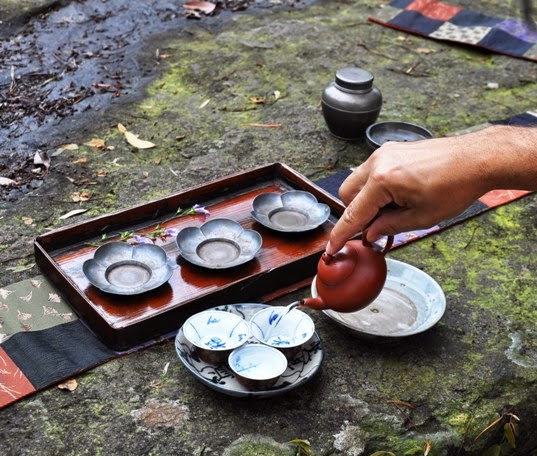
First, water was boiled in a clay kettle (diao), heated by glowing hot charcoal in a Nilu.

This hot water is then poured on the zhuni teapot and then inside it and also also in the bowl (Chaxi):
This hot water in the bowl is used to preheat and wash the teacups. Using 2 fingers, the brewer turns the cup(s) in the hot water behind the teapot
The third cup is handled alone. What's important when handling all the cups is to only touch the outside walls of the cups. Touching or holding the cup's inside would be seen as a mistake, since the goal is to clean the cup.
The hot water inside the teapot is emptied in the cups. That's when you see if you have a good fit between the size of your teapot and the size of your cups:
The empty teapot floats on the water in the bowl if it is light enough and a real Shuiping (water balanced)! This is where this teapot quality came into play. The lid either rests on the Jianshui (waste water bowl) or on the cups. The dry leaves were stored in the pewter caddy and we put them now in the teapot with our hand, in the middle of the teapot. In case of Wuyi Yancha, we would first crush 30% of the leaves and then add 70% of whole leaves on top in order to produce a very strong brew:
The boiling water is poured onto the leaves:
No rinsing. The tea was top quality. While the leaves brew, the water is emptied in the Jianshui.
As I prepare to pour, I slowly let my teapot glide over the rim of the Chaxi in order to leave any water inside the bowl. It's also possible to use a piece of fabric to let the teapot rest a couple of seconds to dry its bottom:
The tea is poured in the cups: 1, 2, 3, 2, 1 in order to make the brew even:
The cups are placed on their pewter saucers:
The tea is then presented to the guests on a tray (cha pan):
The guests drink their cup of tea in three sips at least (not in 1!), because they wish to enjoy the taste rather than just drink to quench their thirst. (品 means tasting and this Chinese character is composed of 3 mouths).
For this Chaozhou Gongfucha demonstration, I've used my winter Shan Lin Shi strongly roasted Hungshui Oolong. Fittingly, the sun came out as we were enjoying this tea and shone its bright and warming light!