Thursday, June 11, 2015

Innovations in the high mountains

 Last week, I had the visit of R. who lives in Fujian and spent a couple of weeks working with a tea farmer in Wuyi. He loves tea and wanted to experience how it's made. I guess this is the dream of most tea fans... What could be more beautiful and interesting than making your own tea surrounded by tea plantations, sunny weather in the mountains, in contact with nature? 

There are lots of tourist tours that let you touch the leaves at various stages of the process. But working 2-3 weeks shows a lot of commitment and perseverance. And you'll need a lot of that! Because the work of a tea maker is hard, very hard. And it takes a lot of skills that you can not pick up within weeks.
When you make tea, the leaves are like your baby. They are your priority. If they are only ready to be heated at 2 AM, that's when you have to process them! And as soon as one batch is done, the next leaves are coming already and the work starts again without much time to catch a break.

This job is so hard that you mostly see young guys performing it in the mountains. Most of them chew betel nuts, smoke cigarettes and drink very strong tea to stay awake. During the production season, they have to adapt to the leaves and can't have a regular day of work anymore.
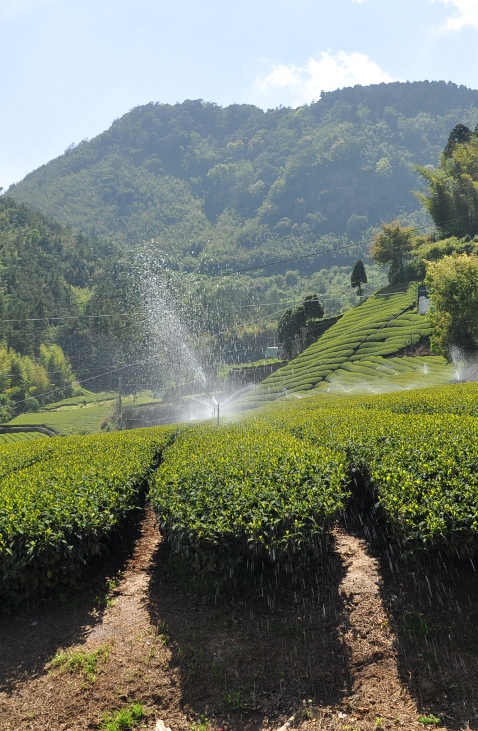
Tea farmers in Taiwan's high mountain need to continue to adapt to hostile conditions. This year, water sprinklers proved very valuable during the draught. Otherwise, this is what you get if you can't reach the tree with sufficient water:
The pictures of tea mountains are beautiful, but this beauty requires a lot of work and fewer and fewer young people are ready to work physically in the mountains. It starts with the pickers who harvest the leaves by hand.
Changshu Hu, Alishan area
After the picking, the leaves are brought to the nearby production site. There, they undergo some outdoors withering first, directly under the sun and in the shade.
Outdoor withering, under the sun and in the shade
This is a step that hasn't changed much. What has changed is indoors withering. R. had told me he wished more of the tasks were performed mechanically, because this would be more consistent than when it's made by someone inexperienced.
Traditionally, indoors withering is made on these round bamboo trays. While the leaves loose their moisture, the farmer and his team of workers will shuffle the leaves around several times, at regular intervals. The leaves are slightly bruised by this action and oxidize a little bit as a result.
But when you harvest several hundred pounds of leaves a day, that's a lot of work to shuffle all the leaves on these racks so often. Since there's a manpower shortage and since most high mountain Oolongs are made 'nuclear green' (with very low oxidation), this innovation is more like a natural development: the big indoor rack in an air conditioned (AC) room. (See picture below).

Most plantations have these big racks now. It's much easier to control the indoor withering of the leaves this way. The leaves are not shuffled anymore. And since the temperature can be kept constant with AC, this means that the quality of the leaves is more stable. Even the plantation on Fushou Shan has these! It makes sense if the leaves that have been harvested are of high quality and come already relatively dry (like this year). Such leaves are like a great piece of meat or fish: it's so good that it doesn't require much transformation.
We start to have problems with this method if the weather is more rainy or if we expect high mountain Oolongs that are a little bit more oxidized. Some oxidation is what adds sweetness and a nice aftertaste. It's also more gentle on the stomach.

One of my tea farmers in Changshu Hu uses both methods. He acknowledges the advantage of the big mats for the first batch of leaves that arrive quite dry. But he'll use the round bamboo racks for leaves that have more moisture, so that he can better control the withering process and add more taste (oxidation) through the gentle shuffling of the leaves!
Conclusion:

The big indoor withering rack system is a popular innovation that is now even spreading to the Wenshan (Bazhong) area! It allows for very lightly oxidized Oolong to be made in a more consistent manner and at a lower cost, by young guys with less experience and skills than older farmers.

However, there are also certain flavors that won't appear with this method. The characteristic of Oolong is to be be partially oxidized, not just very lightly oxidized. The first skill of an Oolong maker is to find the right oxidation level that brings out the flavors and preserves the spring freshness of the leaves. Such leaves are then also more suitable for roasting and long storage.

The paradox is that you this cost effective method makes most sense with expensive leaves from the highest elevations! And while I tend to prefer more traditionally made high mountain Oolongs, I don't think this is necessarily a bad innovation. It's a tool that is very suitable for certain conditions. Anyway, it's up to us to find the teas that suit us the most.

Tuesday, June 09, 2015

Stage de thé en Alsace du nord le 15 juillet

Voilà plus de 12 ans que je suis des cours de thé hebdomadaires avec Teaparker! Ce blog essaie de transmettre mes découvertes, mais il ne saurait remplacer l'interaction entre un maitre et ses élèves. C'est pourquoi, j'ai envie de vous proposer un stage d'une journée lors de mon séjour en Alsace cet été. Le but de ce stage est de vous permettre de faire des progrès dans votre technique de la préparation des Oolongs. Ce cours ne se limitera pas à des exposés théoriques ou à des dégustations de bonnes feuilles, mais sera interactif et centré sur votre apprentissage de l'infusion.
Date: 15 juillet 2015, de 9h à 18h.
Lieu: Schweighouse s/Moder (près de Haguenau, à 30km au nord de Strasbourg)
Nombre de participants: 8 maximum
Prix: 60 Euros (repas de midi compris).
Matériel : apportez votre gaiwan en porcelaine, 3 petites coupes (et 1 chaxi complet, si possible). Si vous n'avez pas de gaiwan, vous pouvez me passer commande avant le 24 juin.

Je reçois régulièrement la visite d'amateurs avertis et de professionnels du thé à Taiwan. Le gaiwan est alors l'instrument neutre qui nous permet d'évaluer le thé de la manière la plus objective possible.

Avec William de Bannacha, par exemple, hier, nous nous sommes penchés sur une beauté orientale de 2014 et ma Concubine Oolong de 2013.
La porcelaine est le matériau des pro. Mais qu'en est-il de la technique d'infusion? Quelles stratégies adoptées pour bien connaitre ses feuilles? Comment verser l'eau de manière harmonieuse? Quand arrêter l'infusion?... Nous verrons tout cela ensemble!
Il y a un mois, c'est Lydia Gautier qui est venue me voir à Taiwan. Lydia est experte en thé et l'auteure de nombreux livres sur le thé.
Après une visite aux jardins la maison Lin, nous sommes allés en-dehors de Taipei déguster des Oolongs de Dong Ding et de haute montagne.

Les Oolongs torréfiés sont les plus difficiles à infuser correctement. La lecture de mon guide fournit la théorie et un grand nombre d'astuces pratiques. (Je recommande que vous l'ayez lu avant le stage). Mais on apprend encore mieux si l'on voit faire et qu'on peut répéter immédiatement les mêmes gestes avec mes conseils.

Et une fois qu'on a le tour de main, c'est une question de pratique et d'entrainement. C'est un peu comme rouler en voiture. Au bout d'un moment, le passage des vitesses se fait instinctivement, à l'oreille, quand le moteur fait un certain bruit.

Le but ultime de la technique d'infusion, c'est de devenir un feeling, un instinct naturel. On en viendrait presque à l'oublier pour mieux se concentrer sur les plaisirs du thé.
Arriver à un maniement gracieux des ustensiles. La présentation esthétique du thé prépare l'esprit au voyage visuel, olfactif et gustatif.
Contactez-moi à mon adresse e-mail: stephane_erler@yahoo.com pour vous inscrire. Dites-moi si vous avez des questions, des thés ou des thèmes particuliers que vous voulez voir traités durant ce stage.

Mise à jour: Il ne reste plus qu'une place pour ce stage alsacien!

Le stage du 18/19 juillet se déroulera à Prague, en République Tchèque.
Sinon, je serai en Crête (près de Chania) du 29 juin au 3 juillet. Si certains d'entre vous êtes là-bas également, nous pourrions organiser une petite dégustation.
Lydia, paisible et heureuse comme une coupe de thé

Friday, June 05, 2015

Gathering for tea in NYC's Bryant Park

The sunny weather forecast convinced me to organize my NYC tea meeting outdoors. The Bryant Park would be a great place to have tea and connect with nature in this big city. And my Chabu, a Japanese obi, is such a good fit with the tulips! The light is fantastic and it feels so much more free and unbound than indoors.
The key to a successful Chaxi is preparation, so I come early and found a nice bench, long before lunch break, when the park gets crowded. I make a simple setup and decorate the Chabu with 3 x 3 postcards (which I will give away to the participants after the meeting is over).
It's not possible to make fire in the park, unfortunately. And since I don't have all my equipment with me, I decide to brew the only way that was practical here: with my thermos. This is far from ideal and I understand that it lacks the magic of witnessing the brewing process. So, I rely less on the process than on the tea in the thermos. Since the leaves remain inside, the trick is to choose them wisely for their endurance and their lack of defects when they get overbrewed (here, I use my 2006 wild Lincang puerh). And the second trick is not to use too many leaves, so that it won't get too strong.
I also brought water to share with everybody, so that we would first get our throats wet and clean before tasting the tea. The idea is to drink water (for thirst) and then taste tea (for its flavors).
Another little 'trick' I have when inviting people to have tea outdoors (when I'm not in Taiwan  and don't have access to all my wares) is to ask everybody to bring his own cup! It's one of the most overlooked piece of tea ware. While all eyes are on the teapot and the kettle, few pay much attention to the cup... But a cup has on tea the same effect than a glass on wine. Shape, material, color, thickness... all will impact the flavors of the tea.
From the cup, you can tell how much a tea drinker pays attention to details. And details are very important in tea! This also leads to this interesting experiment: I pour my puerh in each cup and we can all see how color and transparency were different in each cup.
We also smell that the tea felt stronger or sweeter in certain cups and lighter in others. In theory, cracked glaze would rather be smell absorbent, but if the cup has been used a lot and has absorbed a lot of flavors, then it could actually smell stronger. This probably explains why R's cup was so fragrant! (But then it's best to always use it for the same type of tea, like a clay teapot).
We talked about architecture, facial recognition, cups, Chinese translations while enjoying the long-lasting aftertaste of my puerh. It was a real pleasure meeting my NYC tea friends on such a short notice! Thank you so much for coming!
And 2 big thanks to 2 fellow tea bloggers:
1. Sara from Tea Happiness. It's a wonderful name for a blog! Actually, if you wonder what the calligraphy on my site means, one possible translation is "Tea Happiness"!
2. Nicole Martin from Tea for Me Please. I'm glad it was her day off from work and that she already wrote her own account of this Chaxi on her blog here.
PS: I took this fun picture before the start of the meeting:
See how this fly was fooled by the bright color of the postcard! It looks so real! (Did you know that you get a free tea postcard if you place an order on my online tea boutique! By the way, I have recently changed the 25 gr sample you get for free with any tea order of more than 60 USD: now it's this Sijichun Oolong from Zhushan. And if you purchase for more than 200 USD, then I'll upgrade the sample with 25 gr of this Oriental Beauty!)

In 3 weeks, I will be on my way to Europe, so the best is to place your spring order before June 24th!

Saturday, May 30, 2015

11 Madison Park

3 étoiles au guide Michelin, quatrième du classement des 50 meilleurs restaurants du monde, premier aux USA pour le Business Week, 'Eleven Madison Park' fut l'une de mes destinations gustatives à New York le mois dernier avec Teaparker. L'ambiance dans cette grande salle est très différente de Per Se (où nous étions allés l'an passé). C'est un peu plus lumineux (mais pas assez pour faire de bonnes photos au diner) et c'est plus vivant, plus bruyant. L'ambiance est moins romantique et plus décontractée, tout en restant très élégante.

Mais c'est surtout pour le plaisir des papilles que nous sommes venus! Le menu est long et nous dégustons chaque 'plat' par petites bouchées, comme nous dégusterions un grand thé, en petites gorgées.

Tout fut bon et certains plats furent divins (ces oeufs Benedict au caviar, l'asperge aux truffes...). L'utilisation de produits nobles permet effectivement de réaliser des merveilles. C'est comme pour le thé: quand les feuilles sont exceptionnelles, il est plus facile d'arriver à un bon résultat. Mais pour être à la pointe de la gastronomie, ce restaurant ne se contente pas d'employer des aliments fins. Il utilise aussi des légumes communs comme ce radis (voir la photo en haut) ou des carottes. Mais, primo, ils seront très frais (comme des bourgeons) et, secundo,  on les présente de manière très esthétique et/ou de manière innovante (comme ces carottes 'tartare' broyées comme du boeuf cru!)
La présentation compte pour beaucoup, mais l'important c'est quand même que le plat soit très bon au départ.

De cette belle et longue expérience gastronomique, je remarque de nombreux points communs avec la pratique du Chaxi pour le thé. Je profite d'un rayon de soleil pour vous remontrer ma préparation d'un Oolong de Da Yu Ling
Fraicheur et qualité exceptionnelle des feuilles. Préparé avec soin et professionalisme. Et servi de manière harmonieuse et plaisante. Le feeling de cet Oolong arrive au niveau d'un tel restaurant 3 étoiles. Et c'est 0 calories!
D'ailleurs, le point faible du 11 Madison Park, c'est leurs thés et leur eau trop chlorée. Il est d'ailleurs possible de commander du thé là-bas, mais pas plus d'un thé par table. Leur autre problème vient de leur poteries. Trop épaisses et grossières, elles absorbent trop les saveurs. (Nous leur avons donné ce feedback). Bref, même en amenant nos propres feuilles, le résultat fut bien inférieur à ce qu'on peut goûter chez soi. 
Le thé reste donc encore une boisson très peu connue de la grande gastronomie. Or, on peut y retrouver des sensations similaires de plénitude gustative. Les chefs jouent sur les alliances de saveurs, de couleurs et de textures. Pour le thé, le jeu consiste à préparer un seul ingrédient (le thé) de la meilleure manière possible.
Et arriver ainsi à la pureté et au sublime.
Boire mieux chez soi que dans un '3 étoiles'!
Note: ma sélection des Oolongs de haute montagne du printemps 2015 est complète. Pour profiter de leur fraicheur cet été, je vous recommande de passer commande (bien) avant le 25 juin, avant que je ne parte 1 mois en Europe. Actuellement, j'offre 25 gr de Si Ji Chun Oolong de 2014 pour toute commande de 60 USD ou plus. Et la livraison est offerte au-delà de 100 USD!

Thursday, May 28, 2015

Da Yu Ling, sorrow and joy

The locations of Oolong plantations on Taiwan's highest tea mountain, Da Yu Ling, are known by the number of kilometers on the Road #8. Here, for example, we have the sign for the 103 K(ilometer) mark. And I remember clearly taking some wonderful shots of the nearby plantation some 4 years ago very early in the morning.
I shall never forget the density and luminosity of the morning blue sky. It felt like NYC! Big tea bushes, tall white trees. Everything feels bigger, brighter and more energetic in Da Yu Ling!

This week, I drove back to 103K with all these memories in my head.
The sky was still blue, but the tea trees are gone,
they are gone, uprooted. (Partis, disparus, y'a plus!)
The leases on these lands expired and the government took them back. The primary reason for this action is to prevent erosion. That's why trees have been planted instead.
This didn't come as a surprise. I had received a warning by tea farmers in Alishan. They told me that Da Yu Ling plantations are being closed and that this impacts the volume (less) and price (higher) of Oolong from this famous tea mountain. I had to see it by myself to really believe somebody would do such a thing. It's a very strange experience: my brain kept on bringing up images of the majestic tea bushes in my mind, but I couldn't match them with what my eyes were seeing.
This uprooting of tea trees isn't just limited to the 103K location. It also took place at 104K.
And around 101K we can also see the uprooted lines of trees from a distance:
The good news is there are still a few remaining plantations on Da Yu Ling. There, the leases have not expired, yet, or they are outside the area to protect.

The access to these high plantations remains very difficult and tiring. So, to get to the one near 100K, you need to use a little train on a monorail!
Who wants a ride?

The view from a Da Yu Ling Oolong plantation is magnificent and not something you forget easily!
How long can we still enjoy Oolong from Da Yu Ling? Who knows? So let's drink it while we still have the opportunity! That's why, this spring, I selected 3 different lots from Da Yu Ling:

These are the leaves from the 100K plantation.

Cultivar: qingxin (ruanzhi) Oolong
Harvested by hand on May 12th, 2015.
Elevation: 2500 meters!

The color theme for my Chaxi is sky blue! The leaves touch the sky and we're almost in heaven! This is how it feels hiking in the plantation and how it should feel drinking this tea.

As you can see, I don't use many leaves, but I do use my silver teapot, which helps get more out of the leaves (thanks to its heat conductivity).
The cups are my light celadon singing cups. Today, I'm using the big model. 3 cups are a good fit for the 20 cl teapot.
 The tea feels pure, energetic, sweet...
 Simply perfect.
 The fine energy of spring on Da Yu Ling.
So good that cups are emptied before I have time to take my shot!
Perfect score for this 100K!