Tuesday, August 08, 2017

Un rêve de puerh devient réalité


Bourgeons de puerh d'arbre multi centenaire
De nos jours, ce serait quoi un jeune puerh de rêve? Essayons un instant de faire une liste de ce à quoi un tel puerh idéal pourrait ressembler:

- Il proviendrait de grands théiers sauvages anciens, plusieurs fois centenaires,
- Ces théiers pousseraient dans une forêt reculée du Yunnan,
- Les sols de cette forêt seraient rocailleux comme Lu Yu le préconise dans Cha Jing,
- Les feuilles seraient récoltées au printemps, lorsque leurs arômes sont les plus fins,
- Pas de mélange de feuilles d'origines diverses afin d'obtenir un goût très pur,
- Et pour plus de pureté encore, ces arbres anciens n'auraient encore jamais été récoltés de mêmoire d'homme!
- La production serait confiée à un expert de puerh local motivé autant, voire plus, par l'excellence du produit bien fait que par le gain matériel.


Arbre sauvage de puerh de plus de 500 ans
"Stéphane, tu es tombé sur la tête?! As-tu un peu trop forcé sur le vin d'Alsace lors de ton séjour en France? Cela fait plus de 10 ans que tu ne sélectionnes plus de jeune puerh du Yunnan, mais proposes des puerhs d'un certain âge, admirablement conservés à Taiwan et pour des prix tout à fait décents comparés à ce qui se pratique en Chine continentale! C'est quoi ce rêve fou de licorne du thé?"

C'est vrai qu'au début des années 2000, le Yunnan était l'eldorado pour les marchands Taiwanais. Ceux-ci y allaient trouver des fermiers tout juste libérés du monopole de la CNNP et y pressaient leurs propres galettes avec les meilleures feuilles qu'on puisse trouver. A cette époque, j'avais pu sélectionné des galettes de puerh sauvage d'Yiwu en 2003 et de Lincang en 2006. Mais les prix de chaque nouvelle récolte augmentaient chaque année, sous l'impulsion des nouveaux riches Chinois de Shanghai et Pékin. Et, tandis que les prix montaient, la qualité des puerhs anciens avait plutôt tendance à baisser: les arbres anciens, gu shu, sont surexploités. A cause des fréquentes récoltes on en vient même à les nourrir d'engrais, et à les entourer de clôtures pour les protéger. Bref, ils sont de moins en moins sauvages, malheureusement.

Mais la hausse du prix du puerh a pour conséquence heureuse (pour les buveurs et les populations locales) qu'il est dorénavant possible de développer économiquement l'exploitation de zones plus reculées, autrefois trop lointaines. Le bémol à cette évolution, c'est que les jolies histoires sont nombreuses et qu'il faut savoir raison garder.
"Alors, ce jeune puerh cru, il est comment? Rêve ou réalité?"

La meilleure façon de tester un thé, c'est l'infusion standard de compétition (3 grammes, 6 minutes) en porcelaine. Voyez vous-même mon compte-rendu de ce thé dans ma sélection. On peut pousser les feuilles plus encore en utilisant une théière en argent. Elle conduit et conserve au mieux la chaleur sans lisser le goût car l'argent n'a pas de pores.

J'ai pu déguster ce puerh à de nombreuses reprises en France et en Grande-Bretagne en juillet. Les mots qui revenaient le plus souvent furent: impressionnant, pureté, clarté, puissance, beauté... 
Ce rêve fou est donc une réalité aussi improbable qu'un arc-en-ciel dans un ciel bleu. Mon seul mérite est d'avoir saisi cette chance quand elle a fini par se présenter après plus de 10 ans d'espérance.

Friday, August 04, 2017

Alsace traditions and tea

I've now lived 21 years in Taiwan and every time I go back to Alsace, I better appreciate its culture and traditions. I've become more and more a tourist in my own home region and it's interesting to see the same things with my new Taiwan perspective.
These local crafts look as kitsch and colorful as the most modern designs! During my youth the colors of these pots would have looked much duller. It's good that tradition doesn't mean that things are frozen and can't adapt to today's fashion a little bit. But in a time when mobile phones don't last more than 2 or 3 years, it's a relief to see traditions with a longer sense of continuity between past, present and future. 
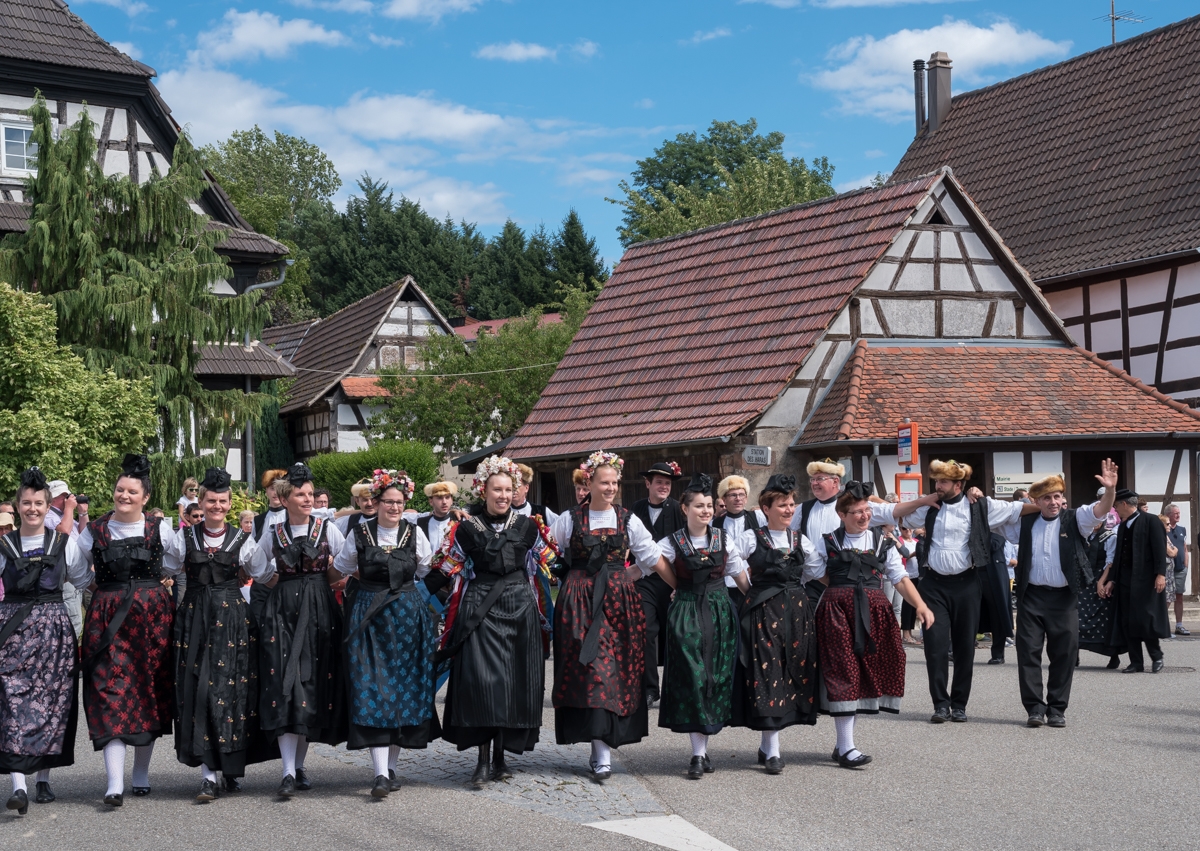
Traditions are basically a way to protect the past and transmit it to the next generation. The town of Seebach, for instance, hosts a yearly event of an Alsatian peasant wedding (called the Streisselhochzeit). The whole town transforms into a big wedding party and showcases traditional crafts, music and food from the 18th-19th century! 
Seebach traditional dresses
It's a unique opportunity to see that the Alsatian dresses would differ from town to town and that they evolved during the last 200 years. Nowadays, white wedding gowns have become international, erasing ancient wedding traditions in most big cities of the world... 
The wedded couple
The village of Seebach has been doing this showcase of traditions since 1982 and I'm glad that I finally got to see it in 2017! In previous years, this event was a mock, a fake wedding performed by actors. But this year, this couple wished to get married for real according to the ancient Seebach traditions! They received the applause and cheers of tens of thousands of guests and visitors! What a revival!
To preserve something you like, it can be useful to turn it into a habit and then the habit into a tradition. If people like what you're doing, they're going to imitate you and spread this habit/tradition.
Summer in Europe is the perfect time to enjoy tea outdoors, under the shade of a big tree. I've brewed many high mountain Oolongs on a Chaxi like this last month. 
That's my way of staying true and dedicated to the tea passion that I have developed in Taiwan. This is the most enjoyable way to taste tea, for me.
The Alsace wedding event shows that some traditions could be limited to just a couple of villages. So, it's perfectly OK to use your own ideas and creativity to achieve a unique setting/Chaxi.
This Yixing zhuni teapot brewed my fresh Oolongs with strength and grace.  If I had time, I would usually start with an Alishan Jinxuan, then a Lishan Qingxin Oolong before finishing with a Hung Shui Oolong or a Zhuo Yan Oolong.
A Chaxi is like a little wedding: It's turning what could have been an ordinary day in a something special, filled with love, pleasure and beauty!
Beer and wine are the Alsatian drinks that bring joy at local parties! But there's always a risk in their excess... There's much less problem with tea in this regard! 
Another benefit of a strong tradition is that it gives you a feeling of belonging somewhere, almost a purpose. With my Chaxi, I create a place where I feel well and at home. It doesn't matter if I create on in my Taipei apartment, in my parents' garden or in a tea mountain. Once I'm at my Chaxi, that's the center of my universe and the place I wish to be.
Of course, good things are never easy to obtain. Like for any tradition, it takes time and some money to rehearse the skills and purchase the right equipment/dresses. But this has the potential to make your life more special and meaningful than following the latest globalized trend.
Lishan Oolong
There's something else that Alsace's culinary and China's tea traditions have in common. They are both made of real local food coming directly from the farm or the vineyard! No artificial flavors where added to those genuine, big tea leaves! It's all grown by peasants, but this doesn't mean a lack of beauty or refinement. Century old Alsace and Fujian tea traditions shows that countryside people always had a keen sense for beauty and enjoying life!
Summer sunset in my village in Alsace

Tuesday, June 27, 2017

La modernité du thé de la dynastie Song

J'aime boire du thé avec tous les gens qui aiment boire le thé, et cela quelque soit leur origine, leur religion, leur convictions politiques, leurs habitudes alimentaires, sexuelles... Partager le plaisir d'une bonne coupe de thé est un tel acte de fraternité que je n'aime pas le gâcher par des sujets qui divisent.
Aussi, en règle général, je n'aime pas trop la confusion des genres et ce mouvement de politisation tout azimut. Je n'ai pas envie que le thé soit de droite ou de gauche ou du centre ou des extrêmes. Le thé doit rester la boisson universelle de tous. J'écris donc ces lignes sans sectarisme et sans désir de politiser ma boisson favorite.
Néanmoins, je trouve que l'histoire du thé nous permet de mieux comprendre les grands enjeux de notre humanité. Prenons le thé durant la dynastie Song (960-1279). La Chine était alors au faîte de sa gloire. Prospère et instruite, la Chine d'alors était technologiquement bien supérieure aux autres nations.
Que se passa-t-il alors avec le thé? Durant la dynastie Tang qui précéda, les feuilles de thé vert étaient broyées, mais moins finement,  et simplement cuites quelques secondes dans un chaudron, avec un peu de sel, avant qu'on ne partage cette boisson dans des bols plus petits.
La méthode Song va vers plus de finesse:
- pour faire le thé en poudre matcha, on ne récolte que les bourgeons, la partie la plus concentrée et qualitative de la plante. Agriculture bio et raisonnée. Transport facilité.
- Tout est bu: zéro déchet.
- la méthode de préparation est personnalisée: chacun son bol. Indivualisme au sein de la tradition.
- le fouet en bambou permet de faire ressortir la mousse du thé, le côté le plus onctueux et délicieux de ce thé. Plaisir.
- Quand on a tout bu, il reste le plaisir d'admirer les variations chromatiques de noir et de brun. La beauté du bol Jianyang est simple et moderne, mais profonde à la fois. Art.
Le thé de la Chine des Song montre la voie comment évoluer dans un monde de plus en plus riche. La réponse, c'est plus de qualité et moins de quantité. L'enjeu est de faire en sorte que la baisse de quantité est plus que compensée par une hausse de qualité. On peut alors continuer à parler de progrès. C'est le cas quand le plaisir augmente plus que le prix, par exemple. Pour cela, il faut avoir un palais sensible et expérimenté.
L'exemple venait du haut. L'empereur Song Huizong ne fit pas une loi, mais écrivit un traité du thé qui permet de propager cette méthode de préparation par l'exemple et le désir plutôt que par la coercition. 
J'espère que ces quelques reflexions ne vous auront pas apparu trop 'politiques'. Ceci n'est pas un non plus appel à ne boire que du matcha ou bien à monter en gamme dans vos thés si vous êtes étudiant et n'arrivez pas à boucler vos fins de mois! Ce sont juste quelques reflexions sur les parallèles entre nos problématiques alimentaires et économiques actuelles et le thé de la dynastie Song.
Etudier le thé des Song, c'est contempler la voie d'un avenir radieux et raffiné pour l'humanité!

Friday, June 23, 2017

The 2017 Chinese Porcelain Exhibition of the Tea Institute at Penn State. Day 3: black glazed bowls

The third day's subject were black glazed bowls from the Song dynasty (960-1279). The Song emperor had his made in Jianyang, in Fujian. But being popular at the court, they were made/reproduced all over China. Sometimes the kiln can be determined from the shape, design of the bowl, but the best way is to look at the unglazed foot. A lighter clay indicates a northern kiln, while the original Jianyang clay would be rich in iron oxide and therefore dark/red.

The beauty of the black glaze comes from its apparent simplicity (1 color: black) that contains with so many fine variations: hare's fur (see the modern bowl in the picture) or partridge feathers when the spots are round or lion fur when the bowl turns almost completely brown. These variations were difficult to control when the bowls were fired in saggars in long dragon kilns. The failure rate was very high, but the best pieces are amazing. Song black glaze almost as modern and abstract as Malevich's Black Square! In the many shades of black there's so much more to see than animal fur...
Jianyang bowl from the Met museum in NYC
In the afternoon, Teaparker's student Nancy demonstrated a Song dynasty style brewing for the first time on the American continent!

But before I come to it, let's look at the Jianyang bowl more in detail. There were several possible shapes for the bowl, but they were all designed taller, less shallow than Tang dynasty bowls. This was a practical matter, because if you whisk tea in a shallow bowl it will spill outside easily. A small foot is more elegant, but less stable. That's why the center of gravity is lowered by making the base thicker than the top. Then, there's the strange fact that the glaze stops above the foot (instead of trying to cover it). This is actually made on purpose as an indication for how little tea powder should be put at the bottom of the bowl. And finally, you may also notice that the top of the bowl is not evenly curved. 1 cm below the rim approximately there's a change in the shape. This is also some kind of visual clue for the brewer/whisker: that's where the limit for the pouring the water.
The Song dynasty technique was recorded by emperor Song Huizong (1082-1135) in his Treatise on tea, but this tea whisking tradition was discontinued in China. Teaparker is one of the rare tea scholars to have revived the original technique.

The Tea Institute at Penn State also has a group devoted to learn the Japanese Chanoyu (Omotesenke and Urasenke schools). Its members could see that the Song tea technique is different from what they are practicing, even if the matcha used is the same.

The key differences are:
- using an ewer to pour the water in the bowl while whisking at the same time,
- a lot of whisking and more water to create a thick layer of foam (like a cappuccino).

We then had students prepare the tea using the Japanese technique (less whisking and less water). Guess what style the great majority of the participants preferred? The Sung dynasty style way, because it didn't taste bitter, but smooth and harmonious.
An interesting discussion followed about the differences between the Chinese and the Japanese approach. At the very start of this discussion, Teaparker told the audience that he has the greatest respect for the longevity of Japan's Chanoyu. Unlike the Chinese, the Japanese were able to preserve their tradition until now. Without this big accomplishment, it wouldn't be possible to revive the Song dynasty tea tradition today. The Japanese were quite creative in adapting elements of Tang and Song to make it their own. However, in the process of establishing a beautiful and polite ritual, they lost sight of the essential concept: producing a good tasting bowl of tea. The tea students explained that the bitterness of the tea is a symbol for the human condition and our hard lives. But for Teaparker, this is just a bad excuse. Yes, life may be hard, but when we brew tea we seek pleasure. The goal of brewing is always tea happiness!
After this class, the Tea Institute had a little ceremony to name their tea house after Teaparker. This honor recognizes all the knowledge, expertise... that Teaparker has contributed to the Tea Institute over the last 6 years. And we hope this will continue for many more years!
After the event, we had several tea tastings during the master class (reserved for Tea Institute members). We tasted several WuYi Yan Cha and Teaparker taught the students how to smell and identify if a Yan Cha was made with several different cultivars.
We also had a proper Yan Cha that felt so amazing that just a few drops per cup were enough to enjoy and feel the difference!
On this Satuday night, State College was full of parties as there was a special blue on white football game. That's when State College's defense and offense teams play against each other. Many alumni came back to town for this event and the bars were all full with long lines in front of each.
The Tea Institute members couldn't care less! Most came back to the Teaparker Tea House after dinner for our nightly Chaxi!
Tatum brewed with Mahler's 5th symphony in background. This proved too relaxing for Jason! He missed some excellent roasted Oolong in the process...
We started the event at 10 AM and at 11:30 PM we were still brewing tea, kind of hoping all this tea pleasure would never stop!
Reminder: please place your tea orders on tea-masters.com now (before June 29) as I'll be off the whole month of July. 

Thursday, June 22, 2017

Spring 2017 Alishan Jinxuan Oolong

This April 16th, 2017 Jinxuan Oolong from Alishan is the most most affordable high mountain Oolong in my selection this year. While it's an excellent gift choice for Oolong beginners, it's also a nice everyday fresh tea for experienced drinkers.

I still tend to eat and drink great food or tea on special occasions only. Drinking Da Yu Ling or Lishan Oolong every day would end up being boring, I feel. Call me a reasoned Epicurean! Or maybe it's because I'd feel guilty to indulge in the very best teas every day?! 
But no matter the tea that is on the menu, it's always the same question: how do I get the most of these leaves? How do I make this moment the most meaningful?
My answer for this tea is summed up in this 'Refreshing Waves' Chaxi!
This round zhuni teapot makes a great job unfolding the leaves and releasing all the light aromas of this Jinxuan. If you have a great tool to improve your tea, it feels right to use it!
Jinxuan and qingxin Oolong are 2 different cultivars with different characters. If you're used to drinking High mountain Oolong made from qingxin Oolong leaves, this Jinxuan will feel lighter in taste with different fragrances. To enjoy it, you need to adjust your expectations. When you go to a guitar concert, you don't expect it to hear the sounds of a violin! While there are the similarities coming from the Alishan climate and soil, the Jinxuan cultivar has its own, lighter, character.
This lightness is actually a good match with the high mountain spring freshness of this tea. It's a simple pleasure, but very satisfying nonetheless.
And I feel my Chaxi has well captured the spirit of AliShan and its diverse vegetation!
Note: Place your order until June 29th (preferably a little bit earlier) before my month long holiday in Europe in July.