Monday, August 08, 2011

Stage de thé chez David Louveau de la Guigneraye

Vendredi 29 juillet, j'ai pu animer un stage de thé chez mon ami potier David Louveau à La Borne. L'ambiance de son atelier de poterie a permis de nous immerger facilement dans le monde des Oolongs de Taiwan.

Mais pour notre premier atelier, je décidai d'ouvrir les papilles de chacun avec une dégustation en semi-aveugle de 3 eaux minérales. Ayant chacun 2x3 gobelets, chacun devait retrouver les gobelets qui forment une paire. Parmi ces eaux, nous avons bien aimé la Roucous, la plus légère et la plus neutre ; nous avons aussi aimé la Wattwiller, à laquelle nous avons trouvé un goût un peu 'laiteux' et doux ; mais nous n'avons pas aimé le goût plâtreux et l'arrière-goût un peu amer de la Cristaline.
Durant le second atelier, j'ai fait une démonstration d'infusion en gaiwan/zhong/gaibei avant de laisser chacun l'occasion de pratiquer plusieurs fois cet instrument. Je choisis des Oolongs peu oxydés et non torréfiés de 4 saisons différentes pour nous exercer à découvrir les caractéristiques propres à chaque saison.

L'atmosphère est studieuse et détendue. Je réponds aux questions et partage mes petits 'trucs'. C'est aussi pour moi l'occasion d'être témoin de l'étonnement de certaines débutantes devant mes thés. Au départ, il y a une petite déception: les odeurs d'un Oolong de haute montagne sont moins puissantes que celles d'un thé parfumé. Même au goût, il n'y a pas de feu d'artifice. 'Je sens à peine le thé quand il passe dans la bouche', me dit Patricia, perplexe. Où est la qualité? En quoi est-ce un bon thé?
J'essaie de ne pas imposer une/ma réponse, mais demande à Patricia de maintenant se concentrer sur le goût qui reste en bouche. Elle remarque que ce goût fin et subtil continue à évoluer agréablement, autant sur la langue qu'au haut du palais. De plus, elle sent ce bien-être se propager dans tout le corps. Ce n'est pas un explosion de joie, mais une douce brise paisible.
J'ajoute que le point déterminant est effectivement la longueur de cet arrière goût et de toutes ces saveurs. Le bon thé est accepté par le corps, et c'est pourquoi il semble comme glisser dans la bouche et au fond de la gorge. Mais après ce passage furtif, les saveurs envahissent la bouche et nous accompagnent longtemps.

L'après-midi, nous avons parlé Cha Xi, exploré les saveurs de différents Hung Shui Oolongs et avons comparé ces thé infusés en gaiwan et théière zhuni d'Yixing. Pour ce faire, nous avons utilisé le tout nouveau set 'fleur de lotus' en porcelaine de David Louveau.

La torréfaction des Hung Shui Oolongs intensifie leurs saveurs. Aussi, un peu paradoxalement, certains débutants le préfèrent aux Oolongs frais et légers.

La particularité des Hung Shui Oolongs est l'équlibre entre le côté chaleureux de la torréfaction et la fraicheur du Oolong à sa base. Ce sont des thés qui peuvent très bien se conserver en Europe et évoluer avec beaucoup de grâce. Aussi, pour clore cette journée en beauté, j'ai infusé un Oolong de Dong Ding du printemps de 1980 aux sons d'un mini concert de viole de gambe! Magique.

Merci à Lucas pour nous avoir fait partager sa passion de la musique ancienne. C'était tout à fait dans l'esprit de cette journée de thé: faire revivre les traditions d'autrefois pour mieux nous guider sur le chemin du bonheur!
Encore merci à vous tous pour votre participation!

Thursday, August 04, 2011

Summer 2011 red tea in Fürstenberg porcelain

The above pot and cup come from the Fürstenberg manufacture in Germany. Established in 1747, it is the second oldest porcelain manufacture in Germany. (Theo oldest is Meissen, 1710).

This blue on white set is called 'Lottine', named after Duchess Philippine Charlotte, the founder's true love! Nowadays, this set is only produced in white, without the exquisite handpainted decoration (and is called old Fürstenberg).

This 1760 design represents an interesting mix of Chinese and European influences. The European customers continue to favor the classic blue on white porcelain. However, the paintings and designs take a new European approach. The flowers represent the refinement of European aristocrats.

The knob in shape of a rose is similar to the Herend (Hungary) teapot I used 2 years ago in France. It's on top of the pot and the focus of our attention.

The oval and refined shape of the handles of the pot and cups find their inspiration in the baroque and/or rococo movements. There's an element of grandeur, power and magnificience. At the same time, it's also a good symbol of the frivolous, happy life of the European courts before the American and French revolutions.

The high shape of the Lottine set shows that it wasn't designed for tea but for coffee! But this didn't prevent me from brewing tea in it! The 'rules' of tea brewing apply here too: a good preheating of the pot (and its cover) and the cups. However, to adapt my tea to this pot, I didn't fill it to the top.

I'm using a red tea (fully oxidized) picked by hand on the East coast of Taiwan.

Cultivar: Da Yeh Oolong
Harvest date: June 26, 2011. (See the previous winter version for more details).

The red fruit and honey flavors are intense and carry all the warmth and sweetness of Taiwan's summer! These intense fragrances burst like a bouquet of flowers and fruits. The clean and mellow aftertaste lingers graciously on the palate.

The big spent leaves are pretty impressive! I was able to get 3 very nice brews out of them using this Fürstenberg set. Using a gaiwan and a higher leaves to water ratio, you could get more brews. But I find that the tea came out well balanced using this relaxed method.

The clarity of the golden dark orange brew is shining in the white porcelain. This tea is so concentrated with fruity flavors, that it's a good fit to brew it more lightly than Oolong and use bigger cups with fine walls. The underlying honey sweetness of this particular red tea has surprised and seduced those who have tasted it. (I've added it to my selection!)

Tuesday, August 02, 2011

De Passage à Strasbourg

Nikosan a répondu à mon appel du 3 juin et m'a invité dans son lieu de travail et d'exposition du 120, Grand rue à Strasbourg. Cet endroit en mouvement s'appelle le Passage et est situé dans une petite cour intérieure du 16ème siècle, à deux pas de la Grand rue.

Nikosan a mis les bouchées doubles pour préparer ma venue. Les 2 pièces sont nickel et je pus rapidement installer des Cha Xi sur les tables. Sur la plus grande, nous dégustons au zhong. Nous commençons par mon Oolong de Lishan du printemps 2010. L'avis est unanime: c'est un thé qui a gardé tout sa fraicheur.

Puis, nous passons à la découverte de mon Hung Shui Oolong de Shan Lin Shi du 20 avril 2010. Sa torréfaction équilibrée a su donner plus de saveurs, de force et de chaleur tout en préservant la fraicheur et les parfums printaniers de cet Oolong de haute montagne.

Ce genre de thé est également susceptible d'évoluer positivement dans une jarre. J'en fis la démonstration auprès de ces amoureux du thé: j'infusai en parallèle des feuilles sorties de mon sachet en plastique et d'autres qui ont reposé 5 minutes dans une jarre en faience de la dynastie Ming. Le résultat: le Oolong issu de la jarre est plus doux et fin que celui du sachet. Et la différence fut très nette selon tous les participants.

Puis, j'invitai tout le monde à suivre une préparation plus lente et harmonieuse autour de ma théière en zhuni.

Un grand merci à tout ceux qui ont pu me voir durant mon passage. Merci notamment à Francine, Nicolas et Françoise d'être venu de Belgique juste pour cette rencontre. Et merci surtout à Nikosan pour ce lieu qui mêle création et thé au centre de Strasbourg, au centre de l'Europe!

Wednesday, July 27, 2011

White gold in the 'Favorite' Palace

The Favorite Palace is located near Rastatt, next to the Rhine river, in Germany. The margravine Sibylla Augusta von Baden-Baden (born von Sachsen-Lauenburg) built this summer palace from 1710 to 1712. She was wealthy and the widow of Louis the Turk, a general famous for defeating the turkish army in Vienna in 1683.

This baroque palace is also called a 'porcelain castle', because it contains so many pieces of porcelain from China and Europe. The main reception room mixes red alabaster with blue on white tiles made in Nüremberg. For a long time, it was believed that these were 'Delft' tiles, faience made in Holland and imitating Chinese qinghua porcelain. But they actually came from Germany.
(Picture courtesy of Schloss Favorite)

The palace also contains a great number of jars, plates, vases, cups... made of porcelain from Jingdezhen, De Hua and Meissen. They used to be diplayed in each room. Now they are mostly kept in an exhibition room in the top floor. (Pictures are not allowed). This fine porcelain collection was Sibylla Augusta's "white gold", her treasure. She was one of Meissen's first customers (Meissen is the first German porcelain manufacturer). And it's interesting to see how popular Chinese designs and art was at that time: in her collection, we can see both the Meissen made cup and the Chinese original cup it imitates! Yes, this was the 'good old time' when Europeans were imitating the Chinese!

This visit is a useful reminder that we are not the first Westerners to fall in love with Chinese porcelain and art. 300 years ago, the wealthy and powerful families of Europe were huge fans and collectors of Chinese tea and table wares. Thanks to their deep pockets, that's also the time when the finest qinghua porcelain was made.

Castles and museums in Europe offer great opportunities to discover these Chinese masterpieces. No need to go to China or Taiwan to admire such pieces! In Paris, for instance, I recommend the musée Guimet.

And next time you drink tea from a porcelain cup, remember that you are holding a piece of 'white gold' and that this is how only the European high society enjoyed life 300 years ago!

Saturday, July 23, 2011

Un été frais en France

Durant la première partie de mon séjour, je n'ai pu faire qu'une seule fois le thé dans le jardin. (Photo ci-contre). Ce jour-là, je fis du Oolong de haute montagne de printemps, rafraichissant.

Mais la plupart du temps, les températures oscillent autour de 20 degés seulement. Une envie de chaleur me tourne alors plutôt vers mes Hung Shui Oolongs, mon Oolong Concubine ou mon puerh sauvage cru. Ces thés apportent le soleil qui manque parfois à ce curieux mois de juillet alsacien 2011.

Ce sont aussi des thés qui nous transporte virtuellement, grâce à leurs saveurs, vers ces chaudes contrées d'Asie. Ainsi, j'ai beau être en France, mes thés me procurent les mêmes sensations qu'à Taiwan, le temps d'une bonne coupe de thé!

Saturday, July 16, 2011

Tea morning in France

My tea cups, Cha Tuo (saucers), teapot and Cha Bu have accompanied me to France. The other items come from my parents' collection. The white waste water bowl is a simple rice bowl, while the painted porcelain plate for the teapot comes from Meissen. Now that I'm back in Europe (for a month), I find it's quite alright to mix some European ceramics in my Cha Xi.

The other thing that has come with me are my teas! Today, I'm drinking some winter 2010 semi-wild Concubine Oolong.
(Note: Many readers have been asking ; I've tasted more than 10 summer 2011 Oriental Beauty teas this year, but haven't found the right one, yet. I'll resume my search in August).
And thanks to a mineral water low on minerals (Mt Roucous), I manage to get this tea as I know it. The cooler temperatures in France also add to the pleasure of drinking a mildly roasted Concubine Oolong.

I've brought a piece of Taiwan to France. It feels like home!

Thursday, July 07, 2011

Simplicité et retenue

La lecture d'un livre sur le Chado japonais m'a inspiré cette herbe verte à la place d'une fleur (ou d'un arrangement floral). Le maitre de thé japonais qui a fait le plus pour le 'moins', la simplicité, est Sen no Rikyu (1522-1591). Il voulait le thé accessible à tous. Il a privilégié les accessoires locaux et des petits espaces à thé peu décorés. Or, il fut le maitre à thé de Hideyoshi, un des guerriers les plus puissants de son époque. Comme il a du être tentant d'utiliser la magnificence et la grandeur pour en imposer aux autres! Il est donc fort admirable que malgré la fortune et la puissance politique à sa disposition, Rikyu ait choisi une voie simple et intérieure, véritablement exemplaire.
Ce Cha Xi est donc un mix de plusieurs influences, l'une qui vient empiéter sur l'autre (bambou sur Cha Bu!). La beauté de la courbe d'une simple herbe est à la portée de tous. Essayez, je vous garantis que vous serez ému par tant de grâce!

Monday, July 04, 2011

Life, Liberty and the Pursuit of (Tea) Happiness

On this 4th of July, I celebrate 15 years since I've moved to Taiwan! On this occasion, I want to write about the tea party I recently had with my American friend Jason (president of the Tea Institute at Penn State).

After a month of tea study in Taipei -and just before his departure-, I wanted him to experience not just the pursuit, but the achievement of tea happiness. This is, I feel, the best reward for the commitment and effort he has shown this month. Such an experience is also a good motivator to learn and practice more and more.

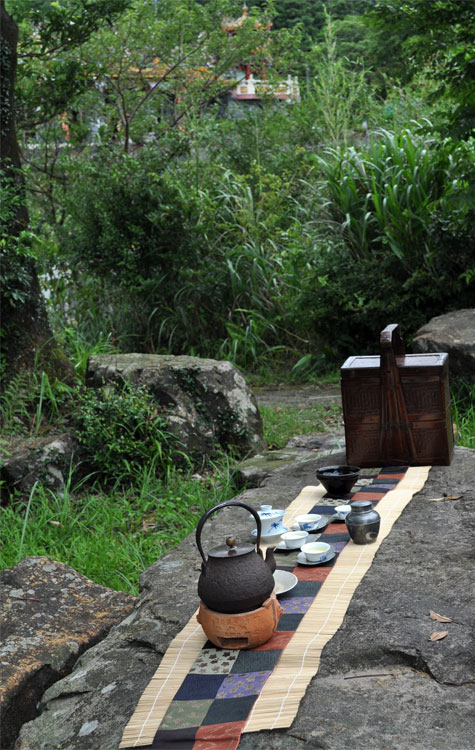
So, I took Jason to one of my favorite spot near Nan Shan temple in the Wenshan mountains. We started with the obligatory Wenshan Baozhong. Below, a picture of the spring 2011 'Subtropical forest' Baozhong we brewed.

Our water comes from a nearby spring. Fresh.
I unpack my accessories from an ancient, 2 levels, bamboo basket. Lovely.
The bamboo mat and kimono belt create a thin and long Cha Xi. Elegant.
A porcelain gaiwan lets us taste several teas. Neutral.
Pewter and porcelain tea jars protect the dry Oolong tea leaves. Fragile.

Great tea moments rarely happen by accident. They require Preparation, Practice and Patience. It's the right fit between high quality leaves, the proper accessories, sweet water, learned brewing skills and a quiet mind. There are many variables and no guarantee of success. Failures are part of the experience and road we have to travel. Let's learn from them, too. And let's be cheerful and thankful when we achieve such tea happiness, as here, in the Wenshan mountains!

Happy 4th of July!

Friday, July 01, 2011

Holiday Countdown

In 10 days, I'll board a flying dragon (a plane) that will take me to France (Japan was last year) for a month.

Reminder: If you need some more unroasted high mountain Oolong or green Bi Luo Chun to cool down this summer, now is the time to send me your order! Once I'm in France, I won't be able to send packages.
(I hope you like my latest Cha Bu!)