Thursday, September 20, 2012

The Quest for Oriental Beauty continues (Part 2)

 In the first part of my quest, I reviewed 4 different tea cultivars processed into Oriental Beauty. Today, I continue this quest with another 4 cultivars. The first 2 are products of Taiwan's tea research:
 1. Left - Taiwan No 19, Bi Yu (blue - jade)

This cultivar was obtained in 2004 by crossing qingxin oolong with jinxuan oolong. It is recommended to make Baozhong tea. This makes sense, since all these samples were obtained from the Wenshan area (famous for its Baozhongs).

Appearance: The leaves are greenish and with fur.
The smell is intoxicating, but it also has a tofu lu smell, which feels heavy and disturbing.

 2. Right - Taiwan No 13, Tsui Yu (emerald - jade)

This cultivar was obtained in 1981, at the same time as the jinxuan. It's also a more floral cultivar that can be processed into Baozhong, Oolong or even red tea. (I currently have one from Yi Guang Shan in my selection.)

Appearance: long and red dry leaves. Little fur.
The dry scents have the intoxicating scent I like and no defects.
 The brew of the Bi Yu is darker. Both have a good clarity (or turbidity if you want to use a more technical word).
Bi Yu vs Tsui Yu
The Bi Yu leaves appear darker than the Tsui Yu. The tea has a strong ripe smell that reminds me of soy sauce. The taste is weak and I feel my throat closing, which is a bad sign. This last problem could be a defect of production instead of weakness of the cultivar. Nevertheless, overall the Bi Yu doesn't seem to make a good Oriental Beauty.

The leaves of the Tsui Yu are very young. The fruity fragrance is clean and high pitched. The taste is mellow, but doesn't last very long. The tongue feels a little bit 'heavy', unclean afterwards (too much fertilizer, maybe).


Still, it beats the Bi Yu and shows why Tsui Yu is quite a popular cultivar nowadays. 

For the decoration, I'm having some fun using the small vases made by my children (in Yingge, with the help of a potter). This is what happens when Sponge Bob character Plankton inspires pottery! Kids love to play with clay and they are happy to see their works on my Cha Xi.

After 2 modern cultivars, let's taste 2 lesser known, local leaves:
3. Left - Tao Ren.

The leaves are dark, long and thin. We see few white buds. The dry smell is fruity with a hint of chocolate and quite pleasant.

The brew has a light orange color and a good clarity.

The scents are complex and ripe. But they lack elegance and finesse. 


4. Right - Man zhong

The dry colors are closer to a '5 colors tea', the synonym of Oriental Beauty. The many tips are very furry and large.

The dry smell feels too 'green'. The oxidation seems to have stopped too early.

The brew is darker and has a good clarity as well.
Tao Ren vs Man zhong
The Tao Ren Oriental Beauty is a mixed bag. It includes tips and older leaves. The taste is sweet and nice, but there are some wrong fragrances.
Tao Ren
The Man zhong leaves are smaller and orange. The fragrances are light and simple. The taste is sweet and there is a decent aftertaste. Unfortunately, it also leaves some unpleasant dryness in my throat.
Man zhong
I haven't spoken a word about the tea jassids. Oriental Beauty is mostly known for the fact that the leaves are bitten by these insects. But these tea jassids don't always come. On the leaves I have tasted, there was very little evidence of their bites. (I also remember that 2010 was a difficult year to find a good Oriental Beauty...)  Still, even without them, it's possible to produce Oriental Beauty!

This tasting didn't reveal a flawless Oriental Beauty. It shows, again, how varied Oriental Beauty can be from one cultivar to another. Tasting average Oriental Beauties could be a disappointment. What makes this interesting is the fact that we know the cultivar of each sample.
qinghua jar to store Oriental Beauty
(The quest will continue...)

Tuesday, September 18, 2012

RED - Rouge Extrême Délice


Cultivar: Qingxin/luanze Oolong
Origine: Mojiang, Yunnan, Chine

Altitude de la plantation: 1700 mètres
Récolté à la main au printemps 2012.
Process: feuilles oxydées presque entièrment (thé rouge).

Infusion en gaiwan en porcelaine ivoire. Eau bouillante chauffée (au gaz) dans une tetsubin.

 Je dépose délicatement les feuilles au milieu du gaibei en les faisant glisser de ma main. C'est un geste assez lent, puisque l'on cherche le calme pour mieux apprécier le thé.

Ce contact tactile entre la main et les feuilles vient enrichir l'expérience sensorielle de voir, sentir, puis entendre tomber les feuilles (et finalement goûter leurs arômes). Chaque thé a un toucher différent, comme la poignée de main varie d'une personne à une autre. Chez ce thé, je ressens immédiatement une force dure et souple, malgré la finesse des feuilles.

L'intimité entre moi et le thé commence par cette prise en main. Ce geste est une appropriation ; à l'opposé, il y a la frustration d'un signe "Ne pas toucher". Le thé m'appartient en faisant un avec mon corps. Je ne cherche pas à m'en distancer en évitant son contact. (D'ailleurs, je ne considère pas que les feuilles sont sales et ont besoin d'un rinçage!) La chaleur de ma main est un premier préchauffage.

"Si vous êtiez ces feuilles de thé, préferiez-vous glisser sur un tobbogan lisse et froid pour tomber brusquement dans le gaiwan? Ou bien préferiez-vous la sensation d'une main chaude qui vous bascule délicatement?" C'est ainsi que Teaparker répondit un jour à une amatrice de thé intriguée par l'absence d'ustensile pour ce geste!

Bien entendu, les mains propres s'imposent! (Le cuisinier aussi manipule les aliments mains nues).

L'infusion est d'une couleur orange dorée éclatante dans la grisaille automnale. La clarté de l'infusion est excellente.

Les feuilles sèches dégagent des fragrances si fines et intenses. On dirait un concerto pour violon. Les notes sont aigües et pures. Un charme pour le nez!

L'enchantement vient de ce que l'on retrouve toute cette finesse et ces notes pures et légères dans l'infusion! Les arômes sont ceux d'un parfum féminin séducteur et naturel. Il a la chaleur douce du thé rouge, mais aussi la fraicheur d'un thé de haute montagne. Le goût s'accorde en pureté et finesse avec les fragrances. Sa présence en bouche est longue et plaisante. Son Cha Qi, son effet sur le corps est puissant et chaleureux.
 La porcelaine de Dehua (Fujian) est aussi appelée 'Blanc de Chine'. Ce centre de porcelaine précède historiquement celui de Jingdezhen. Plus marquée autrefois, cette porcelaine a encore une teinte 'ivoire'. Le rendu des odeurs du thé dans cette coupe est naturel, doux et précis.
Le relief de la coupe représente 2 dragons en train de se disputer un ballon, une perle! A moins que ce ne soit la lune... C'est un motif traditionnel qu'on retrouve sur de nombreuses coupes chinoises. Il convient parfaitement en cette année du dragon, à moins de 2 semaines de la fête de la pleine lune! Elle apparait alors si rouge et ronde au-dessus de l'horizon, à la tombée de la nuit...
 On notera aussi la jolie transparence de la porcelaine. Elle laisse ressortir le dragon en relief.

Les feuilles ouvertes dévoilent leur qualité. La haute élévation de la plantation se traduit par des feuilles et des bourgeons de grande taille, épaisses et souples. Elles ont su donner le meilleur d'elles-mêmes pendant un grand nombre d'infusions. Constance dans l'excellence.

Ce thé rouge me transporte par-delà les nuages, vers la douce clarté lunaire. Thé rouge extrême. Délice fin et sans fin.

Cette impression d'infini, de pureté surnaturelle ouvre l'esprit au recueillement.
Petit vase réalisé par ma fille!

Friday, September 14, 2012

The Quest for Oriental Beauty (Part 1)


2 summers ago, I had trouble finding a good Oriental Beauty (in Hsinchu county). So, I expanded my search to the Wenshan area. The specialty there is mainly Baozhong tea. However, this region extending from Nangang to Shiding and Pinglin is home to some of the earliest tea farms on Taiwan. In summer, they also produce Oriental Beauty when the high temperatures call for higher oxidation.

As I spent time searching for a good batch, I was fortunate to meet a farmer who had been collecting various Oriental Beauty samples to educate his son (to take over his tea business one day). He noticed my interest for this tea and shared this collection with me! Each sample is a Wenshan Oriental Beauty made in the summer of 2010. But each sample is made with a different tea cultivar (and comes from a single batch).

White cultivar (Bai zhong)
Oriental Beauty Oolong has a great potential for aging if it is dried/roasted well. Highly oxidized leaves are less fragile during roasting. After 2 years in their air sealed foils, I am curious to taste these samples and find out which cultivar makes the best Oriental Beauty!

1. White cultivar (due to its white appearance)

The scents are light, even weak. Dry grass. The leaves seem a little humid. The leaves show many small white tips.
The brew is a little cloudy.
The taste is simple, fruity, but flat overall. No major defect, but no aftertaste.

Da Yeh Oolong
2. Da Yeh Oolong (big leaf Oolong).

Note: you will remember this cultivar used on the East Coast of Taiwan to produce red tea.

The dry smell is intoxicating and perfume like. The brew's scents are not as pleasing as the dry leaves, though. The taste has a slight defect. It's like there's something that is hard to swallow. A strange astringency, maybe. But the overall taste has more full body.

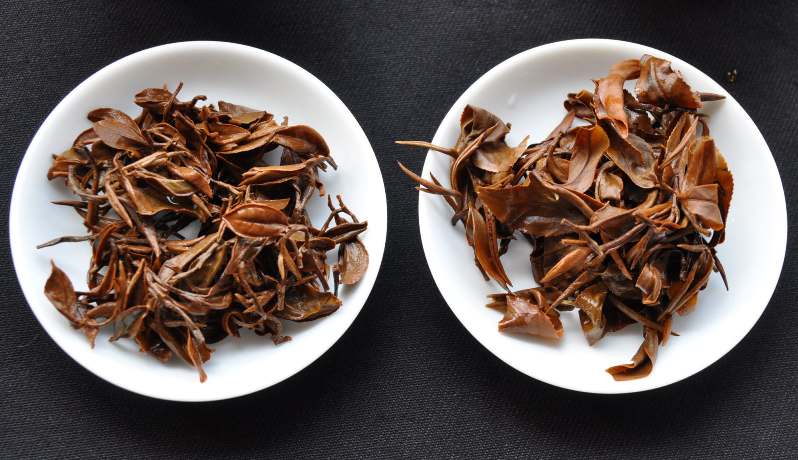
The open leaves of the white cultivar (right) are clearly smaller, more tippy than the Da Yeh Oolong leaves (right).
In a duel between these 2 cultivars, the Da Yeh Oolong wins on points thanks to its great scent and better taste. However, the white cultivar dry leaves appear higher grade at first sight, thanks to their small size and generous white fur. (Another name for Oriental Beauty is Bai Hao oolong, white hair Oolong!) This is why this white cultivar remains popular here: farmers can blend it with other cultivars to improve the overall appearance.
Chinese Moon Festival is approaching. That's why you can see some moon cakes as part of the decoration of my Cha Xi. As for the jar, since I am tasting two Oolongs at a time, I chose my Double Happiness qinghua jar!
For this contest, I use 2 white porcelain competition sets. 3 grams of tea brewed for 6 minutes.

Let's have another contest between 2 cultivars:

Bailu (left)
3. Bailu:
Readers of my blog might remember this cultivar. In spring 2008, I had a green tea from Wenshan made with such leaves. This cultivar is also known as Taiwan No 17. The Taiwan Tea Research Institute invented it in 1983. And, according to the Institute, this tea is particularly well suited for... Oriental Beauty! Let's see:

The visual aspect is very pleasant. Different vivid colors appear. The white hairy buds look very 'fat', thick.

The dry fragrance is very refined and has this almost alcoholic fragrance that aged Oriental Beauties project.
The brew has a wonderful transparency and color. It smells like fine lychee juice! The tastes is a little bit on the light side. There were no defects. And once I had well tasted the first cup, I drank the rest quickly and happily!


Jinxuan (right)
4. Jinxuan
The jinxuan cultivar is also a creation by the Taiwan's Tea Research Institute. Created in 1981, it has the number 12. You regularly find a couple Jinxuan cultivars in my selection. Right now, there is the Jinxuan Oolong from Zhu Shan and a spring 2012 Baozhong. Jinxuan cultivar is generally used to make low oxidized tea.

For this high oxidized Oriental Beauty, the dry fragrance also displays the 'alcoholic' scent, but, compared with the Bailu, the scent feels more fuzzy or rough.
 The dry leaves are long and thin.

The brew has a good clarity and is darker than the Bailu's. But the scents are weaker and very common. There is no elegance, purity here. And it leaves an unpleasant bitterness in the mouth.
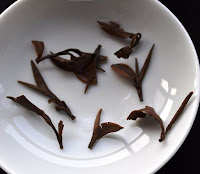
The open leaves of the Bailu are much smaller than the Jinxuan's. This time, the harvesting of buds has paid off in terms of quality of the tea. For the white cultivar, the small buds were not sufficient to be beat the Da Yeh Oolong. This shows the importance of the cultivar of a tea. That's the reason why you see me mentioning it so systematically.
Bailu
Jinxuan

After these contests, we have made great progress on our quest for an elegant and pure Oriental Beauty. Miss Bailu is the current champion.

It feels almost like a medieval tournament where knights fought one on one! (Ancient Chinese compared buds to spears!) So, after the fight, now would be the time to feast with delicious food... This traditional moon cake looks like it would pair perfectly with these Beauties.

This is also a Double Happiness: tea and moon cake! 
(More reviews will follow.)

Thursday, September 13, 2012

Cooling down in Taiwan's summer

The Chihkan Tower in Tainan was built on the foundations of the former Fort Provintia, the Dutch administrative fort built in 1653 in Tainan. The decorative designs is very similar to the Lin Mansion in Banciao. There is an exuberance of colors and detailed carvings. This is typical for southern Chinese architecture. The farther from the austere capital Beijing, the more colorful and fancy the designs.

But behind all the symbolism and aesthetics, I also notice the practical impact of this tall building. Like in the Lin Mansion, it feels noticeably cooler inside. It provided welcome relief to the hammering heat Taiwan experiences unabashedly every summer. And there are no electric fans or air conditioning.
 The ornament of the edges of the ridge are particularly intricate and beautiful. Elegant curves... 
And as this summer lingers on in Taipei, I often turn to my spring 2012 Alishan High Mountain Oolong.

It is my island of spring freshness represented by my green Cha Bu. Smelling the dry leaves transports my to 1600 meters high! The crisp air I breathe is filled with with flowers and green grass.
The sun shines bright and clear in each Dehua cup. The taste is sweet and warm, but the aftertaste turns to coolness. This simple pleasure brings more calm and freshness to my mind.
Hot High Mountain Oolong tea can have a longer lasting and more natural effect than a cold beverage! It feels like visiting the Chihkan Tower (instead of an air conditioned house).

Friday, September 07, 2012

Oolong aux orchidées


Cultivar: Luanze (qingxin) Oolong
Origine: Dong Ding, Nantou
Récolte: printemps 2005

Process: Hung Shui Oolong (torréfaction moyenne et douce). Puis, ces feuilles de thé ont été parfumées au contact de plusieurs milliers d'orchidées. La présence des fleurs suffit pour que le thé s'imprègne de leurs odeurs. Telle est la méthode traditionnelle. Aucun additif, parfum ou huile n'a été utilisé.

Ce thé fut conservé sous vide. Ce fut une production unique, destinée à une grande marque (de soins pour femmes) pour le lancement d'un de ses produits. Mais je préfère ne pas m'attarder sur l'histoire autour de ce thé. L'essentiel sont ces feuilles baignées d'une odeur fleurie délicate et raffinée.

3ème infusion
Pour bien l'infuser bien, j'opte pour la porcelaine (l'argent aurait été meilleur, mais trop rares sont ceux d'entre vous à avoir une telle théière...). D'habitude, avec le Oolong, on prend de quoi bien remplir le gaiwan et on fait des infusions courtes au départ. Mais ce thé n'est pas ordinaire ; j'en prends à peine 2 grammes (exceptionnellement, j'ai même fait la pesée!) et l'infuse 10 minutes!

Le résultat est sucré et soyeux. Une liqueur tout en rondeur glisse dans le palais et n'y laisse que des arômes chaleureux et fleuris. La frontière entre le thé et l'orchidée est abolie. On ne saurait dire où commence l'un et où s'arrête l'autre.
Telle est la raison pour laquelle je place mes coupes entre le Cha Bu et la natte de bambou. Ce thé se situe entre 2 mondes, fleurs d'orchidée et feuilles de thé. Le féminin fleuri et le masculin du Hung Shui Oolong. L'un complète l'autre. Les feuilles ajoutent un supplément de fines fragrances, tandis que le Oolong prolonge le bonheur de ces arômes en bouche. Une impression dorée, lumineuse et radieuse se maintient dans l'arrière-goût sans fin. Sucre candy!

Et elles sont nombreuses! On aurait pu penser que le thé serait épuisé après une première infusion si longue, mais j'en tire encore plusieurs de ces feuilles. On remarque que les tiges ont été triées et retirées de ce thé (cela concentre encore plus les arômes). Elles s'ouvrent complètement, signe que leur torréfaction fut longue et à basse température.

J'avais eu l'occasion de goûter ce thé en 2005. Avec le temps, les odeurs fleuries n'ont pratiquement pas perdu en intensité ou fraicheur. Par contre, le goût est devenu nettement plus moelleux et concentré.
Disponibilité réduite: maximum 25 grammes par personne.

Oncidium 'pluie d'or'