Tuesday, June 04, 2013

Oolongs above 2000 meters: into the Blue

Oolong plantation on Da Yu Ling
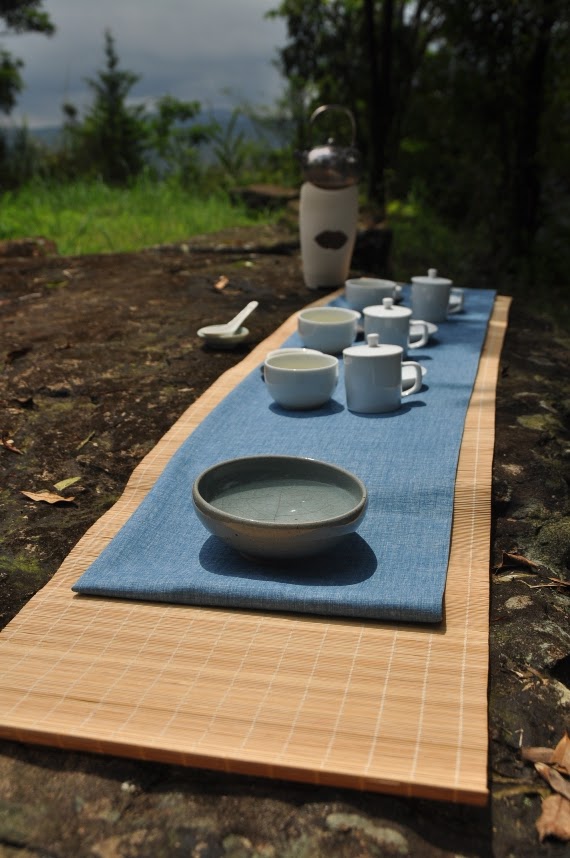
The perfect place to taste 3 High Mountain Oolongs: on top of a mountain in the Wenshan forest, near Pinglin.
On this familiar rock, I set up my Chaxi with 3 white porcelain competition sets to compare 3 mountains with plantations over 2000 meters high. The blue fabric on the bamboo mat symbolizes the intense and clear blue sky at such elevations.

From left to right, the teas are all luanze Oolong:

Origin: Lishan

Elevation: 2200 meters
Hand harvested on April 17th, 2013.

(Left on the Chaxi)
Origin: Da Yu Ling

Elevation: 2300 meters
Hand harvested on April 20th, 2013.

(In the middle of the Chaxi)


Origin: Qilai Shan

Elevation: 2050 meters
Hand harvested on May 10th, 2013.

(Right on the Chaxi)

There are some obvious visual differences for the dry leaves from these 3 different mountains. The Lishan seem biggest, while the Da Yu Ling leaves look the greenest.

Does this means that there are also big differences in the oxidation level. Let's find out! I'm brewing these leaves for 6 minutes:
Lishan, Da Yu Ling and Qilai
Amazingly, the 3 brews look very similar in terms of color, clarity and shine!
Lishan, Da Yu Ling and Qilai
The transparency (lack of turbidity) is a sign of quality that these 3 Oolongs share.
In the outdoors, it's more difficult to analyze a tea in great detail. And when you compare 3 at a time, what you remember are the main differences. Let me start with these impressions and then give you my tasting notes from other (indoor) tastings:

(Left) Lishan: Elegance

This tea is very sweet and light. Compared to the 2 others, it feels more 'elegant', very easy to drink. The Chaqi is very subtle and playful. On the first brew, it's almost beating the Da Yu Ling!

The fragrances are also the lightest and most flowery.  

It brings a clean, pure mouthfeel with a nice cooling sensation that is common to all these 3 high mountain Oolongs.

It has the finesse of a solo violin playing baroque music.


(Middle) Da Yu Ling: Power

Da Yu Ling has almost the same sweetness, but it packs more power in a still very harmonious way. The tea tastes thick without turning bitter. It's delicious and has the greatest durability/brewability.

This 'thickness' means also that this tea has a lot of complexity and evolves from brew to brew. Amazing!

This Oolong is more like a cello (played by Ma, Yo Yo!)


(Right). Qilai : Fruity

Qilai shan has the properties you'd expect from a top High Mountain Oolong. The sweetness and power are good. It has an added dryness which adds to the aftertaste. The fragrances feel a little more fruity, as the leaves seem slightly more oxidized.

Brewed with a competition set, the taste appears less 'elegant', less smooth than the 2 others. But if you brew it alone with greater care, than I have found that this is hardly noticeable.

Qilai would be closer to an organ instrument.
Tasting 3 top mountain Oolongs from this spring side by side is a chance to enjoy the character of each mountain. Compared with previous years, I have found that this character is something that doesn't change much.
The second brew was even a little bit stronger than the first. These Oolongs have very long leaves and it takes time to release all their fine and powerful flavors!
It's a pleasure to enjoy the clear blue sky and spring mountain air from each of these peaks!

Thursday, May 30, 2013

2013 Spring Jade Hung Shui Oolong from Zhu Shan


Cultivar: Jade (Tsui Yu/Cui Yu) Oolong (Taiwan Nr 13)
Origin: Zhu Shan, Nantou County, Taiwan
Harvested on March 20, 2013
Process: Ball shaped Oolong with medium roast.

Test brewing in a porcelain gaiwan and 3 classic cups. No weighing of the dry leaves and no timing of the brews.

1 - Appearance

The leaves are small with few stems and the color appears dark green. It looks very well sorted, the kind of process that is used for competition Oolong.
The color of the brew is dark yellow and has good clarity.

2 - Fragrances

The dry leaves have a very pleasant roasting scent that mixes well with the natural scent of the fresh tea. It's a familiar scent that transports you to one of those old Taiwanese tea shops that still roast their teas. These scents are quite intense thanks to the roasting. They combine fruity, honey and fresh sensations.

3 - Taste

It has a slight astringency and bitterness, but the taste that dominates is mellow and sweet. It has plenty of 'body' or structure to borrow from the wine tasting vocabulary. The roasting is most present in the first brew and it makes the tea feels stronger, riper and sweeter.

4 - Body sensations

The taste lingers for some time in the mouth and creates a smooth and warm feeling in the throat and down to the stomach.


Roasted Oolong leaves take longer to open up. With this tea, we see that the leaves expand and return almost to their original state. Even the color remains fairly green.

This is a sign of excellent roasting skills: the tea's flavors are stronger, the taste sweeter, and at the same time the freshness of the leaves is still well preserved. 

It doesn't have the elegance and fine notes of a high mountain Hung Shui Oolong, but it has almost everything else. 


Thanks to its low price, it's a tea that can be brewed daily, in a big or small teapot. Here I'm using a gaiwan for analysis, but this is a tea that would benefit from the use of an Yixing teapot.

One way to appreciate great teas is also to experience more humble teas from time to time, especially when they are so easy to drink.

This tea also offers a good opportunity to practice your brewing skills and try to make it taste the best it can. It won't break your heart (and your wallet) if you make a mistake.
My Chaxi is inspired by this union of green freshness and (roasted) warmth. Enjoy!

Tuesday, May 28, 2013

Retour en France cet été

Un petit mot pour vous annoncer mon séjour d'été en France cette année. De mi juillet à mi août, je serai dans l'Hexagone (et surtout en Alsace). Je ne pourrai donc pas m'occuper de vos commandes de thé et d'accessoires pendant cette période. Je n'ai encore aucun événement de prévu, mais compte bien organiser au moins une rencontre autour d'un Cha Xi dans la région d'Haguenau, au nord de Strasbourg. Je passerai voir mon ami David Louveau à La Borne, et espère à nouveau faire un thé dans le joli cadre d'un château. (Avis à tous mes lecteurs châtelains!...)

L'été est l'occasion rêvée de prendre le thé dans la nature. A Taiwan, aujourd'hui il fit 36 degrés à midi! Et, par cette température, ce ne sont pas les insectes qui manquent. Aussi, il vaut mieux être en pantalon qu'en short! Sinon, on devient le plat principal des moustiques, et ça c'est encore moins zen que de transpirer abondamment (comme j'ai pu en faire l'expérience!)
Xianpiao d'Yixing en glaise hungni

Friday, May 24, 2013

Japanese Tea - Free Style


This spring, between 2 tea events at the Tea Institute at Penn State, we had the pleasure to be invited for a bowl of Japanese tea, twice! The first time, Mary H., a senior tea student at Philadelphia's Urasenke school, performed a formal tea ceremony on the Institute's tatami mats.

The folding of the red cloth (fukusa) was done with grace and precision. Just that was quite a show and made me think of all the practice Mary must have had repeating all these steps so well. At first sight, it may seem that the Urasenke school is over doing it with this cloth:  What connection is there between this complex, traditional folding and the quality of the tea? I see several important connections: first, it teaches you an attention to details, to being graceful and the importance of clean ustensils. The second point is that this folding ceremony before the tea ceremony helps to calm down and focus your mind, so that you are getting ready to perform and enjoy your tea. All these strict rules in the Japanese ceremony help and guide the tea student to pay more attention to his/her tea brewing.

This tea was done in a very traditional, ceremonial way. The only way this experience could have been more authentic is if Mary (and us) had worn a kimono!


A couple of days later, Mr. Koike prepared a bowl of matcha for all the participants at this event. This 76 years young Japanese tea enthusiast is a big supporter of the Tea Institute. He feels it's important to learn and preserve the culture and traditions of Japanese tea. But he feels this knowledge isn't something that should make you feel constrained, uneasy. On the contrary, the main purpose of tea is to enjoy life and friendship. Tea should be part of this life, not something that feels separate and full of dust.

An Omotesenke school practitioner, Mr. Koike (like Mary) brought us Japanese sweets to pair with the matcha. But he didn't want to move to the tatami. It was more convenient to use this table and the Cha Xi set up by Teaparker. Mr. Koike simply whisked one bowl after another and, very quickly, we all could enjoy a bowl of matcha.

The essentials were preserved: water had reached a boil in the tetsubin, the tea quality was high, the bowls were clean and suitable for tea and Mr. Koike performed with the assurance of years of experience.

This Omotesenke style matcha looks and tastes very different from the Urasenke matcha. We can see that Omotesenke doesn't produce much foam, but still manages to well mix the green tea powder with the hot water. Mr. Koike's tea had its intented character. He made the complex seem simple, almost casual. This kind of improvisation could only succeed because he is a master of the formal technique.

A couple of weeks ago, I had the chance to have tea with another longtime Japanese tea master, my friend Kim. I took him to the hills of Tucheng to taste some of my spring Oolongs. But before that, I surprised him with my Sung dynasty tea equipment.

Kim is a teacher in Germany for the Uedo Sôko tradition. This school was founded by a samurai who had learned from Sen no Rikyû.

For Kim, this way of preparing matcha is 'free style'. And outdoors ceremonies are the hardest to perform, because the environment is so distracting and uncontrollable. Nevertheless, like with Mr. Koike and Mary, I was impressed by his ability to seamlessly calm down and focus on the tea preparation.
His tea was much stronger and thicker. It should be drunk in three and a half swallows. (The last half one is for the foam). It was exactly the boost of energy I needed!

We placed bamboo chasen in my zhuni teapot so that it would be blown away by the wind! And Kim folded a white tissue paper to serve as his fukusa to clean the bowl and hold the lid of the tetsubin.
The foam appears rich and this tradition intends to have a little foam elevation in the middle of the bowl. This is also the case for Sung dynasty tea. The straight whisking technique is also close to what I have learned. But this tradition uses less water, which makes for a more concentrated bowl. It's the 'green tea espresso' for strong men (and ancient samurai)!

Japanese matcha tea schools have the longest and strictest traditions. But we can see that their most experienced practitioners are able to go beyond and don't feel limited in what they can do. On the contrary, a good understanding of what's important in the technique helps them to adapt to various situations. It also gives them the means to be more creative with their Cha Xi arrangement.
To make tea part of your life and enjoy it fully, you first have to learn to master its traditions, and then practice it with your own, creative, free style.

Thursday, May 23, 2013

Yiguang Shan - 2 Luanze Oolongs

Luanze oolong sans torréfaction
Cultivar: Luanze (qingxin) oolong
Origine: Yiguang shan (entre Zhushan et Shan Lin Shi)
Elévation: 700 mètres
Récolte: le 31 mars 2013
Process: Oolong à oxydation légère, roulé en boule sans torréfaction.

Testé en mode de compétition: 3 grammes pour 6 minutes d'infusion en porcelaine blanche.

Hung Shui Oolong (= torréfié)
Ci-contre, il s'agit exactement du même thé que ci-dessus, mais cette fois-ci les feuilles ont été torréfiées de manière douce et lente. Aussi, il s'appelle Hung Shui Oolong, car son infusion est plus rougeâtre.

Jusqu'à présent, je n'avais proposé que la version torréfiée de ce thé (voir hiver 2011 et spring 2012). Cette année, j'ai trouvé la version fraiche très réussie avec son odeur particulière de groseilles à maquereaux. Le goût est légèrement fruité, sucré/acidulé et frais. Il a les qualités d'un bon Oolong de printemps de Taiwan. 
Version fraiche et version torréfiée

Préparé avec soin, cet Oolong frais peut presque passer pour un Oolong de haute montagne! Il peut être éducatif de le comparer à un Shan Lin Shi pour découvrir l'impact de l'élévation de la plantation. A Yiguang shan, on n'est plus en plaine, mais on n'est pas encore en haute montagne (il faut plus de 1000 mètres pour cela). Aussi, cet Oolong partage certaines caractéristiques des Oolongs de haute montagne, mais à un prix plus abordable. En contrepartie, ce qui lui manque c'est la force et la finesse des Gao Shan Cha. Ce n'est pas très grave si on s'en sert comme thé de bureau. (En préparation 'gongfu', on pourra compenser ces défauts avec un peu plus de feuilles pour la force et une technique 'douce' pour la finesse).

On remarque que les feuilles ne sont pas aussi grandes et épaisses qu'en haute montagne. L'oxydation est visible sur les bords des feuilles. Elle est plus importante qu'en haute montagne, car cela convient mieux au caractère de ces feuilles. La torréfaction, elle, donne une couleur plus brune à toute la feuille. Torréfiées, elles mettent aussi plus longtemps à s'ouvrir.
La version Hung Shui (à droite sur les photos) de ce printemps a un goût plus mielleux, moins crue que la version fraiche. La première infusion fait surtout ressortir ces notes de baguette grillée et aussi de pâte d'amande, dans une moindre mesure. Dans les infusions suivantes, le côté fruité apparaitra plus nettement et l'on finira par retrouver ces notes de groseilles.

Pour ce qu'on perd en fraicheur, la torréfaction ajoute en intensité aux odeurs et au goût du thé. Aussi, le Hung Shui Oolong convient bien à des infusions avec une eau plus dure. On remarquera moins les défauts de l'eau qu'avec la version fraiche et légère. Sa torréfaction permet aussi de bien stabiliser ce thé pour sa conservation.

Monday, May 20, 2013

The quiet language of tea


Do you feel that your tea changes from brew to brew? Not just that the leaves get depleted the more they are brewed, but that some brews come out better than others? This kind of experience is even more obvious in a tea class, when several people brew the same tea with the same water and same ware. The brews are never exactly the same. 

These 'differences' are the second, quiet language used by the tea leaves to communicate with us.

(The first, loud language are the flavors that come out pretty consistently for a certain tea and that reflect the nature of the tea, its soil, climate, production process...)

So, what does the tea want to tell us with this second language?  
The tea tells us how well we brewed the leaves. It's like a professor that gives you a grade. The grade may be low, but the message from the leaves is caring and full of hope: if you can hear (taste) this message, it means you have the power to improve your brewing technique.

Can the Holy Spirit help you become proficient in this tea language on this Pentecost day?! I don't think that tea is a language taught by the Holy Spirit! But what we can learn from people practicing faith is the calm, serenity and focus they use when they meditate, pray... There are no distractions, no iphone or computer that distracts their heart or mind. Let's bring this attitude to tea tasting.

The quieter you are, the louder the tea will speak to you. Then it's easier to distinguish this quiet voice that tells you how well you have brewed. You might then realize that being calm and focused also helps you to make better tea: you don't make technical mistakes (like forgetting to preheat your tea vessel), you take more time to analyze what kind of pour your leaves require or what flavors you want to make come out, and your pouring gesture is smoother.

Then, sometimes, it feels a miracle: you experience the perfect cup of tea. The tea flows inside your mouth as if it were a very light and pure water. Then the delicate flavors come out wave after wave. The mouth and throat feel clean and smooth despite all the richness of these flavors. And the body feels the comfortable effects of the tea for several minutes. Good quality tea is necessary, but not sufficient to enjoy this perfection. You also need to learn the quiet language of tea!

Enjoy a quiet Pentecost Tea time!

Friday, May 17, 2013

Les Trésors du Printemps 2013

Parmi tous les trésors que l'on peut trouver à Taiwan, il y en a deux qui ne finissent pas de me charmer et de me retenir ici. Le plus grand trésor sont ses heureux habitants, accueillants et généreux. Son second trésor pousse presque chaque saison dans les collines et montagnes de cette belle île. C'est au plus profond de la nature et au plus haut des sommets que l'on récolte les feuilles les plus précieuses. Elles sont la réunion d'un sol, d'un climat et du savoir-faire de producteurs de thé. (Sans ces hommes et femmes de Taiwan, il n'y aurait pas de thé: voilà aussi pourquoi ils sont le plus grand trésor de Taiwan).

La météo a une influence capitale sur la qualité récolte des thés. Ce printemps avait commencé tôt par un temps très sec et ensoleillé jusqu'à la mi mars. Par après, Taiwan a connu un temps très pluvieux, entrecoupé par quelques jours de beau temps par ci par là. De nombreuses récoltes se firent par mauvais temps, afin de ne pas rater le moment où apparaissent les bourgeons. Pour pallier à ces conditions difficiles, les fermiers ont du compter sur la chance d'éclaircies et leur savoir-faire pour transformer ces feuilles en thé. Trouver de bons Oolongs de haute montagne fut donc difficile: les différences entre un bon et un mauvais batch sont grandes. Les bonnes feuilles sont rares et de vrais trésors cette année! On ne les trouve pas par hasard, mais grâce à un travail de contact et d'étude sur de nombreuses années.

Luanze Oolong d'Alishan 2013
Aussi, j'ai la joie d'avoir pu mettre la main sur du Luanze/qingxin Oolong des 4 montagnes majeures de Taiwan, ce printemps. Chacune a son caractère et son charme. Da Yu Ling (2300 m) et Lishan (2200 m) sont les 2 grandes stars de ces plantations proches des étoiles! Puis, on a un Alishan (1500 m) et Shan Lin Shi (1200 m). Le Shan Lin Shi est le moins oxydé des 2, mais il n'en reste pas moins très moelleux et fin, alors que l'Alishan est plus  puissant. Pour goûter au caractère de la montagne d'Alishan à un meilleur prix, je vous propose aussi  un excellent Jinxuan d'Alishan.

 Il me reste encore un peu de Da Yu Ling d'hiver et des Jinxuan et qingxin Oolongs d'Alishan d'hiver. Voilà de belles opportunités pour comparer le goût des saisons au travers des mêmes feuilles d'un même terroir.

Cette année, j'ai ajouté un Luanze Oolong non torréfié d'Yiguang Shan (700 m) à ma sélection. Il s'agit d'un thé issu de la même récolte que le Hung Shui Oolong (torréfié). C'est l'occasion de comparer ces 2 thés pour comprendre l'impact d'une torréfaction moyenne sur le Oolong. Sans torréfaction, cet Oolong frais a des odeurs de groseille maquereau. Cet Oolong n'est pas de haute montagne (car il a moins de 1000 m), mais il est transformé de la même manière. Arriverez-vous à faire la différence?

Ces Oolongs de moindre altitude ne sont pas des thés d'exception, mais l'on peut passer du bon temps avec eux aussi. Un très bon exemple de torréfaction réussie nous vient d'un Hung Shui Oolong fait avec le cultivar jade oolong (prononcé tsui yu ou cui yu) récolté à Zhu Shan. C'est aussi là-bas que je trouve mon jinxuan Oolong dans la catégorie fraiche pour tous les jours.

Baozhong 'forêt subtropicale'
Du Wenshan, j'ai sélectionné mon Baozhong 'forêt subtropicale'. Fait également avec le cultivar le plus noble et traditionnel de Taiwan (le qingxin/luanze Oolong), ses arômes diffèrent encore des luanze Oolong ci-dessus à cause de leur terroir et de leur process un peu différent, sans roulage des feuilles.

A Wenshan, dans le nord de Taiwan, on trouve aussi un peu de thé vert. En plus du Biluochun de San Hsia (qingxin ganzhong), j'ai pris thé vert de Pinglin fait avec ce cultivar qingxin (luanze Oolong). Il est intéressant de sentir les puissantes fragrances de ces bourgeons à l'état de thé vert.

Comme toujours, vous pouvez consulter la liste de mes trésors ici. Et n'hésiter pas à me (re)demander cette liste en m'envoyant un mail à: stephane_erler@yahoo.com
Chaque thé est un voyage!