Thursday, October 24, 2013

Le numéro gagnant: 7542


Voici quelques puerhs crus compressés que j'ai pu acquérir ou recevoir gratuitement de grossistes ces dernières années. J'ai pu encore goûter bien plus d'échantillons chez divers importateurs Taiwanais ; ces derniers font ce genre de cadeau avec l'espoir que je vende leur thé par la suite. Cependant, rien de tout cela ne m'a suffisamment plu pour les ajouter à ma sélection de puerh. Ce travail de triage est mon exigence personnelle de ne pas vous faire perdre votre temps (et votre argent) avec des thés de qualité inférieure.

La vie est trop courte et le temps trop précieux pour boire des thés moyens! L'idéal, est de même pouvoir déguster ce qu'il y a de meilleur à un prix raisonnable. Tel est l'objectif avec cette galette 7542 de puerh cru de la CNNP, produite par Menghai en 1999.

7542 est la recette la plus célèbre et convoitée dans le monde du puerh de moins de 40 ans d'âge (ensuite, on trouvera 8582). La raison est que cette recette est ce qu'il y de plus proche de la galette à marque verte (Lüyin) plus ancienne. C'est un peu son héritière, sa sucession. De plus, avec le recul du temps, les amateurs de puerh ont pu mesurer le degré de bonification des galettes 7542.
Cette popularité entraine son lot de problèmes habituels en Chine: contrefaçon, désinformation et surexploitation de la marque. L'emballage est standard et ce qu'il y a de plus facile à copier. L'âge est souvent exagéré ou flou : au lieu de préciser que cette galette est de 1999, on pourrait pu dire qu'elle est des années 90s! Et après la privatisation des fabriques de puerh au début des années 2000, la qualité des galettes '7542' (et les autres numéros) a baissé, car le nouvel actionnaire voulait vite s'enrichir avec sa marque.
Avec une galette de 1999, nous avons donc l'une des dernières années où la qualité de la '7542' était encore stable et bonne. N'êtant pas trop vieux non plus, son prix n'a pas encore subi trop d'inflation comparé aux productions plus anciennes de cette recette. Et, comparé à certains puerhs 'haut de gamme' de cette année, on a déja la certitude que l'évolution dans le temps est bonne pour cette galette.
Pour déguster ce puerh aujourd'hui, j'utilise ma théière Xianpiao en hungni d'Yixing :

Sa forme simple, équilibrée et en rondeur rappelle la forme Shuiping étirée vers le haut. Sa taille est relativement petite avec 10.5 cl environ. Ainsi, elle a une plus faible 'consommation' de feuilles. Mais elle n'est pas trop petite au point de refroidir trop rapidement et donc de ne pas sortir le maximum des feuilles.

Le son aigü de ses parois indique une haute température de cuisson. Aussi, sa glaise est bien 'fermée', un peu poreuse sans être absorbante.
Son maniement est aisé et gracieux. L'écoulement est bon. Elle adoucit un peu les angles de ce puerh de 14 ans et lui donne plus de profondeur. Il apparait plus âgé qu'en gaiwan.
L'odeur de cave provient plus de l'emballage que de la galette elle-même. Son entreposage Taiwanais fut propre et sans fermentation manuelle, mais il est bienvenu de retrouver ainsi des odeurs anciennes. Les feuilles sèches ont un aspect clean et je ne les rince pas.
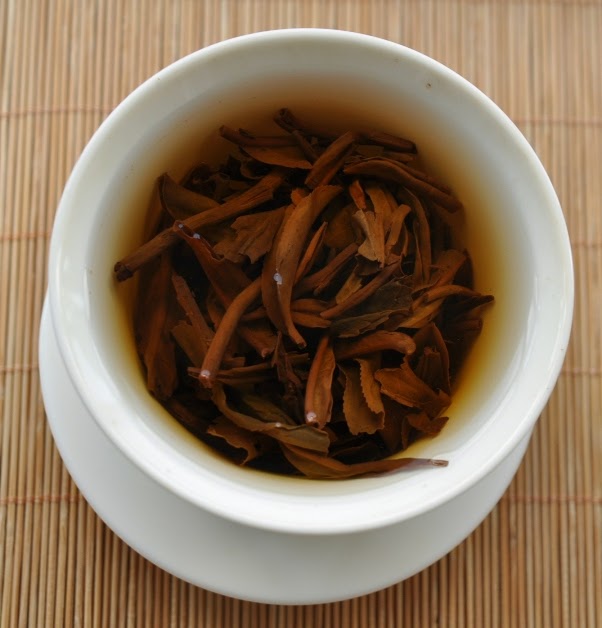
La puissance du chaqi de ce thé est telle que je sens tout mon corps chauffer et même transpirer lors des premières infusions! Les fragrances de l'infusion sont camphres, menthol et un manteau de feuilles d'automne. Les odeurs de jeunes côtoient encore les odeurs vieillies. Le goût est clean, mais riche et harmonieusement long. Au fil des infusions, il s'adoucit lentement. Ses feuilles infusées montrent une bonne portion de bourgeons (aux arômes les plus fins):
En cette journée grise d'octobre, ce puerh 7542 me me joue un sacré numéro! Et j'en redemande!

Wednesday, October 23, 2013

The spirit of various tea preparations

Sung, Ming, Qing dynaties and modern era tea methods
With these pictures of various tea sets, we can time travel and remind ourselves how tea used to be prepared. Let's characterize the methods of each period and see if we can find inspiration in this rich past.
Sung and Ming styles

Sung dynasty tea used to be steamed green tea, turned into powder and then whisked in a black bowl. For Kakuzo Okakura (The book of tea), this represents the romantic period of tea. Tea drinkers saw tea as a reflection of their spiritual journey. Why? Because tea is so sensitive to how it is whisked. Your state of mind is reflected in the tea you prepare. Zen meditation helps to control yourself and was intricately linked to the tea preparation. Zen is the spirit of Sung tea.

After the Yuan dynasty, it's a peasant who became Emperor Hongwu of the Ming dynasty. Starting 1391, he only accepts gifts of loose leaves tea (instead of compressed). Green tea was then brewed in big teapots. This marks a return to nature, to simplicity. Loose green tea is the least processed tea. It's therefore also the cheapest to produce and the most affordable for the population. The big teapot helps dilute the light, but concentrated flavors of spring tea buds. Drinking green tea is all about the natural purity and freshness of its taste that connects us to nature. Nature is the spirit of Ming tea.

Oolong is invented during the Qing dynasty and the Chaoshan region prepares this complex, semi-oxidized and roasted tea in a small Yixing, preferably zhuni, teapot, (or a shantou teapot) with water boiled in a small Nilu and 3 small porcelain ruoshen cups. The small size of the teaware demonstrates a search for quality and refinement. The spirit of Gongfu cha is minimalism and elegance rooted in the Chinese culture.
Qing and modern styles
The contribution of the modern (western) era is to bring rational rules and standards to tea brewing. Tea preparation becomes a science. The most standardized brewing is the competition brewing. You often read me preparing my teas this way: boiling water (98 degrees Celcius), 3 grams, 150 ml porcelain vessel, for 6 minutes. The spirit of this tea is reason.

Each method, each era has its pros and cons. We are privileged to live at the beginning of a new era, the information age, and we can learn the best from each period. This will help us create or adapt our own new brewing style.
For example, the rational approach of having a very standardized brewing process works very well to select and/or compare teas. This is true when we treat tea as a beverage, a simple commodity. It's like having a set of standard questions for meeting somebody (name, age, origin, where did you go to school, what's your occupation...) It is helpful in the beginning of the relationship. But once you get to know this person, you will start to treat it more and more individually. You'll go to a certain type of restaurants together or do certain activities or discuss certain topics with this particular person. Likewise, once you know a tea well, you'll tire of always brewing it the same way. You'll want to experiment and try what type of ware are the best fit, how long it prefers to brew. That's how you'll find the best way to brew these leaves.

So, the competition brewing standard helps you quickly to get to know the basic character and qualities of your tea. (I also recommend that you use standard and rational methods to compare tea cups, teapots, various water, kettles...)

It's a good start to learn about tea, but there is no skill in following a 'recipe' like a robot (7 grams, 30 seconds....) Even in recipes, you're supposed to judge on your own when a dish is ready. The cookbook may say 30 minutes at 200 degrees, but you might shorten or lengthen the time if your eyes tell you the crust isn't as it should be, or if the smell isn't well done yet.

So, at some point, you'll have to start using your senses to brew. This is the second step on the path to a great cup of tea.
You'll go even further if you find your inspiration in the quest for quality and refinement from the Chaoshan gongfu cha. You can also pursue very natural and pure flavors, like during Ming dynasty. Tea may even lead you to a more peaceful self if you use these moments of calm to connect body and mind... China's past shows us that tea is so much more than just a beverage!

Monday, October 21, 2013

Du thé en chemin : méthode d'infusion

Les méthodes d'infusion du thé sont nombreuses et variées. La classique traditionaliste est le gongfu cha. La simple et rustique est l'infusion dans le bol. L'anglaise est dans une grande théière en porcelaine. Le standard de compétition est 3 grammes pendant 6 minutes dans une tasse cylindrique de 15 cl...L'infusion en dilletante consiste à se préparer un thé très concentré, et de le couper avec de l'eau bouillante (d'un dispensateur d'eau chaude) dès qu'on a envie de boire du thé etc ... L'inconvénient de toutes ces méthodes est qu'elles se pratiquent difficilement lorsqu'on est chemin, loin de chez soi.

Or, durant les saisons fraiches, il est particulièrement réconfortant de se réchauffer avec une coupe de bon thé. C'est surtout le cas lorsqu'on passe du temps à l'extérieur. La solution pour pouvoir déguster du thé facilement en (presque) toutes circonstances, c'est le thermos!

C'est ce que je fis hier lors d'une promenade à la maison Lin de Banciao en compagnie d'Anne-Marie, une lectrice Belge passionnée de thé.
Bol noir de Michel François et coupe 'dragon'
Pour bien réussir ce type d'infusion et trouver du plaisir de la première à la dernière goutte, je vous recommande de bien choisir votre thé. Les plus fins et légers ne conviennent pas (exemple: thés verts, Oolongs de haute montagne non torréfiés...) On pourrait être tenté d'utiliser des feuilles de qualité et prix moyens, puisqu'on ne cherche pas à les préparer de manière optimale. Mais cela serait une erreur, car la méthode de l'infusion en thermos consiste à y laisser les feuilles. Elles vont donc infuser pendant plusieurs heures à haute température. Tous leurs arômes et toutes leurs saveurs vont donc sortir. C'est pourquoi la qualité est importante: on ne veut pas d'un thé qui devienne amer ou astringent.

Mais comme l'on va obtenir une infusion très concentrée, cette méthode ne requiert que très peu de feuilles. Ainsi, le coût d'un thé en thermos peut rester très raisonnable, et offrir des petites gorgées de plaisir étalées sur de nombreuses heures.
Hier, j'ai infusé mon Oolong Concubine organique de Feng Huang. Pour mes trajets en voitures, je prends mon puerh cru de Lincang de 2006 pour me donner la pêche. Coincé sur un siège étroit à 9000 mètres au-dessus de la terre, j'aime ressentir le calme harmonieux d'un de mes vieux puerh en vrac. Et pour un parcours matinal, mon Dian Hong me contente avec sa chaleurs et ses arômes gourmands. Un Hung Shui Oolong à forte torréfaction donne aussi de très bons résultats. Le faible dosage est la clé de la réussite. Il variera d'une personne à une autre, en fonction de vos goûts. Je ne peux donc pas donner de règle, mais juste un conseil de commencer vos tests avec vraiment très peu de feuilles et d'en rajouter la prochaine fois si vous avez trouvé votre infusion trop fade.

Comme vous le voyez sur les photos ci-dessus, je n'ai pas bu le thé dans la tasse qui sert de couvercle au thermos. Une coupe en porcelaine a un rendu bien meilleur que le plastique! Et elle ne prend pas beaucoup de place!

Il est parfois surprenant de redécouvrir ses thés, poussés ainsi dans des infusions extrèmes en longueur.  Le goût est accentué et tout semble magnifié, comme une musique jouée à puissance maximale.


Thursday, October 17, 2013

The most sought after 4 numbers in puerh: 7542


This new addition to my selection is the famous '7542' raw puerh cake. Many regard this cake as the follow-up to the  "Luyin" (green mark) puerh from the 60s. Having seen both next to each other, I must agree that both cakes look very similar when you look at their mix of dry leaves.

7542 is the name of the recipe.
'75' stands for the year when it was started: 1975.
'4' stands for a certain mix of leaves. In the case of this cake, 4 means a mix that contains smaller leaves and more buds that the '8582' cake, for instance.
'2' stands for the Menghai Tea Factory.
The buds are the easiest leaves to spot on a raw puerh cake: they keep the lighter yellow/gold color.

There are many pitfalls in finding a good '7542':
- Fakes: the more famous a puerh is, the more forgeries there are!
- Age: This is a recipe that has been produced year after year until now. How do you know its age when the wrapper stays the same?
- Quality of the leaves: Is this 7542 recipe stable in quality over the years?
- Storage: How clean was it? Did it go through a wodui (fake aging) period?
- Price : A high price is not a guarantee that it's real or good. Too good a bargain, though, is a sign of problems.
There is nothing written on this cake that tells us its age. My source says it's from spring 1999. To confirm this information, the best is to compare it to other puerhs that have the same age (more or less). From a visual point of view, it's the color of the puerh buds that will give the most clues about the age of the puerh. Because they turn brown very slowly. Second, the brew itself will also tell us how old it feels. That's where reliable samples are essential to provide good benchmarks to evaluate a puerh.
Visually, we can also tell that these leaves haven't been through a wodui process, otherwise their color would be much more evenly dark brown. We can also see that the wrapper is quite clean. There are no stains from water or tea the paper. The smell, on the other hand, points toward a typical old puerh storage scent: old wood, old basement smell.

 For this very first brewing, I have easily flaked 3 grams from the cake without breaking any leaf.

To get an accurate brew, I have opted for a simple porcelain gaiwan. My goal isn't to make the best brew today, but to get to know these leaves and confirm that they are legit (or not).

I want to push these leaves to their limits and test their quality. Quality will help determine if this is a real '7542' or a fake. 
Nevertheless, I can't resist using my Nilu on this cooler day. The red charcoals slowly heat my silver kettle. The silver will provide a very sharp and very hot water for these brews. The charcoals add a sweet scent and a very cosy, 'take it slow' atmosphere.

Indeed, there is no rush with my brews. Each lasts several minutes. No rinsing of the leaves, either, since the cake is clean.

In 1999, the CNNP company (China National Native Produce) is still a state company and hasn't been privatized, yet. It was still operating like it had for decades. The privation happened in the early 2000s and this major change probably explains why consequently the quality of this recipe diminished greatly afterwards: the new owners of the brand wanted a quick return on their investment...

The reputation of recent 7542 disappeared like steam in the air!
The first brew we obtain is dark red turning slightly brown. This color confirms that there is no cooked puerh mixed here (or the brew would be much darker).

The camphor and old wood scents are very powerful and persisting. The tea coats the whole mouth quite comfortably. There's still some sharpness and astringency due to its still young age. But despite this concentration, the brew tastes very smooth and clean overall. Its aftertaste is amazingly powerful. There are so many nice things happening in the mouth: salivation, releasing of sweetness in the throat... The stomach feels warm: good chaqi.
 Another important characteristic: the mouth and the tongue continue to feel 'clean' and light.
 The follow-up brews develop even more this clean and pure taste combined with these nice old raw puerh smells and the powerful aftertaste. This is a cake with lots of energy and a good balance.
 The quality of the brews and the endurance of the leaves convinces me that this is indeed a puerh of high quality. A real '7542' from the year 1999 that has been well stored in Taiwan.
 The open leaves all unfurl well and don't show any sign of having been artificially fermented. There's a generous amount of buds among these leaves. But there are also some thick stems. These are also quite nice to have, as I have experienced on the '8582'
Acquiring a cake or a sample of this puerh makes a lot of sense at the current market prices. Very old puerhs have so much increased in value these recent years that they have become very expensive. 'High quality' young puerhs are selling at relatively high prices and it isn't easy to tell their quality or how well they will age. This classic, iconic '7542', on the other hand, is already 14 years old (that's also 14 years less to wait) and comes at a very reasonable and attractive price for its launch. (It's 1 dollar per gram or less. Valid through 2013 only.)
Enjoy this classic puerh with age, character, power and harmony!
Update: For GN, here is a better picture of the neifei. (It's very difficult to remove without breaking it!)

Wednesday, October 16, 2013

Retrouvailles en montagne

La Chawan Exposition internationale est de passage à Kaohsiung (au sud de Taiwan) du 5 au 20 octobre. Une centaine de bols à thé de potiers du monde entier y sont exposés. De nombreux artisans ont pu faire le voyage, et c'est ainsi que j'ai pu revoir Patricia Cassone, céramiste française. Notre première rencontre date de ma présentation : "Le thé donne vie à la céramique" à La Borne.
 
 La semaine dernière, Patricia Cassone, une organisatrice taiwanaise de l'exposition et un couple de potiers chinois sont venus me rendre visite. Après un repas dans les montagnes, en plein air, j'ai insallé mon Chaxi 'haute montagne, ciel bleu'.

Tous ces potiers sont des buveurs de thé passionnés. C'était maintenant mon tour de leur montrer et faire goûter mon savoir-faire en matière de préparation de thé. J'avais un peu la pression, mais je réussis à réorienter mes pensées vers le bonheur de faire ce thé dans ce cadre, par une si belle journée.

Je choisis mon Alishan Luanze Oolong 'fin', cueilli le 2 octobre 2012, soit tout juste un an auparavant. Ses fragrances se transforment doucement en fleurs d'osmanthus, je trouve. De plus, comme il provient de la même époque de l'année, il résonne bien avec les odeurs des alentours. Il dégage une chaleur moelleuse, sucrée d'été indien différente des Oolongs printaniers.

Je voulais ainsi montrer à mes invités qu'un Oolong de haute montagne peut rester bon après un an si on l'a bien conservé et s'il a été bien fait au départ.

Visiblement, ce couple de potiers de Henan a bien apprécié la pureté du goût de cet Oolong!
 Et Patricia Cassone également!
 Le second (et dernier) thé sera un Oolong torréfié. J'en proposai 3: le Dong Ding de compétition de ce printemps, le Hung Shui Oolong de Shan Lin Shi du printemps 2011 et le GueiFei Oolong d'Alishan de ce printemps. Après délibérations, l'organisatrice Taiwanaise a convaincu les autres que cet Oolong Guei Fei est très rare, car il dépend aussi de la morsure d'un petit criquet vert, et qu'il fallait absolument y goûter!
 Je profitai aussi de ce thé pour varier les bouilloires: argent, puis inox, puis argent. Tous constatèrent que la bouilloire en argent donne des meilleurs résultats que la bouilloire en inox. Le choix des accessoires est un point déterminant de la qualité de l'infusion. L'esthétique de l'objet n'est pas le point essentiel. L'important est l'affinité entre le thé et ses accessoires.