Last Saturday, I had the privilege to meet Lin Chen-Long, a famous Taiwanese ceramic artist who lives and works in the mountains south of Tucheng (in New Taipei City). The very first thing he did was brewing some tea in his tea pot, on the tea tray he fired and then pouring the tea in the pitchers and cups he made! This is the kind of ceramic artist we appreciate most: he's not just making abstract art, but also tea ware that he's using in his everyday life!
Lin Chen-Long was born in 1955 in Lugu, the town that is holding the Dong Ding Oolong competition. So, it's not a surprise that he would create so much tea ware! That day, he prepare a zhuoyan (jassid bitten) Oolong in his teapot and this is how it looked in his qinghua cup.
Teaparker organized this meeting for his tea students that day.
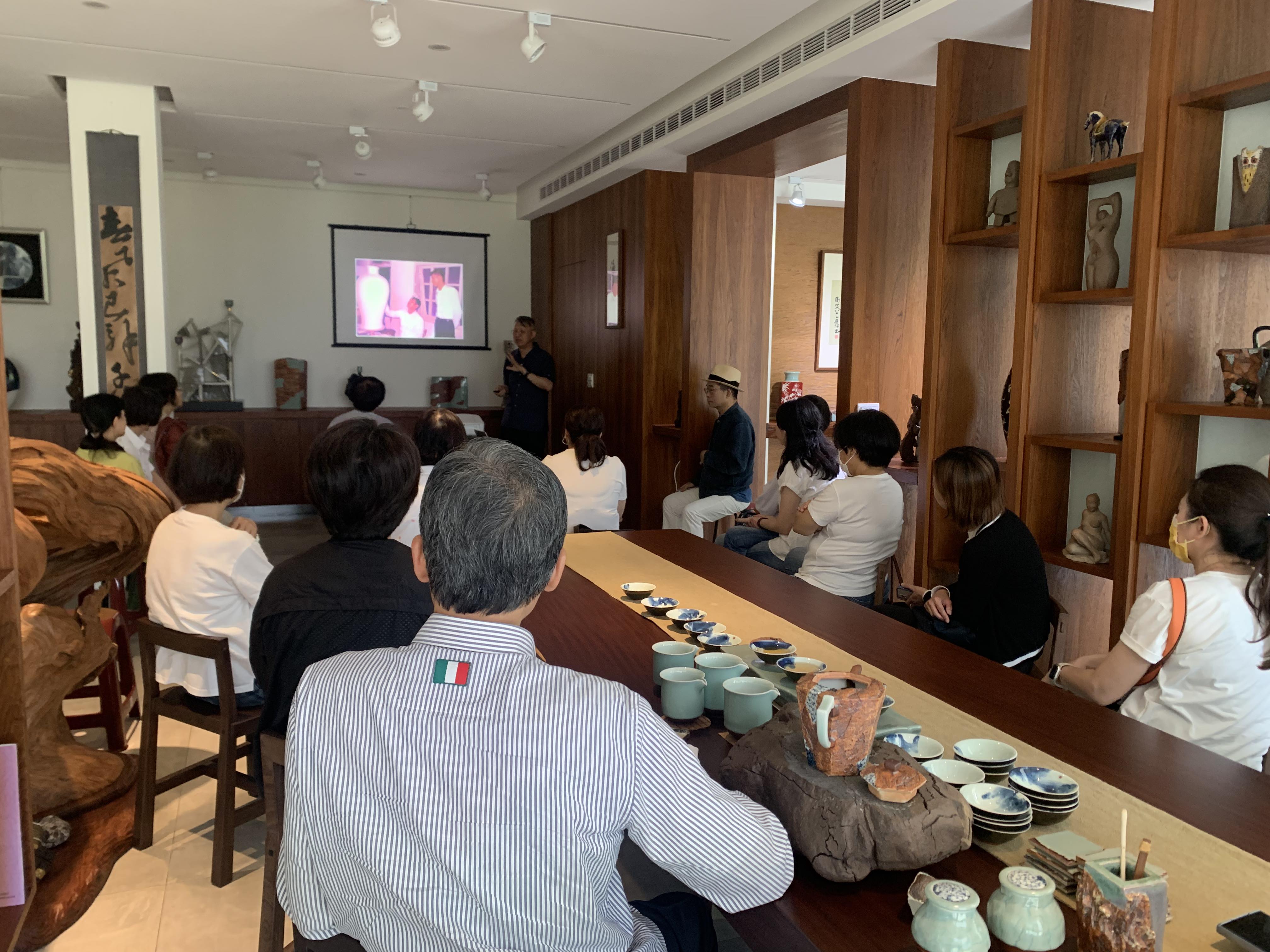
Here we are listening to M. Lin's presentation of his career.
He started at a pottery at a young age, his parents too poor to send him to university. But he loved creating shapes from mud so much that it quickly became his passion. In the early years, he was doing a lot of imitation of antique potteries, like Tang tri-color horses.
 |
| Lin Chen-Long is in the middle |
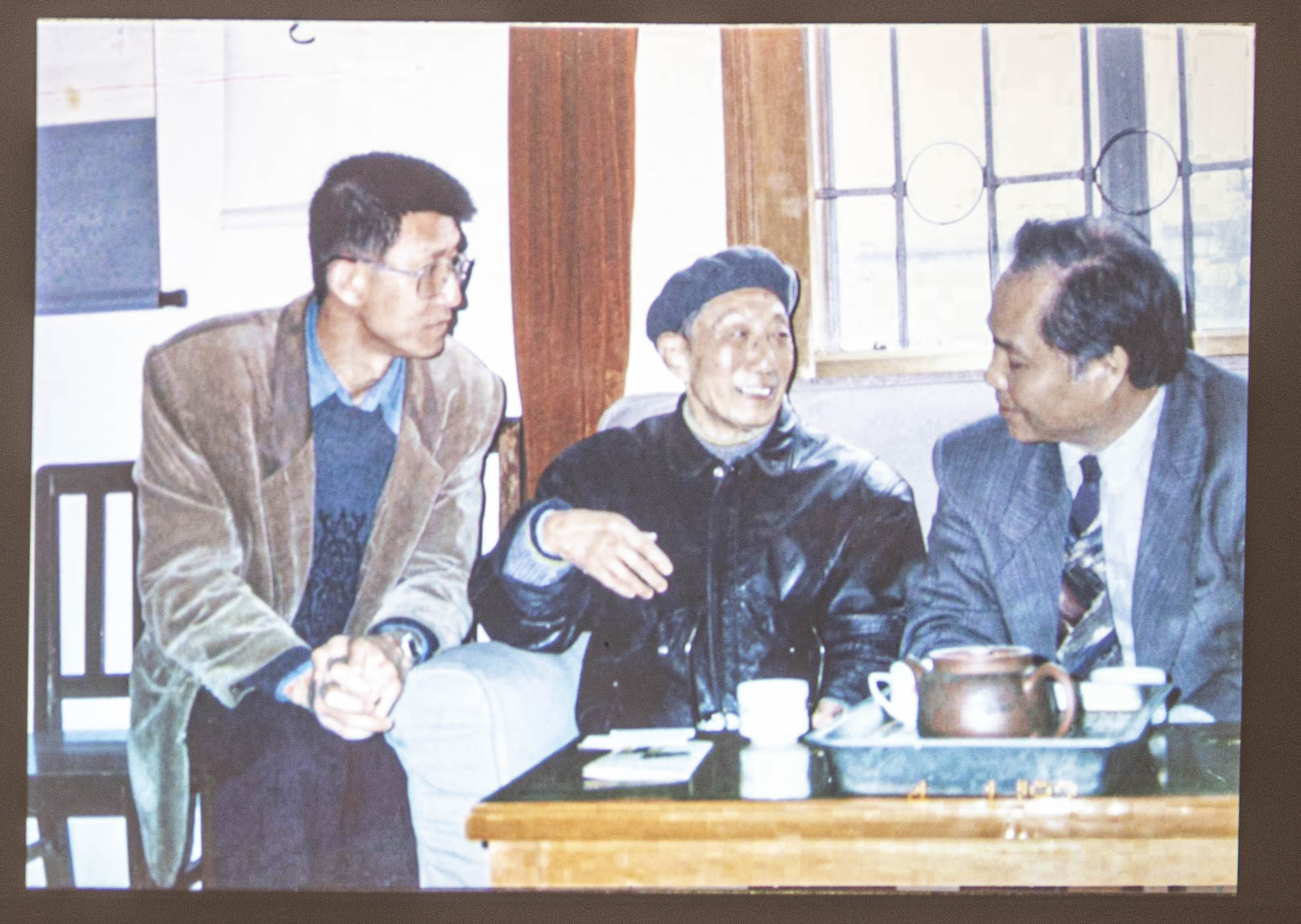
He was starting from scratch and had to learn a lot from artists and other potters. Below, we can see that he met with the most famous Yixing artist Gu Jingzhou (1915-1996) when he visited China in 1992.
These are all the tools that a zisha teapot maker may use to make a teapot. M. Lin was quite amazed by the level of skill that was required to make an Yixing teapot!
M. Lin was also fascinated by the use of large containers that enable potters to keep their wares wet for months, so that they may continue to work on them as it pleases them.
In his learning period, M. Lin Chen-Long also invited countless famous artists to cooperate with him. They would paint on ceramics he would create for their works. This enabled him to meet and interact with many painters, calligraphers and poets. M. Lin gave them a new medium (ceramics) to express their art and he was able to see their creative process at work.
The next vase shows that M. Lin had achieved a good command of various porcelain styles: celadon, qinghua, cracked (ge) and red.
Then came M. Lin started to be creative on his own and one of his first theme was inspired by a walk near a water reservoir. He noticed the beautiful, calm, green water surface next to eroded stones. And this has inspired lots of works. Here a detail that catches the contrast:
And here is the whole piece, framed like a painting, even though it's a ceramic! Indeed, it can be enjoyed like a painting, at different levels. The bluish green celadon is very calming to watch. The barren soil creates unease, but it's not worthless. There are a few gold spots! Hope?
The next vase continues this coexistence of cracked pottery and cracked qinghua (underglazed blue on white) porcelain. It is quite a bold statement to make cracks such a central piece of one's work for a ceramist. After all, a crack is the imperfection that every potter fears and strives to avoid. So, it's a powerful symbol of humility. The coexistence of different textures, colors while still achieving harmony is also full of positive meaning.
The next vase continues to explore these cracks that connect different colors. This one pays homage to
Ge (or Ko) ware, a cracked white style from the Sung dynasty (960-1276).
Then M. Lin also created works in the shape of books in a theme called 'clean (pure) soil pottery books'. He would again mix several techniques on the same work. Here, we have the clean celadon surface with a pottery that looks as if a stone had somehow grown on the book.
Instead of having cracks, we have layers of soil, like in a river that has run partially dry. Here, the celadon is the white page and the rock the content that we must read. And despite their differences, the combination of both textures and colors works well to achieve harmony and meaning.
The next work is again based on cracks and is from the Clay Land Series (I think, based on other similar works features in the magazine that features M. Lin next):
This magazine was published for celebration of the 100 years of the Republic of China (in 2011): 100 years Taiwan artists, Lin Chen-Long, 2 valleys.
The abstract work on the cover is, like the one below, from the Space/Glazing series. The fine round tubes are tricky to fire. This kind of new work required that M. Lin Chen-Long continued to innovate to make it stand. This time, the concepts of space and interconnections are at the center of these works. But what about the tea cups on top of the tubular structure?
My personal explanation would be that the tea cup is the highest pursuit in life. The tea cup is the crown achievement of a day, as it combines water, fire (to heat), leaf and soil (for the teaware). The explanation that M. Lin suggested is similar: he wanted to add an element that would symbolize his (Chinese) culture. The tea cup (without handle) or the tea bowl are great symbols, according to him, and their harmonious shape and color variations enable him to be very creative in choosing the right cup for each work.
Lin Chen-Long is working on a new interesting project. Let's step out of his gallery, enjoy the view of his garden on top of 2 valleys (hence the name of his ceramic studio) and take a right turn along a small path in the forest to his studio. We arrive at his gas kiln, ready to fire the next artwork.
We also notice this big machine. It's a stone and rock grinder. It turns hard clay/stones into powder, so that it can be mixed with water and become a humid clay that can be shaped.
In the background you can see works from previous periods, but what M. Lin is holding is part of his latest creations. He's showing us how stones evolve when fired in his kiln. The 2 stones he's holding are actually the same, but in his right hand it has been fired at about 1180 degrees Celsius in his kiln. It now looks inflated, very cracked and like cold lava.
You can see these two stones more clearly below. M. Lin explains that each stone will react differently in the kiln. For some the change is radical. for fossil tree stones, however, the heat makes no difference. But when we look at these natural cracks, we can understand that M. Lin would be so fascinated by them. They resonate with his early works.
So, Lin Chen-Long has now combined these "fired stones" into his Space series. The contrast between the rectangular shape of the celadon and the free shape of the stone creates maximum drama.
And he's also using the stones on their own with ceramics on top and on parts of the stone.
This one looks like a mountain with gold and celadon that add contrast of colors and surface.
The next piece reminds me a little bit of the martial arts poses sculpted in stone by Ju Ming, another Taiwanese artist who died very recently (on April 22nd, 2023) were it not for the celadon cup on top.
The more the master refines his art, the lighter seems his touch. He has found to express the roughness of nature in a harmonious way. And even the thick celadon clay feels very natural and linked to the very origin of Chinese ceramics.
M. Lin's exhibition at the Yixing ceramic museum in China was interrupted by the start of Covid, but he's been re-invited to go there and he will bring new works that he has created with Yixing clay he got from his earlier trip there.
So, I was very glad to have met this ceramist who is acclaimed on both sides of the straits. And I brought a little French thing that I fired around 210 degrees Celsius in my oven: an apple pie!
 |
| M. Lin Chen-Long, Teaparker and Stéphane Erler |
The heat/fire helps to transform clay, stones and dough into something with a new consistency and new harmony! Thanks for your exploration of all these possibilities, M. Lin! It was a pleasure meeting you and enjoying a tea party with many of Teaparker's students next to your studio!
Announcement for tea drinkers: The spring 2023 harvests of
Wenshan Baozhong and
high mountain Oolong (3 Alishan, so far) are already available on my online boutique! Every purchase you make supports my blog and my endeavors to share Taiwan and China's tea culture with the Western worlds. Thank you!!








 Posts
Posts


