Sunday, December 20, 2015

Advent day 20: Concubine Oolong season

Sunday is again time for my tea class with Teaparker. This means the tea choice is up to him and will be a surprise! While today's Chaxi is again in the Christmas spirit, the chosen leaves echo those I had 4 days ago: concubine Oolong.
The handmade chatuo are particularly cute:
The link to Christmas shouldn't simply be in the decoration (of the chaxi) but also in the spirit, the feeling conveyed by the tea. A high oxidized, jassid bitten Qingxin Oolong feels rich, warm and sweet. For today's lesson, our task was to identify the differences between 2 types of concubine Oolongs. This is an interesting exercise that you can also make with this and that concubine Oolong. You'll notice more sweetness in winter, and finer fragrances in spring. The dry leaves already look different.
Even the beautiful tetsubin wears a cute Christmas hat that protects the fingers from getting burned!
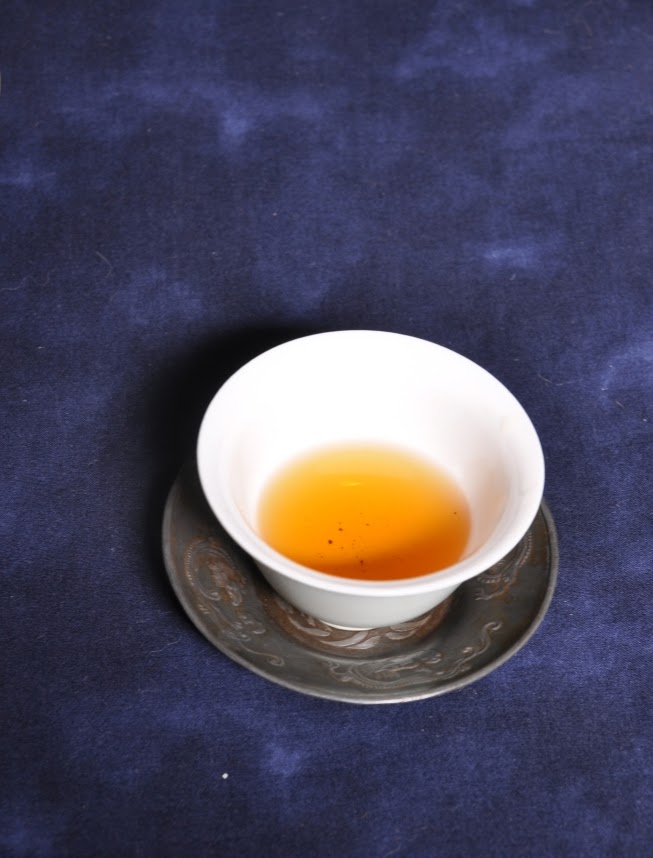
And the brews shines with a dark orange and gold shine! The contrast on the white cup and the dark blue Chabu gives an intense feeling of warmth.

Saturday, December 19, 2015

Advent Day 19, 2003 aged Oolong

We're already the 19th day of Advent and I still haven't tasted one of my favorite type of teas. Let's remedy this situation with a session with my spring 2003 Hung Shui Oolong from Yong Long (Dong Ding).

Aged Oolongs are becoming highly popular in China right now, especially those from the Dong Ding competition that come in their original packaging. 
Since I'm using an Yixing zhuni teapot, I only use a few leaves. That's why the first brew looked a little pale, but the next ones were stronger once the leaves had opened up.
(Good) aged Oolong are popular for a similar reason than puerh: you can still taste their freshness and power as their scents evolve toward more aged wood, incense or even whisky scents! The taste gains finesse and harmony (as the roasting aromas disappear).
For puerh, the transformation can take decades, which is a sign of their amazing power. With Oolong, the impact of aging can be felt much more quickly, especially if you store the leaves in a porcelain jar that allows the presence of some air.
12 years is a cycle in the Chinese calendar. It's also the age of my first child. This gives a special meaning to this tea. It represents time that passes, kids that are growing up. The nice thing is that this tea doesn't feel old in any way, but mature, harmonious and still fresh.
Warm advent pleasure.
A sweet ray of sun on a winter day.

Friday, December 18, 2015

18e jour de l'Avent: Yiwu de 1990


Après avoir récemment bu du puerh cru d'Yiwu de la brique de 1995, il est intéressant de regoûter aux feuilles en vrac de ce même terroir.

La première satisfaction est de reconnaitre de grandes similitudes dans les senteurs entre ces 2 puerhs. La douce et grave odeur de Yiwu se retrouve chez les 2. Elle s'exprime avec bien plus de force et d'intensité chez la brique, et avec plus de douceur, de soyeux chez ces feuilles en vrac. La compression joue un rôle encore plus important que les 5 ans de différence d'âge, d'après mon expérience.
Comme il fait bien froid ces jours-ci à Taiwan, j'infuse ce thé avec plus de feuilles que lorsque j'utilisai ma théière en argent sous le soleil il y a 2 ans et 1 jours! Ce serait triste de refaire toujours le thé de la même manière... L'idéal est d'arriver à l'adapter à nos envies, notre quotidien, notre humeur. C'est un puerh que j'ai bu très tôt le matin: la force au réveil!
A chacun son cinéma!

Thursday, December 17, 2015

Advent Day 17: Understanding and enjoying red teas

Today's tea class was about red, fully oxidized, teas. It's a category that was long overlooked by tea drinkers, because it was synonymous with low quality cut leaves (in bags) that were so astringent and uninteresting that tea makers were scenting them with all kinds of essential oils and drinkers would add sugar and/or milk to be able to drink them!

This changed in 2007, after the end of the (first) puerh bubble in China. A red tea called Jin Jun Mei was introduced and it became very popular with Beijing's elites. This tea was originally made with the finest Lapsang Souchong buds, and it was only lightly smoked. Now, Jin Jun Mei is so popular that it's made from many different kinds of tea cultivars, but it's always made from buds, so that the dry leaves appear as thin as golden eyebrow hair!

Jin Jun Mei marked a rebirth of top quality, whole leaf red tea. It's like a circle that is being regenerated, because Lapsang Souchong is actually the very first red tea that was created during the Qing dynasty (1644-1911), near the Wu Yi mountains in the Fujian Province.
Since 2007, great red teas have been produced on both sides of the straits. In Taiwan, red tea production has become popular even in high mountains (Alishan, Lishan...) where Oolong farmers make red tea in early summer to diversify their tea offer and answer the demand for quality reds. The association of red tea, quality and the organic movement has also helped the development of honey aroma red tea (mixiang hung cha) on the East Coast of Taiwan (with no additives). So, we started by a taste of my red Da Yeh Oolong cultivar from Tse Ke Shan from this spring. Very nice body, sweetness and persistence of the honey aromas.
Then, we brewed my spring 2012 Qingxin Oolong from the high mountains of Yunnan. This is a very fine example of this crossover I mentioned earlier: making red tea with Oolong from high mountains. The fact that it comes from Yunnan enabled us to get very small leaves and a different terroir. The scents are very high pitched: citrus, orange flower. The aftertaste was cool and the taste slightly astringent. 
Our third red was my spring 2011 Big Arbor Dian Hong. This is also an innovation aimed at producing a red tea of the same or higher quality than Jin Jun Mei: making red tea with old puerh tree's buds! This tea had red berry (blackcurrant) scents and a very powerful, rich and clean taste.
The highlight of the class came at the end. Given Lapsang Souchong's importance in the birth and revival of top quality red tea, it was important to get to taste this remarkable tea with leaves from the original Tongmu village. And we did this with the most fitting De Hua porcelain teapot and tea cups! This was Heaven and felt like an early Christmas for us tea!
Loose red teas can be just as enjoyable as Oolongs and puerhs!

Wednesday, December 16, 2015

Advent Day 16, golden straw


The theme for this 16th Advent Chaxi is baby Jesus' baby bed, a manger filled with straw. That's why I replaced my usual Chabu with a simple sushi mat made from thin bamboo. It's similar to straws and it's also an object whose function has been altered.

The tea boat and the teapot have a matching yellow color, my Jianshui (waste water container) is made of gold looking copper and my chatuo are also made of copper!
After yesterday's Oriental Beauty, I switch to my spring 2013 Concubine Oolong, stored in my antique porcelain qinghua jar. The smell coming from that jar is beyond tea. It's divine!
After preheating the teapot and the cups, I delicately take the leaves in my hand. They start to warm up at the contact of my warm skin. Then, I don't toss the leaves in the teapot, but let them slide slowly by aiming for the middle of the teapot. The goal is to achieve a harmonious arrangement of the leaves inside the teapot.
The brewing fun continues as I use this special early Republic of China Yixing duanni teapot with a handle above the pot. It's a special pleasure to use a teapot that reveals the character of the tea we brew!
This tea has a ripe passion fruit scent now. Simply delicious.
Even the snow flake decoration of my tree are made of straw!

Tuesday, December 15, 2015

15e jour de l'Avent: Journée Internationale du thé


La journée internationale du thé, ce 15 décembre, me donne l'occasion de choisir un thé de caractère international qui convienne aussi à la tradition de Noël. Ce thé, c'est la Beauté Orientale (Dong Fang Mei Ren, aussi connu comme 'Wu Se Cha', thé aux 5 couleurs et 'Pong Feng Cha', thé du vantard)!

La légende veut que ce soit la reine Victoria qui ait donné ce nom d'"Oriental Beauty" à ce thé après l'avoir dégusté. Ce ne serait pas la première fois qu'un monarque donne un nom à un thé (l'empereur Qianlong nomma le Bi Luo Chun, par exemple), mais nous n'avons pas vu de preuves de cela.

Cependant, le Oolong Beauté Orientale fut bel et bien le fruit d'un échange international. Le fermier des environs d'Emei qui fut le premier à produire ce thé en été, malgré les nombreux insectes, le vendit à bon prix à John Dodd, négociant de thé implanté à Dadaocheng (ancien Taipei). Et ce négociant fut, en 1869, l'un des premiers (voire le premier, ce n'est pas tranché) à exporter du thé de Taiwan vers les Etats-Unis sous le nom de 'Formosa Oolong'. 
Beauté Orientale 'tradition' de 2013
Le thé était fortement taxé à Fuzhou, Fujian, en Chine continentale (2 pièces d'argent par sac de 50 kg sous l'empereur Daoguang, vers 1850). Cela incita les négociants étrangers à venir s'implanter à Taiwan et à y favoriser le développement de la production du thé sur l'ile dans la seconde moitié du 19ème siècle. Le Oolong Beauté Orientale fut donc une innovation Taiwanaise qui se répandit rapidement en Occident grâce à des négociants étrangers il y a plus de 100 ans.
Fortement oxydé, c'est un Oolong chaleureux aux senteurs d'épices, de miel. Parfois, on dirait presque un parfum féminin envoûtant... Composé de bourgeons et de de petites feuilles, c'est aussi un thé d'une grande finesse. Je fais délicatement glisser les feuilles de ma main dans la théière.
Un tout nouveau Chaxi noir et fleuri symbolise le caractère plus foncé, mystérieux et féminin de ce thé. Le Chaxi est un accessoire où l'esthétisme remplit la fonction de souligner le caractère du thé et d'un sentiment qu'on cherche à exprimer. Cela rend la dégustation plus intéressante car elle prend un sens additionnel. Il ne s'agit plus juste de boire un thé, mais de le boire d'une manière à l'inscrire dans ses rituels quotidiens, dans sa vie.
Pour en revenir au concept d'international du thé, les Anglais ont leur 'tea time' de l'après-midi, les Japonais leurs cérémonies codifiées... Chaque pays a adopté le thé à sa manière. Mais en même temps que la planète s'unifie grâce aux réseaux sociaux, notre approche du thé va, je crois, devenir plus personnelle et créative. Chacun adaptera le thé à son mode de vie pour lui donner une touche unique. Le thé devient l'occasion d'exprimer ses joies, ses humeurs, ses attentes, les plaisirs simples...
Une Beauté d'Orient en attendant Noël!

Monday, December 14, 2015

Advent Day 14, High Roast Tie Guan Yin


For this 14th day of Advent, I chose a traditional tea that is particularly warm, sweet and very fitting the winter season.

It's the new spring 2013 version of my High Roast Tie Guan Yin (from Shiping, Anxi). A model of international cooperation, the leaves come from Fujian, but they are roasted by Master Wang in Taipei.
Today's Oolongs mostly emphasize freshness and little or no roasting at all. This one, on the other hand, gives a rare glimpse at a fully roasted Oolong! If you are still confused about the difference between oxidation, fermentation and roasting, try a fresh Tie Guan Yin ad this tea!
The brew turns brown instead of red (oxidation) or black (fermentation). The roast scents are linked to fire and the transformation caused by dry heat. They come from a Maillard reaction that also happens to toasted bread, marshmallows over fire...
There's a lot of innovation in the tea industry to satisfy the changing desires of tea drinkers. New cultivars get introduced in new regions: my Tie Guan Yin from Alishan, for instance. Or the same cultivar is done in a different way: for the first time, I tried a red Tie Guan Yin just last week! (That one wasn't very good).
This High Roast Tie Guan Yin, however, follows none of these trends or fashions. It still smells and tastes pretty much like 10 years ago, when I first had some. This also makes it a perfect tea for the traditional Christmas season!

Sunday, December 13, 2015

Treizième jour de l'Avent et senteurs de thé


Pas de chance pour mon nez ce 13 décembre. Tel le sapin de Noël, à l'honneur sur ce Chaxi, il est entièrement décoratif! Je ne sens toujours rien.

C'est privé du sens de l'odorat qu'on l'apprécie le mieux! Quand on est amateur de thés naturels, sans arômes artificiels, on regarde d'un mauvais oeil les thés aromatisés. Leurs odeurs sont trop intenses et n'évoluent pas avec les infusions ou le temps. Mais tout le monde ne prend pas plaisir à la subtilité. Quand le nez ne fonctionne pas bien ou n'est pas entrainé, des parfums forts donnent un plaisir facile et immédiat. Soyons bienveillant avec les buveurs de thés aromatisés à la noix de coco, à l'orange ou au caramel (mais essayons de les guider vers le naturel)!
Quand un sens fait défaut, les autres deviennent plus forts. Ne pouvant sentir, j'ai goûter la différence entre les différents thés de cette classe: Picotement un peu désagréable sur la langue pour un puerh, goût un peu acidulé pour un Assam de vieux théiers et moelleux plaisant pour un Oolong torréfié.
Assam de Sun Moon Lake
J'ai aussi apprécié la transparence et la beauté de la couleur des infusions dans les coupes ivoires, sur Cha Tuo en argent! Beauté et raffinement pour préparer la venue de Noël.
Joyeux dimanche!