Showing posts sorted by date for query taipei story house. Sort by relevance Show all posts

Friday, March 24, 2023

Why try this Osmanthus scented Baozhong?

Osmanthus flowers in San Hsia

Fans of high quality loose tea have a natural suspicion towards artificially scented teas! (Pun intended) In most cases, this suspicion is warranted. There are so many 'teas' on the market that barely deserve this name, because 99% of their aromas are completely artificial, lab engineered and chemically produced. The tea leaf is just there to hold and release the artificial scent of milk, strawberry, peach... and fool customers to think that it's natural.
Flower scented teas are very different from such artificial teas. Instead of using chemical additives or oils, the scent of the flower is transferred by a prolonged contact between the flower and the tea. This is a traditional and natural scenting technique already used in Taiwan over 100 years ago. Chen Zhao Jun, a Taipei merchant who built the Taipei Story House, specialized in selling flower scented Baozhong to other South East Asia countries. So, this Osmanthus scented Baozhong is just as traditional as unscented Baozhong!   

The osmanthus tree grows on the tea plantation

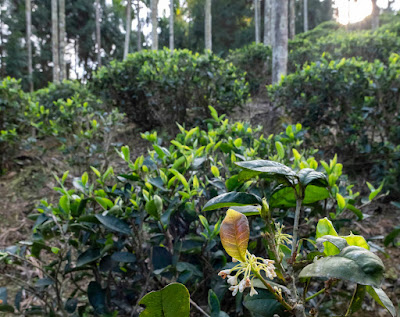
Another critique of flower scented teas is that if the tea were top notch, it wouldn't require the addition of flower fragrances! Indeed, this is very often the case. Most cheap flower teas don't use very good tea leaves, but the flower scents help to hide this fact to some extent, especially for people who focus on the nose instead of the palate. This winter Osmanthus Baozhong is made from the organic tea plantation that produces my spring BiLuoChun. And what's special is that the osmanthus flowers also come from this plantation. (These flowers are most active during the winter season. Now there are few left on this pictures). This is actually a good fit, because winter Baozhongs are usually quite powerful and sweet, but less fragrant than spring Baozhongs. So, the Osmanthus scents do help to improve on a weakness in this tea, while still preserving the round taste of the tea.
If you are not familiar with osmanthus' scents, I particularly recommend that you taste this Baozhong, because osmanthus is a scent I often detect in unscented Taiwanese Oolongs and Baozhongs. Flower scents are often difficult to describe, because they are so light and evanescent. So, it's very useful to have osmanthus scents in your memory in order to recognize it (but also jasmine, lily flower...)

And if this is still not convincing you to add this delicious, natural, organic, traditional osmanthus scented Baozhong to your next cart, I have now discounted it by 10%! 


Monday, February 09, 2015

Taipei Story House event with Teaparker and tea friends


For this special event marking the end of K. C. Chen's era at the head of the Taipei Story House, Teaparker received this picture of himself performing Chaozhou gongfu cha. It was taken at the Taipei Story House in 2010 when a TV crew shot the documentary Global Drinks, tea (for France 5 TV).

Nearby, you can also see pictures from over 50 tea events organized by Teaparker with the Taipei Story House over the years. I have many memories of teas and friends there...

The Taipei Story House was built in 1913 for Chen ZhaoJun, a Taipei tea merchant, as a place to rest and entertain his guests. On Sunday, Teaparker invited us to a trip back in time and gave us 5 teas from the 1920s to brew! 
 Evon started with a Fanzhuang Oolong, meaning it's an Oolong that was sold by a foreign tea merchant in Taipei. While the leaves were provided by Teaparker, all the equipment is her own. She's using a wonderful black obi (kimono belt) as chabu and a cultural revolution big bamboo teapot. Most beautiful are her replica of Yuan dynasty qinghua cups with elevated Chatuo!
 Next, Ms. Wu brews old Wuyi Yancha in her small Yixing zhuni teapot. Wuyi Yancha is the place of origin of Oolong and also one of the most difficult to master. 
 Beauty on a Chaxi can look so simple and easy, but it requires practice and a creative mind. 
 This event with 5 Chaxi is also an opportunity to see that we're not alone in preparing tea with style. Every day we are using similar setups to enjoy our tea.
 Here, Ms. Jian is going to brew a 1920s KeyiXing puerh. The brew's color was amazingly transparent and shiny!
 Then came my turn with the Chaxi I had parcticed of a day earlier.
I brewed a 1920s Sun Yishun Liu-An GuaPian. The leaves are tiny and it's a tea that used to be exported to South Asia. This Yellow Mountain tea (Anhui Province) used to be slightly oxidized. Its scent in the pewter tea caddy is splendid and powerful. It's intoxicating like old liquor or top grade incense! Teaparker recommended I only use few leaves, a slow pour and long brew. The result was surprisingly thick, clean and sweet. The aftertaste of a small cup lasted a very long time, with waves of warmth in the body.

I was particularly glad that I could share this special moment with Emily, a Penn State alumna and reader Miguel with his family!

Old tea and wares are passed from one generation to the next. It's nice to see how tea brings the family together and how a simple moment of happiness can be shared and passed to the next generation.
Above and on the left, Ms. Chen prepared a Baozhong that was sold by Chen ZhaoJun's company in the 1920s! It was interesting to see that Baozhong tea used to be rather flat and small back then.

She also made a beautiful purple color Chabu matching the colors of her early RoC Yixing teapot for this occasion.

All these tea still felt alive and brought lots of joy and astonishment to all the participants. It showed just how resilient top quality teas can be. It's not a quest for the oldest tea, but for exceptional flavors. And this Sunday, we were blown away! It was the highest concentration of great teas and Chaxis I have seen on a single afternoon.
May the Taipei Story House continue to connect tea lovers with Taiwan's rich tea culture!

Thursday, February 05, 2015

Tea event at the Taipei Story House

It will take place this Sunday, February 8th, at 3 PM at the Taipei Story House (next to the Museum of Modern Art). Teaparker's Cha Ren Ya Xin's association will perform several Cha Xi for a special event. I will also participate and hope to take beautiful pictures on this special occasion. Our Chaxi will honor the retirement of the current head of the Story House.
Ce dimanche, 8 février, à 15h, je serai au Tapei Story House avec l'association Cha Ren Ya Xin de Teaparker. Nous aurons plusieurs Chaxi pour célébrer la retraite de la directrice actuelle, K. C. Chen. En 12 ans, elle a su donner une dimension culturelle à cette demeure historique d'un marchand de thé du début du 20ème siècle. Nous lui dirons merci et montrerons que nous continuons de s'inspirer de sa démarche: puiser de l'énergie et de l'inspiration dans l'ancien pour créer du bonheur dans le présent!

Wednesday, September 10, 2014

Tea connections

Japanese style garden in Taipei (Tatung University)
Recent readers of my blog may be surprised to see me preparing Oolong at an event in the Tatung university in Taipei. This picturesque place is better known as a background for wedding pictures! And how do I get access to such an old landmark of Taipei to make tea?

Teaparker, the tea master with whom I learn about tea, is my connection to this event. As a consultant for the Taipei Story House, every month, he gives a speech about tea open to the public (it used to be easy to get in, but now you need to register 2 weeks in advance!) To make these monthly events more lively and self-explanatory, Teaparker always asks one or several of his students to perform a Chaxi. Once a week, he also gives a more formal tea class at the Taipei Story House.

Teaparker thoughtful before the event
Teaparker is a former journalist who has now written about 40 books on the subject of tea. I am fortunate that I attended the very first tea class he taught, 12 years ago! And I have continued to attend his classes every week ever since. The tea world is very large and there's so much to explore. Teaparker doesn't pretend to know everything about tea, but he continues to learn and is passionate about sharing the joys he finds in tea.
Thanks to his tea classes, I have also the chance to connect with other wonderful tea persons who have become great friends.

Tea can be somewhat a lonely experience if nobody around you appreciates it. In Taiwan, this is rarely the case, because so many people like the taste of good Oolong, even if they don't put as much effort as we do in their Chaxi.

Sharing many delicious cups with people who also love tea creates a common bond of happiness. I have found this experience so amazing that I even wanted to share it with other tea lovers overseas and started this blog 10 years ago. And thanks to this blog, I have connected with Baroque musicians, artists, potters, writers, doctors, web designers, university professors, poets, physicists, movie and wine makers...all very talented and very interesting people. Exchanging pleasure and happiness in a meaningful and refined way is so gratifying... (Thanks again, dear tea friends).
We live in a more and more connected world and it's not always easy to disconnect! Too many connections may also lead to lost time, so it's important to nurture the good and the right ones.

There is one more connection I wish to mention in the relationship with tea: oneself. Preparing tea is actually never lonely if you use this moment to connect to oneself. Be here now. Every detail has its importance when you prepare tea. This motivates you to focus on what you are doing. Tea opens a road to meditation.

There's a inner dialogue with oneself during tea. The drinker judges if the brewer has prepared the tea as one wished it to be brewed. So, you learn to know how you like your tea, what taste gives you most pleasure, what smell reminds of which memory... Learn to listen to your inner voice!

Friday, January 03, 2014

Annonce d'une dégustation publique


Je ferai une démonstration d'un Chaxi avec mon puerh cru sauvage de Lincang de 2006 au Taipei Story House ce dimanche, 5 janvier, l'après-midi à 15h. (C'est à côté du Fine Arts Museum). Teaparker animera cet événement public et en profitera pour nous parler de thé en ces périodes de fêtes du Nouvel An. (Note: le Nouvel An Chinois débute le 31 janvier cette année).

Les fêtes de Noël et du réveillon me permirent d'apprécier deux très bons vins ramenés de France: un gewurtztraminer Zind Humbrecht organique et un Sauvignon naturel 'Schistes' d'Anjou de Cyril Le Moing. (On n'a droit qu'à 2 bouteille par personne par voyage!) Un caviste passionné, Jean-Luc Lanoix, m'a conseillé le premier, et le second provient d'un vigneron tout autant fanatique de qualité. Le conseil et le savoir-faire de ces professionnels m'ont fait passer d'excellents moments. La différence avec les vins de grande surface est énorme.

En thé, je me suis notamment tourné vers un vieux puerh cru et du Zheng Shan Xiao Zhong pour me procurer de belles émotions. Je reste modéré dans la consommation de mes thés les plus rares. Peu de feuilles me suffisent pour faire plaisir. Mais moins j'en utilise, plus souvent je peux les déguster!

Note: un petit refroidissement m'empêche de faire la démonstration dimanche, mais l'événement aura quand même lieu.

Tuesday, May 07, 2013

3 Cha Xi dans une maison Japonaise à Taipei

Dans le cadre des événements mensuels de Teaparker pour le Taipei Story House, nous avons préparé 3 thés dans la maison japonaise de l'université Tatung, au nord de Taipei. Ce fut la demeure du fondateur de ce grand groupe industriel Taiwanais durant la période japonaise de l'ile (1895-1945). Elle a été restaurée et son accès n'est généralement pas ouvert au public. Ce fut donc une occasion spéciale de pouvoir y préparer un thé dimanche dernier.

Un très large public est venu assister à notre démonstration et au discours de Teaparker. En fait, il s'agit plus d'une conversation interactive avec les gens présents. Teaparker aime bien poser des questions sur le thé, et il récompense les bonnes réponses avec la participation au Cha Xi.

Linda, au centre, est la première à infuser son thé avec son Cha Xi dédié aux fleurs Tong.

Linda utilise une thé zhuni, une tetsubin, un tea caddy en étain et des coupes Dehua (Blanc de Chine) du 18ème siècle. Elle a réalisé son Cha Bu, ses socles et les fleurs elle-même! N'ayant pas l'occasion d'admirer les fleurs Tong dans la nature (voir mon dernier article), elle voulut quand même célébrer leur éclosion printanière avec ce Cha Xi.

Le public, jeune et vieux, goûta au profond mielleux de son Oolong Concubine organique. Ce goût si sucré et moelleux vient d'une part de la morsure  des Jacobiasca formosana Paoli et de l'oxydation plus poussée des feuilles.

Boire ce thé, c'est un peu se sentir papillon et aller butiner des belles fleurs de montagne subtropicale!

Puis vint le tour d'Evon et son interprétation florale. Elle choisit une très belle ceinture de kimono japonaise bleue. Ses coupes Dehua dragon modernes ont des socles en argent en forme de pétales de fleur. Jarre en étain, petite tetsubin, théière en zhuni et un bateau à thé rectangulaire complètent son Cha Xi.
Le public est varié, mais très attentif et concentré.
Vient enfin mon tour de présenter mon Cha Xi. Tout comme Evon, j'ai choisi une ceinture de kimono afin de créer un lien avec ce lieu japonais. Sa couleur convient bien avec le sentiment de chaleur qui émane de mon thé, le Concubine Oolong d'hiver 2011 de Feng Huang.
Ma bouilloire en argent et ce Nilu blanc proviennent également du Japon et sont des accessoires issus du Senchado. Or, cette pratique et ces ustensiles tirent leur inspiration du gongfu cha de Chaoshan, en Chine, durant la dynastie Qing. Mais l'amour du Japon pour le thé et les objets chinois remonte bien plus loin, à la dynastie Tang. En effet, au Japon, on appele Tang wu (objet Tang), les accessoires à thé. Ces temps anciens constituent un idéal pour la

Dans mon Cha Xi, j'ai donc trouvé naturel d'utiliser le set lotus de David Louveau. Ces pièces sont également inspirées par des pièces anciennes chinoises. La coupe correspond à une coupe Yuan (mongole) qui elle-même découle des bols Sung. L'émaille de ce set fait d'ailleurs penser à l'émaille Ru, bleue-verte tendre, des Sung. Les incisions sur le pourtour des socle et du bateau à thé font penser à des pétales de fleur de lotus (autre procédé ancien).
L'art du thé moderne suit l'exemple Japonais: il s'inspire des modèles chinois classiques et se met au service des passionnés. Pour un Cha Xi sur tatami, ce set convient particulièrement bien: les socles surélèvent les coupes qui deviennent plus faciles à prendre ; de plus, ces larges socles évitent les éclaboussures de thé sur le tatami ou le Cha Bu.
Finalement, il y a aussi l'aspect émotionnel et personnel de nombreux accessoires. Le set est le fruit d'une coopération de plusieurs années avec David Louveau. Le bol à eaux usées provient d'un de mes premiers échanges avec Michel François, un autre céramiste/potier de talent. Et l'on remarquera aussi un petit quilt de tissu formé par 6 hexagones rouges et un bleu. C'est ma mère qui me l'a fait, et je m'en suis servi pour sécher le bas de ma théière zhuni avant de verser le thé dans les coupes.

En regardant la ceinture de kimono de plus près, on se rend compte que sous cette couleur orange unie apparaissent des motifs simples. Je ne connais pas leur signification, leur symbolique, mais ils me font penser à des fleurs petites sur les bords qui éclosent au milieu. (Si un ou une expert en tissu en sait plus, je suis preneur de vos informations!) Cela correspond donc bien α un thème printanier.
Ces motifs sont à l'image du thé. Au départ, l'oeil inattentif ne les voit pas. Seule une certaine concentration permettent de faire apparaitre toute la subtile beauté de cet art.

Tuesday, February 07, 2012

Tea is child's play

This Sunday, at the Taipei Story House, my children brewed tea for Teaparker's monthly public tea lecture! I had told him that they started to prepare tea like me and he suggested that they perform at this historical site, built by tea merchant Chen Chao-Jun in 1914. This Chinese tea merchant found his inspiration in the English Tudor revival style. In this house, he entertained his foreign customers, who came mostly from Southeast Asia to purchase scented Baozhong tea.

This mix of cultures and nationalities is well exemplified by my French-Taiwanese children! And it's further reflected in the diverse Cha Xi they created for the Big Arbor Dian Hong they brewed.
My daughter chose a pink Cha Bu (her favorite color) and qingbai porcelain from Yingge, a teaboat by David Louveau, Chinese Cha Tuo (saucers) and a waste water bowl she made in Shuili county (with the help of a potter)! 
My son is using the 'ivory' porcelain on a Sashiko quilt - made by his French grandmother, the wave patterns remind him of the sea he likes so much, he said -, 2 old Qing plates, a waste water bowl he also made in Shuili (central Taiwan). Porcelain is a good fit for red tea! And both used a Japanese silver kettle: it's lighter for them to hold (vs a tetsubin).

Note: To avoid them getting burned, we didn't use fire in the Nilu, but simply poured boiling water in the silver kettle. Don't let your children handle boiling water unattended!

Tea culture knows no boundaries.
Young and not so young enjoy a sweet cup of tea!