Thursday, June 13, 2013

Comparing 2 Tie Guan Yin Oolongs

This year, Tie Guan Yin is becoming popular again in China. This new emphasis doesn't concern the very lightly oxidized TGY, but the ones with a more traditional process.

I was lucky to discover such leaves during this spring's harvest in Pinglin! This was a surprise, because Tie Guan Yin is usually associated with Muzha, not with Pinglin. I think we have here the same process experienced by Baozhong in the last hundred 100 years: it started to be made in Nangang, very close to Taipei, and then the plantations gradually moved to Shiding and Pinglin. As the soils depleted and the city (pollution) grew, farmers found new land farther and farther from the capital.
Cultivar: Tie Guan Yin Oolong
Origin: Pinglin, Wenshan area
Harvested by hand on April 23rd, 2013
Process: low to medium oxidation, rolled, stems removed by machine and no roast

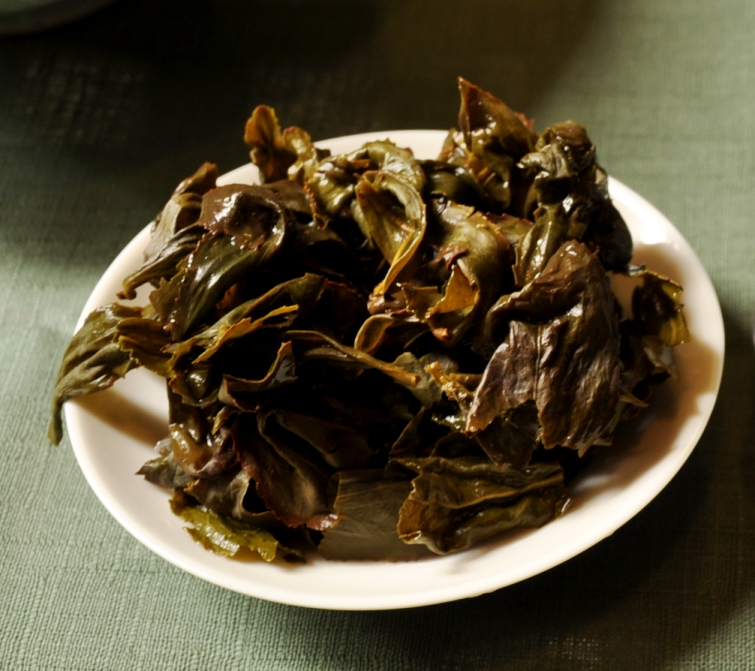
The dry leaves appear dark green. The brew's color is a strong and clear yellow. The leaves are more oxidized than Baozhong.
The fragrances are a mix of ripe apples, cinnamon and dark subtropical forest scents. It's very varied and rich.

The taste has a good mellow presence. It feels very rich, with a slight metallic/astringent taste, but no bitterness.  Overall, a very pleasing and calm sweetness dominates on the palate. Such well oxidized Oolong also feels good on the stomach.

This Tie Guan Yin combines the character of its cultivar with the sweetness of the Wenshan area.
Tasting the following tea makes this tasting even more interesting:

These leaves come from the same harvest as those above (April 23rd, 2013). The difference is that they were roasted by a Tie Guan Yin farmer from Muzha. (The Pinglin farmer is used to roasting Baozhong, not Tie Guan Yin. He wanted to have an expert roast these leaves the proper way. The result provides him a guide of what he should aim for with his roast when he makes more TGY in the coming seasons.)

So, what we have here are leaves with a very traditional and rather strong roast. The result is very ripe fruity, powerful and even sweeter.

There are also dark smells of burned rubber. They are testimony of a strong roast. The relatively high oxidation of the unroasted Tie Guan Yin has made it less fragile and better suited for such a roasting.
But the wrinkled leaves open up and even return to a dark green color after several brews. This shows that the roast hasn't killed the freshness and liveliness of these leaves. This is the key difference with the 2008 strongly roasted Anxi Tie Guan Yin from my selection.

From comparing with the unroasted Tie Guan Yin above, we can experience how the roasting magnifies the aromas, ripens the fragrances and sweetens the taste. The immediate freshness seems lost, but we can still find it in the menthol mouthfeel of the aftertaste. 

For an easier comparison, I have brewed both teas side by side:
Unroasted and roasted Pinglin Tie Guan Yin
There are some other interesting experiences that we can do with this roasted Tie Guan Yin: see how it evolves with time in a jar, and how a clay teapot can refine its taste further.
Enjoy your tea studies!

Tuesday, June 11, 2013

Wenshan Baozhong 'organique'

"Across the mountain passage
 
To the valley of thirsty
 
 Quietness"

Thanks H. for sending me this poem today. It's a nice thought, or even a coincidence, since tomorrow Taiwan will celebrate Duanwu Jie, the Dragon Boat Festival. What's remarkable about this holiday is that it marks the death of a poet (not a king or a god). It's also close to the summer solstice, and the ancient Chinese tea felt that spring water collected around noon tomorrow tastes particularly good. Good to quench a quiet thirst with tea!

Cultivar: luanze/qingxin Oolong
Origine: une plantation bio à Pinglin, Wenshan
Récolté à la main le 17 avril 2013
Process: Baozhong frais, sans torréfaction.

Testé en gaiwan en porcelaine ivoire.

1. Apparence
Les feuilles sont grandes pour du Baozhong. (Le Wenshan est une région sans hautes montagnes).
L'infusion est plutôt jaune pour un Baozhong. Son oxydation faible est un peu plus forte que la moyenne des Baozhongs.
2. Odeur
Elle est difficile à définir précisément. Il y a bien entendu une forte composante de fraicheur printanière pour ce tout jeune Baozhong. On n'est ni vraiment dans les registres fleuris ou fruités, mais dans celui de la forêt subtropicale. C'est l'environnement naturel des plantations du Wenshan. C'est une forêt qui reste verte toute l'année et qui respire la vie et le verdure. Ces odeurs ne sont pas aussi intenses qu'un Baozhong non biologique, mais elles sont plus naturelles et clean.
3. Goût
J'ai beau infuser ce Baozhong longtemps, il ne devient pas amer ou astringent, mais reste agréablement moelleux. L'impression en bouche est calme et harmonieuse. La longueur de l'aftertaste est bonne.
La caractéristique organique est d'avoir des feuilles plus épaisses et saines. Ainsi, le goût a aussi plus d'ampleur. Et comme il ne devient pas amer, on peut le préparer facilement, avec peu ou beaucoup de feuilles.


"Farandole du Baozhong!
Par-delà monts et vallées, rivières et forêts,
au plus profond résonnent tes goûts exaltés."

Friday, June 07, 2013

The Green High Mountains: Alishan and Shan Lin Shi Oolong

Shan Lin Shi
After the top mountains above 2000 meters, I propose to taste some Luanze/qingxin Oolongs from Alishan and Shan Lin Shi, ranging from 1200 to 1500 meters. This difference in elevation results in a big price difference. A Da Yu Ling or Lishan Oolong is typically 50% more expensive that a Shan Lin Shi or Alishan (or more). There are some very good reasons for this: at very high altitudes, it's more difficult to grow tea. With a shorter growing season, yields are lower. This is also a reason why such teas are of high quality. Then, the costs are also higher, because it takes longer for the pickers to go to these remote places and come back at night. 
Knowing what a top Oolong tastes like, we can try to select one with similar characteristics at much more lower price. It won't be the same, because each mountain has its own taste and fragrances, but we can try to get as close as possible.
From left to right: Alishan 1500 meters, Shan Lin Shi 1400 meters and Shan Lin Shi 1200 meters. This time, I'm using a green Cha Bu as a symbol for the spring harvest and the feeling of this elevation level: there are much more green bamboo in the scenery.

Left:
Origin: Alishan, Changshu Hu
Elevation: 1500 meters
Hand harvested on April 10th, 2013

The dry leaves have some yellow color that is different from the greener Shan Lin Shi.
As to the brew, it's also slightly more yellow than the Shan Lin Shi.

Middle:
Origin: Shan Lin Shi, Fan Zai Tian
Elevation: 1400 meters
Hand harvested on May 5th, 2013

The name of this plantation indicates that it is located on aboriginal land.

Right:
Origin: Shan Lin Shi, Yang Keng
Elevation: 1200 meters
Hand harvested on April 8th, 2013.

This tea appears to have the lightest brew of the three.
The oxidation level is very similar to the Da Yu Ling/Lishan/Qilai we tasted previously. In terms of character, the Alishan Oolong displays the most strength and qi. This makes it more similar to Da Yu Ling. The 2 Shan Lin Shi Oolongs are much more soft, light and soothing. This kind of finesse is very much like a Lishan Oolong. The aftertastes are all long and sweet. There was no trace of bitterness in any of them. Great quality!
In terms of fragrances, the Alishan is quite floral, the Fan Zai Tian is more fruity and the Yang Keng smells almost like a Japanese Sencha!

There's much more to discover and appreciate by making a more skilled preparation for each of these great teas. Outdoors, it's more about enjoying the general character of tea. And, here, side by side, it's also an interesting way to compare teas quickly.

As a last note, I want to emphasize to all these unroasted and lightly oxidized Mountain Oolongs give a nice fresh and energetic feeling. This is exactly what I long for in June. They all manage to be more than just fragrant, as they didn't cause any bad feeling in my stomach. (This can often be the case for light oxidized oolongs that are not properly made). This is a basic requirement for a tea: it has to make your body feel comfortable. Only then can the mind hope to find happiness!
Enjoy the green mountain Oolongs!

Thursday, June 06, 2013

Jarres Anping, le retour

Je m'en sers d'une grande pour mon Dian Hung sauvage, et d'une autre pour mon Shui Xian de Wu Yi. Et j'ai aussi celle-ci (en photo à gauche et en bas), dont je me sers régulièrement comme 'décanteur' pour mon thé. En effet, quelques minutes avant la préparation suffisent pour y arrondir un Oolong torréfié ou ouvrir un vieux thé.

Les jarres Anping sont des accessoires bien utiles et leur grand âge leur donne un charme qui se transmet au Cha Xi. Je suis donc bien heureux de pouvoir à nouveau vous en proposer quelques unes dans ma sélection! (Cliquez ce lien et scrollez vers le bas pour les découvrir).

Tuesday, June 04, 2013

Oolongs above 2000 meters: into the Blue

Oolong plantation on Da Yu Ling
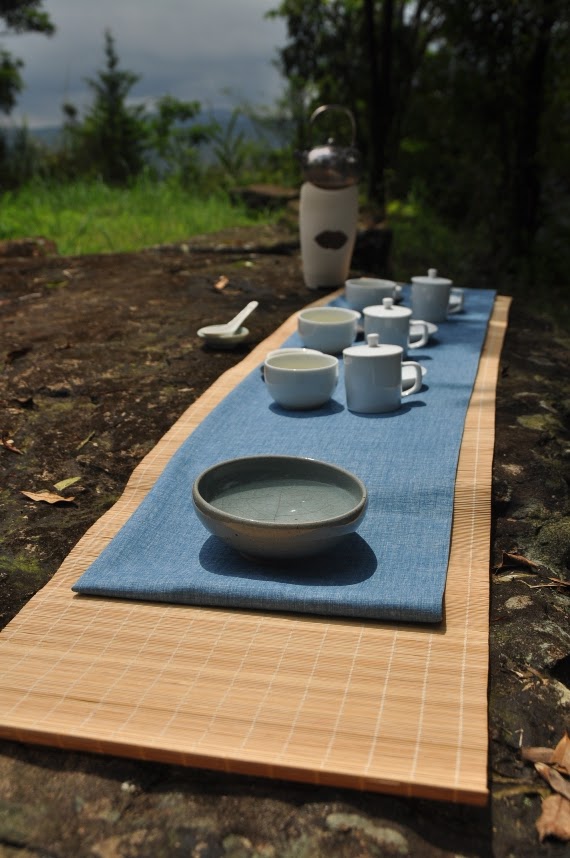
The perfect place to taste 3 High Mountain Oolongs: on top of a mountain in the Wenshan forest, near Pinglin.
On this familiar rock, I set up my Chaxi with 3 white porcelain competition sets to compare 3 mountains with plantations over 2000 meters high. The blue fabric on the bamboo mat symbolizes the intense and clear blue sky at such elevations.

From left to right, the teas are all luanze Oolong:

Origin: Lishan

Elevation: 2200 meters
Hand harvested on April 17th, 2013.

(Left on the Chaxi)
Origin: Da Yu Ling

Elevation: 2300 meters
Hand harvested on April 20th, 2013.

(In the middle of the Chaxi)


Origin: Qilai Shan

Elevation: 2050 meters
Hand harvested on May 10th, 2013.

(Right on the Chaxi)

There are some obvious visual differences for the dry leaves from these 3 different mountains. The Lishan seem biggest, while the Da Yu Ling leaves look the greenest.

Does this means that there are also big differences in the oxidation level. Let's find out! I'm brewing these leaves for 6 minutes:
Lishan, Da Yu Ling and Qilai
Amazingly, the 3 brews look very similar in terms of color, clarity and shine!
Lishan, Da Yu Ling and Qilai
The transparency (lack of turbidity) is a sign of quality that these 3 Oolongs share.
In the outdoors, it's more difficult to analyze a tea in great detail. And when you compare 3 at a time, what you remember are the main differences. Let me start with these impressions and then give you my tasting notes from other (indoor) tastings:

(Left) Lishan: Elegance

This tea is very sweet and light. Compared to the 2 others, it feels more 'elegant', very easy to drink. The Chaqi is very subtle and playful. On the first brew, it's almost beating the Da Yu Ling!

The fragrances are also the lightest and most flowery.  

It brings a clean, pure mouthfeel with a nice cooling sensation that is common to all these 3 high mountain Oolongs.

It has the finesse of a solo violin playing baroque music.


(Middle) Da Yu Ling: Power

Da Yu Ling has almost the same sweetness, but it packs more power in a still very harmonious way. The tea tastes thick without turning bitter. It's delicious and has the greatest durability/brewability.

This 'thickness' means also that this tea has a lot of complexity and evolves from brew to brew. Amazing!

This Oolong is more like a cello (played by Ma, Yo Yo!)


(Right). Qilai : Fruity

Qilai shan has the properties you'd expect from a top High Mountain Oolong. The sweetness and power are good. It has an added dryness which adds to the aftertaste. The fragrances feel a little more fruity, as the leaves seem slightly more oxidized.

Brewed with a competition set, the taste appears less 'elegant', less smooth than the 2 others. But if you brew it alone with greater care, than I have found that this is hardly noticeable.

Qilai would be closer to an organ instrument.
Tasting 3 top mountain Oolongs from this spring side by side is a chance to enjoy the character of each mountain. Compared with previous years, I have found that this character is something that doesn't change much.
The second brew was even a little bit stronger than the first. These Oolongs have very long leaves and it takes time to release all their fine and powerful flavors!
It's a pleasure to enjoy the clear blue sky and spring mountain air from each of these peaks!

Thursday, May 30, 2013

2013 Spring Jade Hung Shui Oolong from Zhu Shan


Cultivar: Jade (Tsui Yu/Cui Yu) Oolong (Taiwan Nr 13)
Origin: Zhu Shan, Nantou County, Taiwan
Harvested on March 20, 2013
Process: Ball shaped Oolong with medium roast.

Test brewing in a porcelain gaiwan and 3 classic cups. No weighing of the dry leaves and no timing of the brews.

1 - Appearance

The leaves are small with few stems and the color appears dark green. It looks very well sorted, the kind of process that is used for competition Oolong.
The color of the brew is dark yellow and has good clarity.

2 - Fragrances

The dry leaves have a very pleasant roasting scent that mixes well with the natural scent of the fresh tea. It's a familiar scent that transports you to one of those old Taiwanese tea shops that still roast their teas. These scents are quite intense thanks to the roasting. They combine fruity, honey and fresh sensations.

3 - Taste

It has a slight astringency and bitterness, but the taste that dominates is mellow and sweet. It has plenty of 'body' or structure to borrow from the wine tasting vocabulary. The roasting is most present in the first brew and it makes the tea feels stronger, riper and sweeter.

4 - Body sensations

The taste lingers for some time in the mouth and creates a smooth and warm feeling in the throat and down to the stomach.


Roasted Oolong leaves take longer to open up. With this tea, we see that the leaves expand and return almost to their original state. Even the color remains fairly green.

This is a sign of excellent roasting skills: the tea's flavors are stronger, the taste sweeter, and at the same time the freshness of the leaves is still well preserved. 

It doesn't have the elegance and fine notes of a high mountain Hung Shui Oolong, but it has almost everything else. 


Thanks to its low price, it's a tea that can be brewed daily, in a big or small teapot. Here I'm using a gaiwan for analysis, but this is a tea that would benefit from the use of an Yixing teapot.

One way to appreciate great teas is also to experience more humble teas from time to time, especially when they are so easy to drink.

This tea also offers a good opportunity to practice your brewing skills and try to make it taste the best it can. It won't break your heart (and your wallet) if you make a mistake.
My Chaxi is inspired by this union of green freshness and (roasted) warmth. Enjoy!