Last week, a reader asked me if I could detect lead in the glaze of my antique ceramics. Since this was not the first enquiry and I see this subject regularly coming up on tea forums/discussions, I decided to get some facts. First, I browsed the web and found this interesting article:
"Lead in Ceramics
Lead can be found all around us in dishes, fine crystal, painted walls and woodwork, toys, furniture, antique varnishes, solder, dust and soil. The effects of lead poisoning are cumulative throughout our lifetime, therefore it is important to limit our exposure to it.
In the ceramics industry, some lead glazes are still used to color or decorate and to smooth the surface of ceramic products. As long as the clay and glazes are compatible, and these glazes are properly fired (at a high enough temperature and for an appropriate amount of time), the lead is not likely to leach through the surface.
With constant use and scrubbing, ceramic products can wear down over time, and may allow lead to leach through. Hot and highly acidic foods, and prolonged time of contact, will increase lead leaching from such damaged surfaces. Antique, highly decorated ceramics are the most likely to leach lead.
You might be able to visually detect lead leaching if ceramic items show a dusty or chalky gray residue on the glaze after they are washed. When testing for lead content, be sure to test the surface that comes in contact with the food."
That page also provided a link to LeadCheck, a company providing lead checking swabs. So, I went ahead and purchased the kit to test my ceramics and get a scientific answer to this recurring question (urban legend?). The kit has arrived yesterday and I first started with my decorated Qing dynasty cups. Some have chips, which makes it possible to check the inside as well as the outside glaze.
Result: negative. No lead found. Excellent! There was still liquid in the swab and I then continued with my other antique ceramics: the Qing wine cup, the Xi cup, the black Tenmoku. Negative results all the way!
Then, I tested my new ceramics and even my Yixing teapots. As you can see below, the swab remained white (except for the dust). The only way to make it turn red was by using the confirmation card below: Conclusion: Readers who plan to buy or bought my antique/modern teaware can drink tea in total peace of mind. The scientific Lead Check test shows no traces of lead in the tea wares I selected for their high quality and artistic design.
There are 2 subjects that can spoil a tasty family meal: illnesses and politics (unless everybody votes for the same party). Several members of my family are in the medical field, so I often get to listen to graphic description of patients' conditions while eating. And some diseases don't even need a description to cut my appetite.
To enjoy food or tea, the state of mind is very important. That's probably why I prefer to look beyond the health benefits of tea. It's just not relaxing to think of all those diseases tea is supposed to protect us against. Tea won't make us immortal, but a perfect cup of tea can taste divine.
But there is an even more disturbing thought: tea could be unhealthy. In this regard, the most recurring fear is that of lead in tea accessories. And this is not something that can simply be thought away. To find my peace of mind, I tested various ceramics 2 years ago. On the Teachat forum, others have also obtained negative results.
I think we can put this concern about lead to a complete rest for most tea ware. Most earth ware (like Yixing pots) and porcelain are fired at temperatures above 1200 degrees Celsius to succeed. Even potteries made at low temperatures still exceed 800 degrees Celcius. Lead, however, melts at 327.5 degrees Celsius. Fired at a temperature above 327.5 degrees, lead would melt and flow to the bottom of the piece (easy to spot by eye). So, the only way there could be substantive amount of lead is if it were added after the firing, as part of a decoration. A plain earth ware teapot would loose its shape if it contained melted lead. The main risk I see, therefore, are accessories with fragile (color) ornaments that look like having been added after firing. These decorations may (or may not) contain lead.
These first 2 pictures show the ideal jar for aging Oolong: a big, round shape, glazed surface and rough clay. Here, this huge jar is over 100 years old. I put a regular Yixing teapot next to it to give you a sense of its dimensions. You'll also notice that the foot of the jar is not glazed. And the thick black glaze reminds us of the color variations of Jian Yang bowls from the Sung dynasty (tenmoku). Here, the same chemical process happened during the firing of the jar. For this jar, the color became brown and black, but I've also seen one with purple tones.
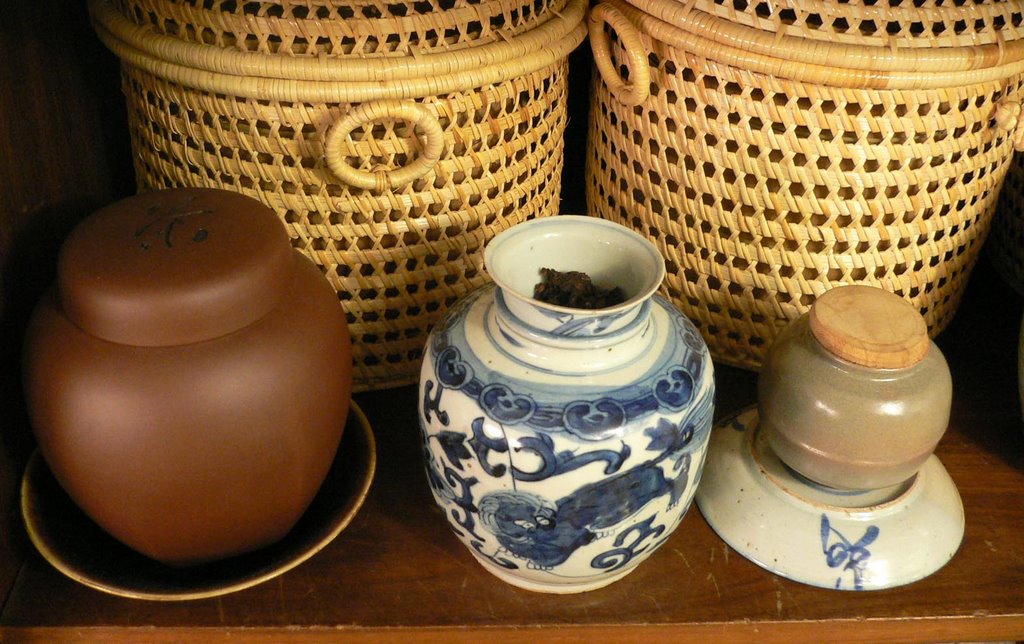
The problem with this jar is that I would need to purchase approximately 8 kg of Oolong to fill it completely. If the jar is just half full, then there is too much air and the tea would oxidize too quickly (like an opened, half full bottle of wine). I think I'll eventually buy one, but not before I move into my new appartment (still under construction). Then I can find one dedicated place for it: no bad smells, no direct sunshine, dry. And I'll probably use it to store 2005 Oolong for my 1 year old daughter. Like this she'll also have nice tea to drink when she reaches 18 and later gets married. (And if she doesn't become as much a tea fanatic as me, she'll always know what leaves to bring to please her loving father!) As an alternative to such a big jar, I have found a smaller one (above right). You'll probably recognize my modern Yixing zisha jar. I use it to let the leaves of my 1989 raw wild Jiang Cheng Puerh breathe after flaking. It's a little bit like decanting old wine, if you want. Compressed old puerh should be allowed to rest before being brewed. Such an unglazed jar will retain the fragrances while allowing sufficient air for this purpose.
I also like this Qing dynasty jar with a Chinese lion. Like with most old jars, there is no cover, so I used my Ming dynasty cup! The cup has a crack and shouldn't be used to drink tea, and the colors fit the jar. It's not very airtight, but this is not a problem, because I use it to store my 1988 cooked Gung Ding Cha Zhuan puerh. This way I get a similar result to the Yixing jar.
On the close up of the small old jar, you can see that the bottom is not glazed. A wooden top loosely fits the mouth. I'll need wax to close it more tightly. But the first problem is to get rid of the basement smell. I will put it on my balcony as soon as the coming typhoon passes its way. Fresh air and the sun should do the trick. My potter told me he got several of those in Beijing. They problably date from the 19th Century. I'll ask Teaparker next time I see him.
The question now is what kind of Oolong to put inside. Phyll wonders:
Do ageable oolongs have to be highly or heavily fired? Can the "lighter" fired one be aged long term (10-20-30 years)? I mean lighter by the fact that the tea still has some hint of greeness, but it's quite roasty too already.
With this kind of jar, in Taiwan, the best is too use a medium to heavy fired Oolong if you're shooting long term and if you don't have the equipment, skills and time to roast your tea yourself. Taiwan is quite humid and Oolong would turn bad, rot if it became too humid. So the easiest way to avoid this problem is to start with very dry leaves.
Teaparker mentionned below 6% humidity during his presentation at the Tea expo. This is how much water should still be contained in the tea leaves you purchase. (My educated guess is that most 'green' oolongs that are now so popular have higher levels, which is why they go stale quickly.)
I also asked this humidity question to my source of the 2004 Da Yu Ling Oolong (2650 m) that several of you have or will have the opportunity to taste. (This was Toki's request). And he told me that he usually gets his to 4% approximately. But he also remarked that the humidity level is not necessarily equal to the fire level. You can reach the same humidity with low, medium or high roast. What changes is the time it takes: if you want to keep the tea's 'greeness', then you need a low fire and up to 2 days of roasting.
The level of roasting can then depend on your taste and the complexity of the tea you roast (high mountain Oolong is best roasted with lighter fire). But both Teaparker and this tea roaster told me that good old Oolong has to retain greenness: after several brews the leaves will look lighter and the leaves will unfold softly. Badly roasted Oolong will remain black and its leaves are hard like plastic. So, it's not only OK to age such tea, but this is the kind of tea that has the best potential, because it's transformation will be greatest.
The 20 year old Oolong Teaparker shared last Saturday was a traditionnally fired Dong Ding Oolong and showed these attributes. Teaparker actually had stored it in a lead cannister. Lead is very heavy and keeps tea's freshness very well. Still, the tea had aged very well and was completely sweet and mellow. But, as I reported before, a 8 year old Lishan well fired Oolong aged in a big ceramic jar showed more transformation (it smelled like Cognac!)
So there are many ways to store Oolong. Best is to check and smell the tea every year or 2 to monitor it's transformation. And the other trick is to experiment with different methods, different teas, different containers. That's what I'll do with my new, old jar!
Last week, I gave a tea class about Chaxi. I started with the theory contained in Teaparker's book 'Chaxi - Mandala' that was published 10 years ago. Then, I proceeded with some practice. I brought all the above tea ware and the Chabu below so that my students could create their own Chaxi and use it to brew tea. This was one of the most interactive and creative class I ever did!
The mandala concept is very helpful to explain what a Chaxi is all about. It's creating a universe, a perfect world where each little part is connected to the whole with the purpose of making good tea. It has been called practical beauty, a multimedia performance involving all 5 senses. Literally, Cha Xi means 'tea play' where 'play' has the meaning of a theater play, a performance. We could go on about the theory and abstract meaning of a Chaxi for several paragraphs and the longer I'd write about it, the more philosophical and less comprehensible my text would be!
Let's start with the beginning: the tea. It's like the story of your theater play. This is the backbone of what you want to express, what you want to perform. So, I started by letting my students choose a tea. I gave them the choice between a spring 2016 Tsui Luan high mountain Oolong and my 2017 spring old arbor sheng puerh. Both chose the Oolong, because that's the kind of tea they drink most (in Taiwan!). The second item I asked them to select is the Chabu: this piece of textile is the background to your performance and its colors are going to create the atmosphere of your tea moment.
The third item to select is the tea vessel (teapot or gaiwan). This is your lead actress! She must be chosen with great care. Her job is to be in harmony with the world you are creating and the tea you are going to brew. Then, choose the other accessories you'll need with the same double constraint: that they fit the Chaxi aesthetically and practically. And choose a plant or flower to add connection with nature and a touch frail beauty that reminds us that life is short and precious.
Then, place your accessories on your Chabu. The brewing vessel is in the center, because it's the most important ware. Next come the cups, the kettle, the jar, the tea display plate and the waste water bowl. Everything must be within the reach of your right and/or left arm. It must be close enough that you don't need to get up during the tea brewing.
Here a few comments on Antonio's Chaxi here on top. You may have noticed that the qinghua cups were not included in the wares I had prepared. These are cups that he had brought (I allowed the students to bring their own ware). They are from the 1980s and are made with good quality porcelain. However, they are tall and have thick walls. This underlines the thickness of the taste and preserves the heat longer. For that reason, they are more suitable for winter than for summer. On this dark and complex Chabu, these cups made sense, though, because this Chaxi's theme is more depth than lightness. High mountain Oolong can express both depth or lightness. It depends how it is brewed and with what. In this regard, while the silver teapot looks nice here, it produces very light aromas. It would have been better to choose the Yixing zhuni teapot!
Let's turn to Manuel's Chaxi. Manuel is a tall fellow and it's interesting to see that his teapot is much farther from his body than Antonio's. There's no set rule for the distance between the brewer and the teapot. The only principle is to feel comfortable when preparing the tea and pouring in the cups.
With this Blue Waves Chabu and a bamboo mat with sand color, Manuel wants to emphasize the fresh energy of the high mountain Oolong he's brewing. The choice of the celadon singing cups and bright Chatuo makes sense to underline the light aromas. The carp jumping out of the water jar is also a nice touch on this setup. The qinghua plate under the teapot features a water and mountain landscape is also OK.
However, the Yixing zhuni teapot produces a thick taste and it would have been better if Manuel had switched his teapot with Antonio! The silver teapot would have looked cool and would have produced lighter aromas that would better fit the Blue Waves feeling of this Chaxi.
Manuel and Antonio were curious about my spring 2017 wild top old arbor sheng puerh. It's a very unique gushu puerh, because it comes from a remote forest with (at least) 500 years old trees that had never been harvested to make tea in modern times! 2017 was their first harvest. So, to satisfy their curiosity, I made my own Chaxi with the accessories they didn't use. And, unlike them, I decided to set up my Chaxi on this wooden floor. There's nothing wrong with a Chaxi on a table, but I wanted them to experience how it feels on the floor. It's the way many people (including myself) prepare tea in Asia. There's one practical advantage: there's less risk of breaking porcelain when you're so close to the floor!
Since I was brewing a new tea for Antonio and Manuel, I thought it's best to use a neutral porcelain gaiwan to discover this tea. The gaiwan is a great tool to learn about tea and is very useful in a tea class! I used 2 Chabu: a long one on its black side and this Turquoise Flowers. Raw gushu puerh is pure and powerful. Even young, it has darker notes (than Oolong). The wood chatuo and old presentation plate for the cups (taken from my old bamboo basket) are echoes to the old puerh tree. The plant on this Chaxi is rather wild, but has very fine leaves. This sums up this puerh!
(Above, you can also see that I used the bamboo mat as a screen so that the guests don't see the modern induction plate on which the tetsubin is heated).
Since this is my 2000th blog post, I would like to make this article particularly meaningful and complete. What you're missing from this class is the most important: how the tea is actually brewed! A Chaxi isn't just a beautiful and harmonious tea setup. Its main function is to make tea in a very smooth, simple and elegant manner. That's why I made these 3 videos of the spring 2018 Tsui Feng high mountain Oolong I brewed today. 1 video per brew:
With this Chaxi I go back in time to the early beginning of this blog. The Chabu is one of the first my mother made for me. And because this blog has connected me to so many generous, amazing, wonderful tea friends around the world, I am using tea ware made by potter friends (Michel François, David Louveau, Petr Novak). It's a mix of new cups and old mini plates. A mix of Chinese Yixing, Japanese tetsubin, Western porcelain and Taiwanese tea because tea has no bounds.
I made a big mistake in the first brew and a small one in the third. These humbling incidents are reminders that I still need to practice daily to master the art of brewing tea. The second brew is the smoothest and, this is no coincidence, it's also the brew that tasted the best!
To celebrate this milestone of 2000 posts, I have discounted this spring 2018 Tsui Feng Oolong along with other teas on my online boutique (until the end of August).
The Qilin pond is at the heart of the Dong Ding region. The slopes on the right lead to the village of Dong Ding. When you take the road on the left, you first pass the village of Yong Lung and then you arrive at Feng Huang, the highest village of this famous tea region in central Taiwan. Far away, we can even see the mountains of Shan Lin Xi piercing through the afternoon clouds.
This spot overlooking the lake is really ideally located to drink some of the best competition Dong Ding Oolong! The air is filled with the same sweet fragrances of flowers that escape from the leaves.
Porcelain gaiwan or Yixing zisha is a matter of personal choice and taste. Those who love the freshly roasted aromas may actually prefer the gaiwan. And those who like to brew smooth, but strong, can use a small shuiping teapot!
The farmer who has roasted my 2021 spring competition Dong Ding Oolong won the competition less than 10 years ago. He told me that this year the roasting level is coming back to the level it was when he won. In the meantime, the judges had been pushing for very strong roasts. Now it's getting more reasonable again.
Maybe this was somewhat influenced by Wuyi's Yancha, the grand father of Dong Ding Oolong. The commercial YanCha are too much roasted, so that (Chinese) tea drinkers may have come to expect this from Dong Ding Oolong as well.
Anyway, now it's back to a more reasonable level. It makes a lot of sense, because the farmers have their best plantations in the higher elevations of Shan Lin Xi. So, the best competition Dong Ding teas have already be coming from the mountains (and not the Dong Ding region) for a while. A lighter roasts helps to preserve the finesse of the aromas. The leaves unfurl better and, most importantly, the freshness can still be felt at the end of a very long and powerful aftertaste.
So much happens in this aftertaste: salivation, sweetness, a dry feeling on the tongue, the natural scents of Dong Ding playing on the palate...!
And now that I'm drinking this competition Oolong at home, it brings me back to that spot with a view on the Dong Ding tea plantations,
the Qilin pond and the green mountains of central Taiwan.
The recent conflicts between Russia and Ukraine, India and Pakistan, Israel and Iran remind us that we live in a troubled world. These terrible news take a toll on our peace of mind and tea can help to sooth our worries for mankind. Quietly focusing on the each step of the preparation has near meditative power. And when it results in a delicious cup of tea, we feel with all our senses that life is worth living! But today's post goes beyond! There are real reasons to hope for a more peaceful future. You won't hear them on the TV or in most social media posts. So, here we go!
First, let's acknowledge that man is both capable of cooperation for the good and for the bad. Our Paleolithic ancestors would hunt animals in groups to feed the tribe, but they could apply the same group hunting techniques to make war on other tribes. They could also barter, trade between tribes. Others were not necessarily enemies. They could become allies, additions to the family (through mating/marriage...) However, for most of its history, man played a zero sum game. When it comes to food, land, water, natural resources... what belongs to A doesn't belong to B. This made competition and conflict more likely.
The good news is that the knowledge economy isn't based on physical goods anymore. It's based on knowledge, mostly bits and bytes in computer systems. They can be reproduced almost infinitely at almost no cost. In this new economy, man plays a game with positive outcomes. Unlike land or food, when we share our knowledge, we don't become poorer, but the person who receives it becomes richer!
This changes the dynamics of human interactions! Of course, the prerequisite is that basic needs are already covered. However, for advanced countries, this paradigm shift means that cooperation will make more sense than hostility.
But the knowledge economy is also partially at work in lots of products that demand a lot of R&D. Because the more these innovative companies can sell worldwide, the more money they can spend on R&D. Smartphones are a good example. The cost of the raw material is low. What costs a lot is the R&D behind the latest chip design and manufacturing. But this cost is fixed and the more people purchase the phone, the cheaper it can become.
Tea is also, in part, a new economy product. Why?
Because it's incomplete. Tea requires brewing to fulfill its purpose of becoming a beverage.
We have 2 cases:
1. The customer doesn't know how to brew the leaves he has purchased. He's therefore likely to make lots of mistakes when brewing the tea (no attention to the water, to the kettle, to the temperature, no preheating, poor choice of tea vessel, tea cups...). A lack of information about the plantation, the process, the character of the tea... might also lead to a lack of understanding on how to get the most out of the leaves.
2. The tea will taste much better if the seller educates his customer and teaches how to brew using either a gaiwan or a dedicated Yixing teapot (and which is most suitable). He will also help make the experience more meaningful if he gives important information about the character of the mountain, the management style of the farmer, the date of harvest... Now, thanks to YouTube, I can even make videos to show you how I brew my teas! All this information doesn't make me, the seller poorer, and it helps the customer increase the satisfaction from his tea.
Note: also remember the principle 'Garbage in, garbage out.'! The more the knowledge matters, the more it's important to find a source one can trust, and to build up your own knowledge to verify it). If the story is too good to be true...
I hope that you see why I'm confident for the future. Knowledge is key to leading a meaningful and high quality life. And sharing this knowledge makes the world richer while not taking anything away from us! By the way, this summer, I will contact the customer with the highest order each week and offer to interact with my on a video call. This will be an opportunity to help improve your technique, discuss the tea challenges you might have or talk about your tea way in general. I am looking forward providing this free service to the customers who trust in the quality of the teas I have selected for a 20th times this year!
I wish all my readers in the US and all over the world a happy Independence Day! By a wonderful coincidence, this is also the day I arrived on Taiwan 18 years ago. And I wouldn't have succeeded here if not for a year of studies in Pennsylvania, where I graduated with a MBA diploma. But most importantly, in my adult years, I have learned to appreciate the good the US stands for. And I wish and pray that the US will rise to the challenges that lie ahead in the 21st century. Despite being European (French AND German!) or maybe because of it, I believe that the world needs American leadership.
Tea Happiness is always multiplied when you give a strong purpose and significance to your occasion. On this 4th of July, let's brew a great tea to lead us towards perfection.
So, I choose this Wuyi Yan Cha: a Shui Xian Oolong from 100 years old bushes. It's from spring 2011 and I have stored it in the porcelain 'Double Happiness' above for quite some time. It's still a young tea, but it has great quality, mostly thanks to the deep roots of the old bushes!
I found this old flag at an antique shop in Taiwan. It must have come to the island when Chang Kai Shek was America's close ally. This flag has 48 stars and was used from July 4th, 1912 to July 3rd, 1959 (when Alaska became a State). It's the flag that won 2 World Wars and brought peace and freedom to (Western) Europe. Respect.
Tea is an offering to life, my pursuit of Happiness.
What do we have on this little island? An old Yixing teapot.
This zisha is so old that it belongs to the reign of Qianlong (1735-1796) who might have heard something about 13 colonies seceding from Great Britain!... Another symbol connects this teapot to this day: the lion painted on the teapot! It's a symbol of Great Britain! Pouring tea from the lion teapot into the white cups on the American flag can be seen as a transition of power and life between one country to the other...
It would be cool to use a silver (US currency) kettle with a phoenix to represent the American eagle! My silver kettle has no such carving, but it feels like one, perched high above the ground on this tall white Nilu.
I pour carefully in the cups to avoid staining the flag. But since I don't view tea as something dirty but noble, I feel it's OK to take the risk and use this flag as a Chabu.
At first, the taste is almost tasteless and disappointing. It's so smooth and easy to swallow and doesn't produce any fireworks in the mouth. What's exceptional about this tea? (Beside the fact that it is several times as expensive as Taiwan Oolong.) Wait a little bit longer. Now I can start feeling the silky and sparkling aftertaste. A deep, warm and reassuring feeling arises. The whole body feels relaxed in its embrace.

 That page also provided a link to LeadCheck, a company providing lead checking swabs. So, I went ahead and purchased the kit to test my ceramics and get a scientific answer to this recurring question (urban legend?). The kit has arrived yesterday and I first started with my decorated Qing dynasty cups. Some have chips, which makes it possible to check the inside as well as the outside glaze.
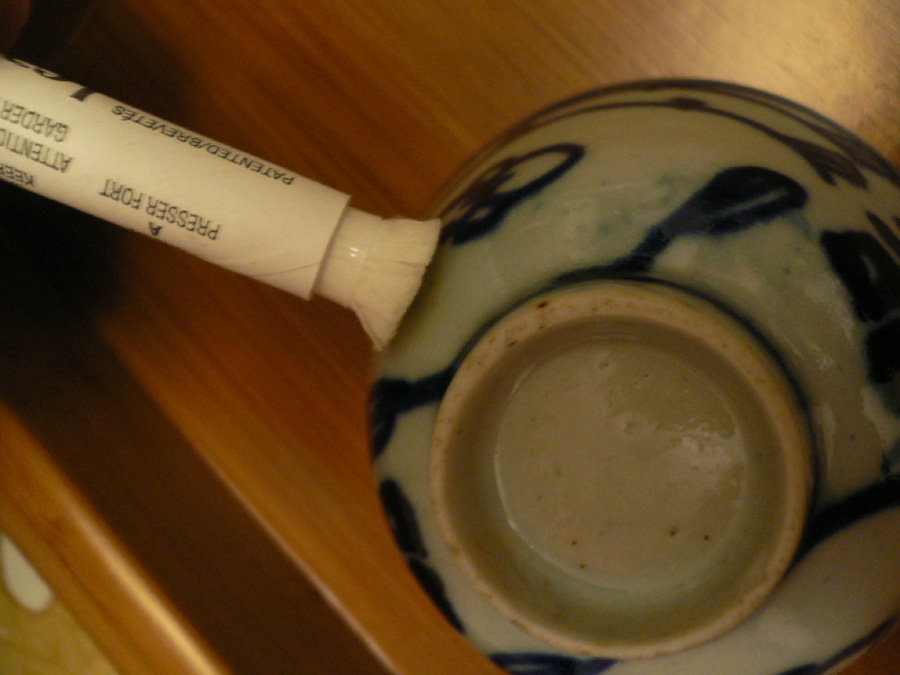 Then, I tested my new ceramics and even my Yixing teapots. As you can see below, the swab remained white (except for the dust).
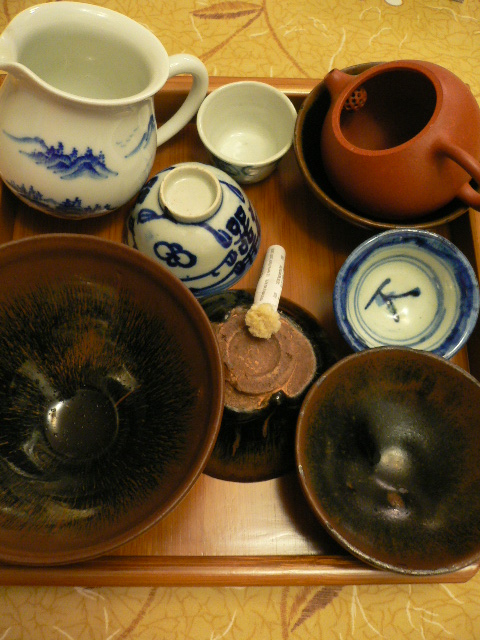 The only way to make it turn red was by using the confirmation card below:
 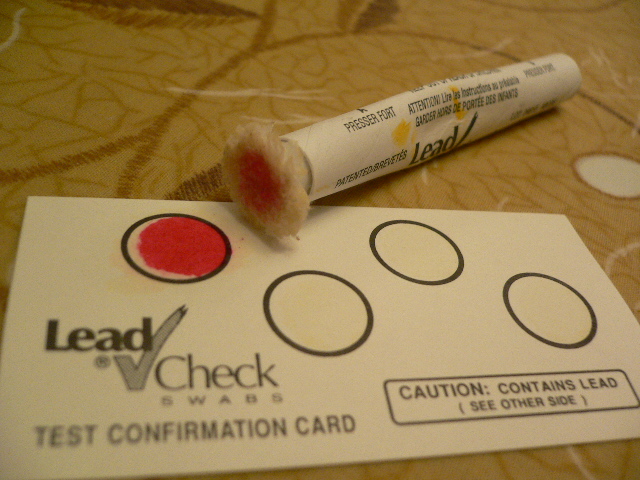 Conclusion: Readers who plan to buy or bought my antique/modern teaware can drink tea in total peace of mind. The scientific Lead Check test shows no traces of lead in the tea wares I selected for their high quality and artistic design.







 Posts
Posts


