
Wednesday, January 11, 2006
Le charbon actif de bambou est magique!
Déjà deux lecteurs et professionels du thé et de phyto-aromatérapie, Sophie et Yoann, qui me signalent ici que le charbon actif de bambou 'chinoise' leur eau française et améliore leur gongfu cha de manière significative. Je crois qu'on peut avoir confiance en leur nez, avec les professions qu'ils ont. Néanmoins, je me demande ce qu'en pensent les autres qui ont reçu mon échantillon gratuit? (Veuillez continuer les commentaires sous l'article en question, merci.)

Un petit truc de Tea Masters
Certaines théières chinoises n'ont pas de filtre interne, mais un grand trou qui a tendance à se boucher avec les feuilles de thé. Que faire? Un filtre interne en métal qu'on rajout est à proscrire (le métal altèrerait le goût du thé). Munissez-vous simplement d'un cure-dent en bois. Si des feuilles bouchent l'embout et empêchent le thé de s'écouler normalement, enfoncez le cure-dent dans l'embout et ressortez-le. Si le problème persiste, laissez le cure-dent enfoncé.
Tuesday, January 10, 2006
2005 a record year for Chinese Antiques
On the paper copy of the Asian WSJ of January 5, 2006 page 31, I read that Christie's business was up 30% over 2004 and for the first time over 3 billion USD. Last fall, they set a record for Chinese and Asian art with a Yuan Dynasty jar from the mid-14th Century, which sold for 27,7 million USD! The reason for the intergalactic price is fact that it's one of the oldest blue and white wares still around (they only become mainstream in the 16th to late 19th Century).
With China producing new millionaires every day, their currency under pressure to increase in value and global interest in arts and high end auctions, it's quite natural that Asian antiques have become particularly sought after. Some commentators see this as a sign the bubble is about to burst. For my part, I think the interest in Chinese antiques will continue to strengthen with China's rise. The good news for us (average consumers) is that it's the very unique Guan Yao (imperial/high society ware) that will increase most in value. Call it the Jordan or Zidane effect on antiques. Only the very best see their value increase exponentially. The average stuff doesn't participate in the craze. At least not if you're a smart buyer and do enough research on sites like Gotherborg.
Regular readers of the blog will have noticed that I have started to acquire Chinese antiques related to tea in the last 6 months. Let's do a quick summary of what I've got.
For instance, here is my late Qing dynasty blue and white jar:
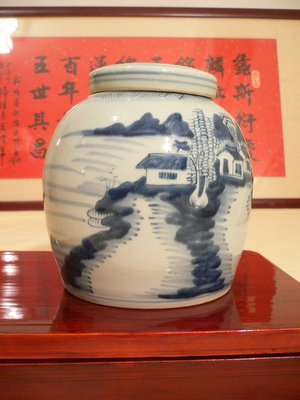
Much later but also much cheaper than the record setting blue and white jar!
It actually all started (below) with this Yuan Dynasty plate with a beautiful tree:
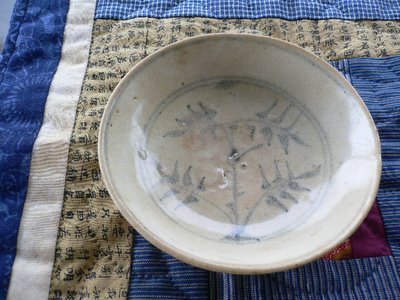
Maybe was it because I cleaned it myself, but I really got attached to this plate and am not thinking of selling it.
And of course, there are the old blue and white tea cups:
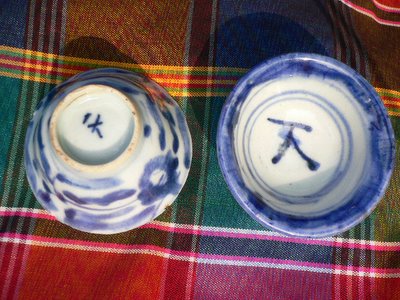
Oolong tea and old puer look very nice in it. It really brings great style to my brews and the price is reasonable too.
These 2 are a little bit less old (150-80 years) and of finer execution, but the glazing is by far not as smooth as the previous ones:
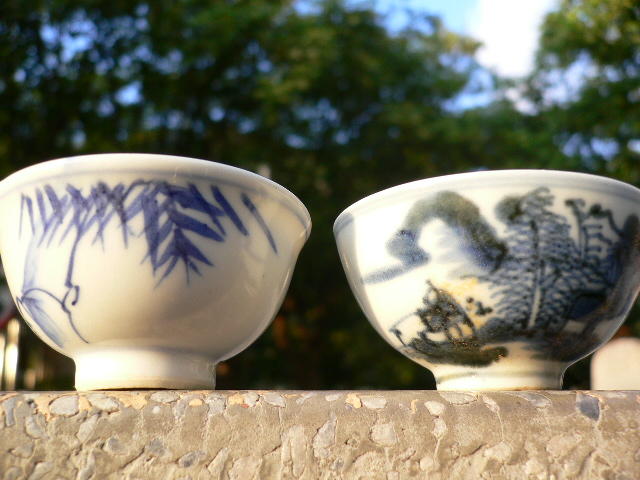
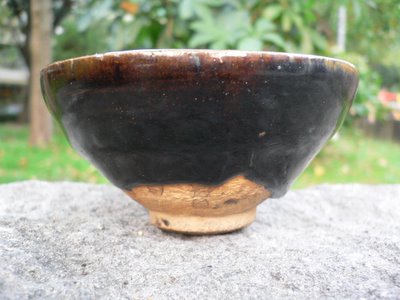
Then comes this Tianmu shan (Tianmu Mountain or Tenmoku in Japanese) bowl. This style was invented during the Song dynasty (and is still used in Japan for green tea), but this is Qing dynasty piece actually (still over 100 years old!) I use it to brew cooked or old pu erh in it directly. The color of the tea is great and the thick glazed walls keep the heat very well.
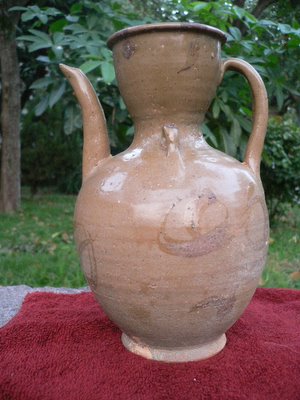
This Sung dynasty (960-1279) ever was used to pour the hot water in tianmu bowls. I may attempt to use it one day, even though my friend the potter/collector advised against it because of its age.
Below is my last purchase: a larger and finer black tea plate. For this object, the exact origin and time are unknown. "Old" is all I could get as an answer.
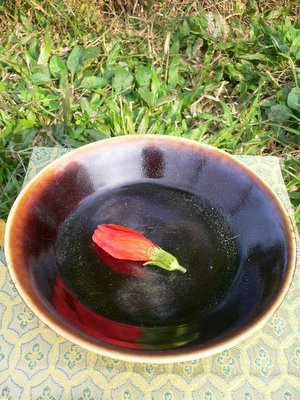
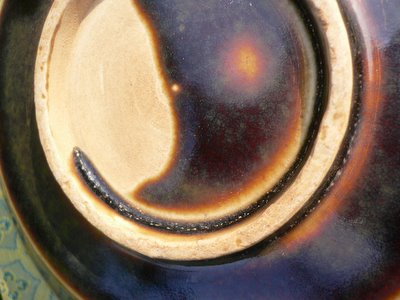
I needed a bigger plate for my bigger red teapots. The black and the red clay of my 7 years old yixing teapot go very well together.
I once spent a whole afternoon in Taipei's Chinese antique flea market looking for old tea cups. So many cups looked bad, overpriced or fake! I ended up buying nothing at all! So, I am glad also to have found this trustable and knowledgeable source of Chinese antiques at reasonable prices. To know that a piece is antique is often sufficient (to me). If the seller starts to tell you a long story he usually just tries to catch you with that. For me (us?) it's not about collecting antiques. It's about finding teaware that match best with my feelings when I do a gongfu cha.
Some people may ask for an authentification certificate, but for pieces that cost below 300 USD, I don't think it's necessarily a good idea. Certificates can be faked even more easily than pottery, and the cost of having an independent expert look at the piece may add too much cost to its intrinsic value. It's like with small diamonds: they should shine and be true, but you don't need absolute certainty about their color, clarity... To know they come from a reliable person is good enough (if the price is right).
Using antique teaware can significantly increase the beauty and harmony of gongfu cha. Tea cups and bowls are made differently nowadays and there is a different feeling and even taste (!) when you use antiques. My advice is to buy items that you will use often, not just put on display.
With China producing new millionaires every day, their currency under pressure to increase in value and global interest in arts and high end auctions, it's quite natural that Asian antiques have become particularly sought after. Some commentators see this as a sign the bubble is about to burst. For my part, I think the interest in Chinese antiques will continue to strengthen with China's rise. The good news for us (average consumers) is that it's the very unique Guan Yao (imperial/high society ware) that will increase most in value. Call it the Jordan or Zidane effect on antiques. Only the very best see their value increase exponentially. The average stuff doesn't participate in the craze. At least not if you're a smart buyer and do enough research on sites like Gotherborg.
Regular readers of the blog will have noticed that I have started to acquire Chinese antiques related to tea in the last 6 months. Let's do a quick summary of what I've got.
For instance, here is my late Qing dynasty blue and white jar:
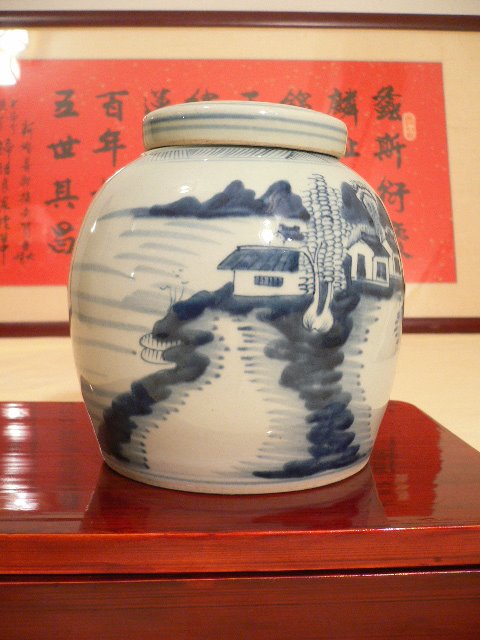
Much later but also much cheaper than the record setting blue and white jar!
It actually all started (below) with this Yuan Dynasty plate with a beautiful tree:
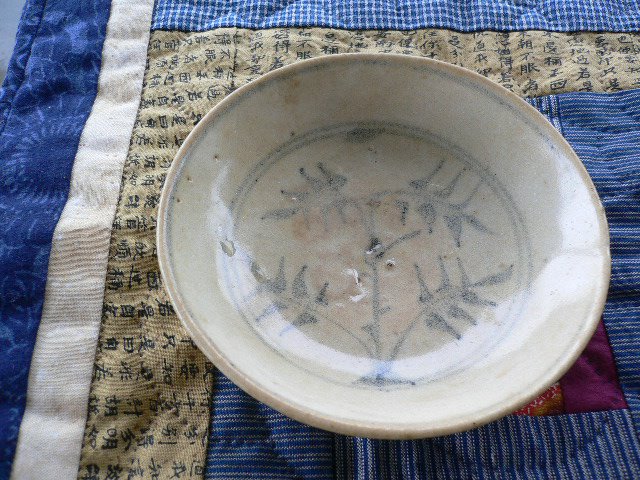
Maybe was it because I cleaned it myself, but I really got attached to this plate and am not thinking of selling it.
And of course, there are the old blue and white tea cups:
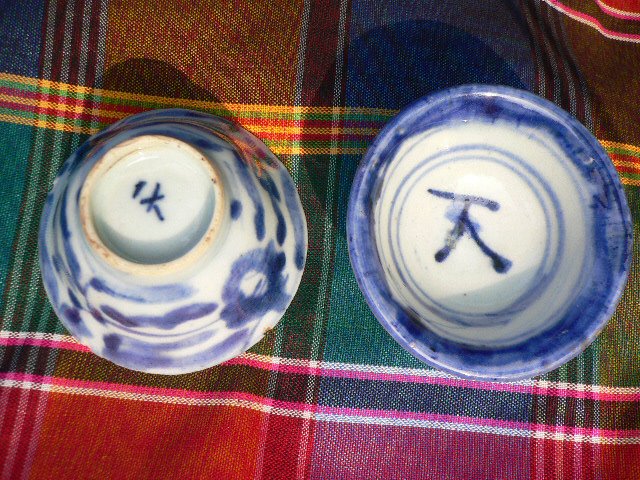
Oolong tea and old puer look very nice in it. It really brings great style to my brews and the price is reasonable too.
These 2 are a little bit less old (150-80 years) and of finer execution, but the glazing is by far not as smooth as the previous ones:
Then comes this Tianmu shan (Tianmu Mountain or Tenmoku in Japanese) bowl. This style was invented during the Song dynasty (and is still used in Japan for green tea), but this is Qing dynasty piece actually (still over 100 years old!) I use it to brew cooked or old pu erh in it directly. The color of the tea is great and the thick glazed walls keep the heat very well.
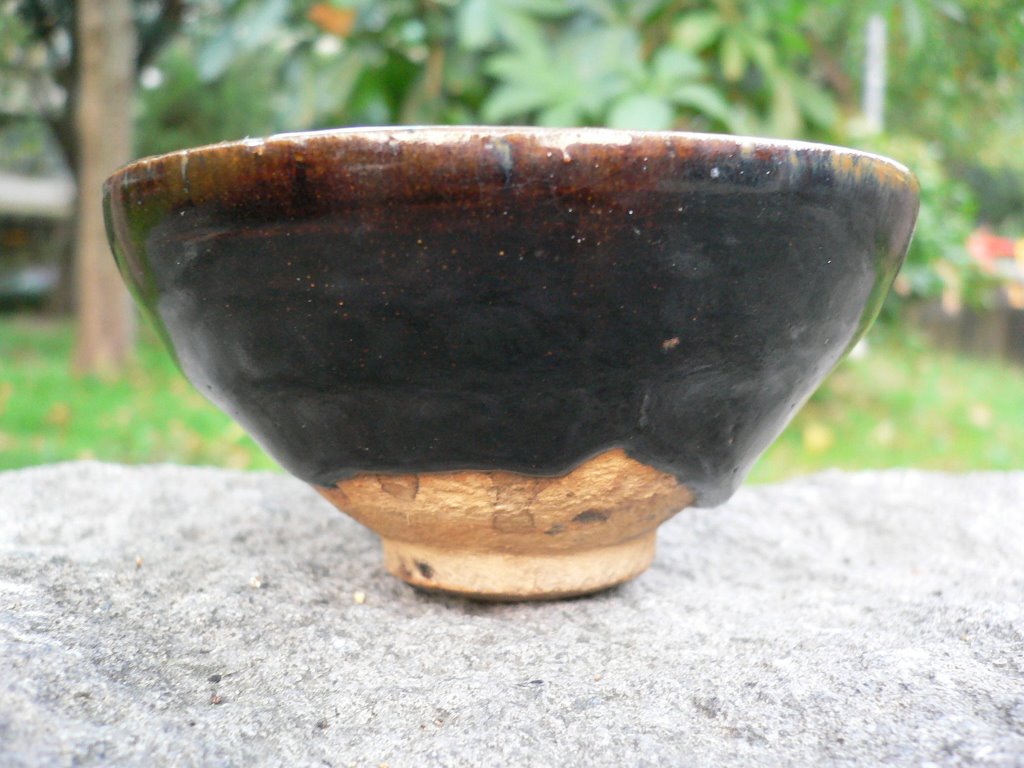
This Sung dynasty (960-1279) ever was used to pour the hot water in tianmu bowls. I may attempt to use it one day, even though my friend the potter/collector advised against it because of its age.
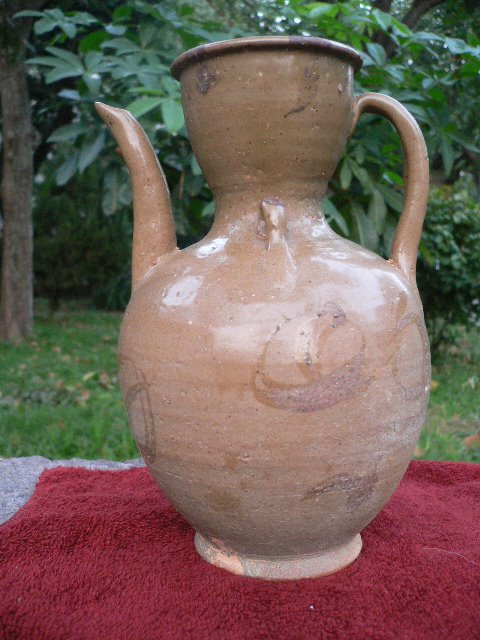
Below is my last purchase: a larger and finer black tea plate. For this object, the exact origin and time are unknown. "Old" is all I could get as an answer.


I needed a bigger plate for my bigger red teapots. The black and the red clay of my 7 years old yixing teapot go very well together.
I once spent a whole afternoon in Taipei's Chinese antique flea market looking for old tea cups. So many cups looked bad, overpriced or fake! I ended up buying nothing at all! So, I am glad also to have found this trustable and knowledgeable source of Chinese antiques at reasonable prices. To know that a piece is antique is often sufficient (to me). If the seller starts to tell you a long story he usually just tries to catch you with that. For me (us?) it's not about collecting antiques. It's about finding teaware that match best with my feelings when I do a gongfu cha.
Some people may ask for an authentification certificate, but for pieces that cost below 300 USD, I don't think it's necessarily a good idea. Certificates can be faked even more easily than pottery, and the cost of having an independent expert look at the piece may add too much cost to its intrinsic value. It's like with small diamonds: they should shine and be true, but you don't need absolute certainty about their color, clarity... To know they come from a reliable person is good enough (if the price is right).
Using antique teaware can significantly increase the beauty and harmony of gongfu cha. Tea cups and bowls are made differently nowadays and there is a different feeling and even taste (!) when you use antiques. My advice is to buy items that you will use often, not just put on display.
Monday, January 09, 2006
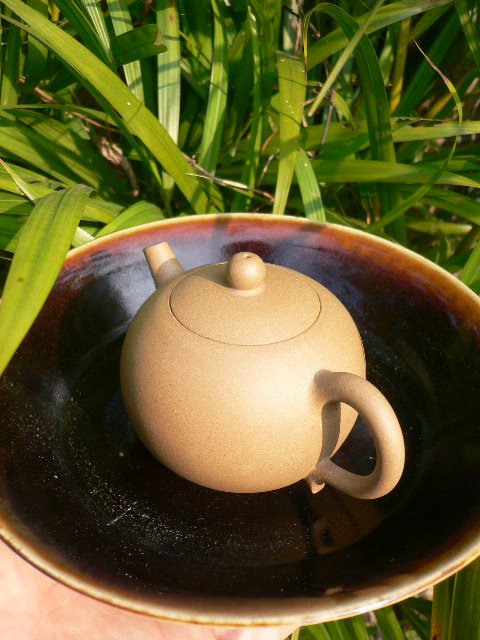
Duan Ni Yixing Teapot
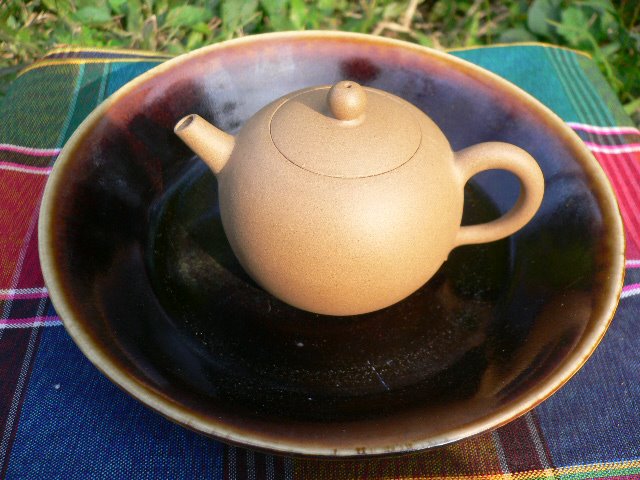
Ma théière en Duan Ni
Contenance: 90 ml environ
Cuite à 1200 degrés Celcius
Parois assez fines.
Finalement, j'ai opté pour le Tie Guan Yin torréfié pour cette théière. Les parois fines font bien ressortir les aromes. Les vieux oolongs ont surtout de la longueur en bouche et dans la gorge. Pour eux, des parois un peu plus épaisses conviennent mieux. Mais à la rigueur on peut en débattre. C'est aussi une question de goût.
Ce qui est intéressant, c'est que j'ai aussi fait mon Gung Ding Cha Zhuan (Pu Er cuit de 1988) dans cette théière et trouvai qu'elle l'adoucit bien. Je vais probablement me chercher une autre théière en duan ni, un peu moins ronde, chez mon potier pour mes pu ers cuits!
(Si quelqu'un est intéressé par cette théière - elle coûte 15 euros de plus que la zisha vieille de 7 ans- j'en possède une seconde neuve de cette série).
Saturday, January 07, 2006
What teapot or gaiwan for what tea
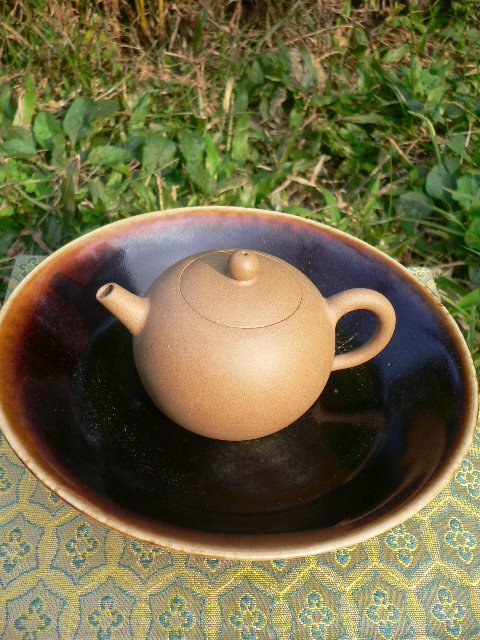 Teaparker has an article about this question. He gives these 3 rules to choose a teapot for a particular tea:
1. For teas that have flat dry leaves (like WuYi Mountain Shui Xian oolong), a rather flat teapot fits best so that tea and water are close together,
2. For teas that are knitted like small round balls (like Taiwan oolong), a round teapot is best to let the leaves open up,
3. For heavy roasted teas, the teapot should be made of softer clay (like zisha or duan ni), fired at a little bit lower temperature. (My picture, for example, shows a small round duan ni teapot that would be best with old Taiwan oolong or with roasted Tie Guan Yin).
A reader also asked me to write about this subject. So let's add the other 'rules' to help you make the best pairing of tea and teapot.
You will choose a gaiwan instead of a teapot to drink:
- (white, yellow and) green teas, or any tea with light and fine fragrance,
- any tea that you want to test, evaluate, compare, (for instance before you purchase it),
- and start learning gongfu cha. It lets you better see and smell the tea while you're doing it.
- tea in a hurry and have little time to clean the teapot.
Other principles to guide your choice of a teapot:
- Thick walls will retain temperature longer and are better fit for teas with long aftertaste, like roasted teas,
- Thin walls fit very fresh and fragrant teas.
- The yixing clay employed should be pure, or even come from a stone that has been grinded into powder so that it contains natural minerals and pores,
- The temperature at which the teapot is fired should be over 1150 degrees in order to reduce the water content of the clay below 2%. Such teapots have a high pitched sound when you open the top. This ensures that the zisha pot fulfills all its functions. Zisha clay will filter the tea: reduce its astringent and sour taste, and make it more round and mellow. It will also keep the tea and the leaves warm and it woun't burn your hands.
In conclusion, to know which tea will be best brewed in which of your teapots you should test it yourself. With a good teapot your tea will have a better fragrance as well as a better yun (finish) than with a gaiwan.
Friday, January 06, 2006
J'ai goûté au paradis
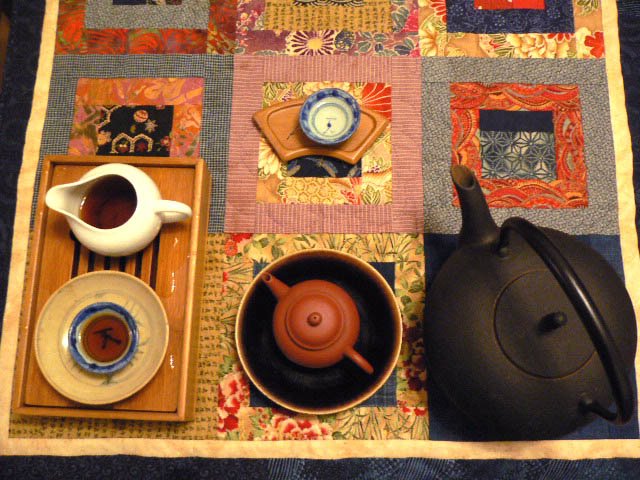
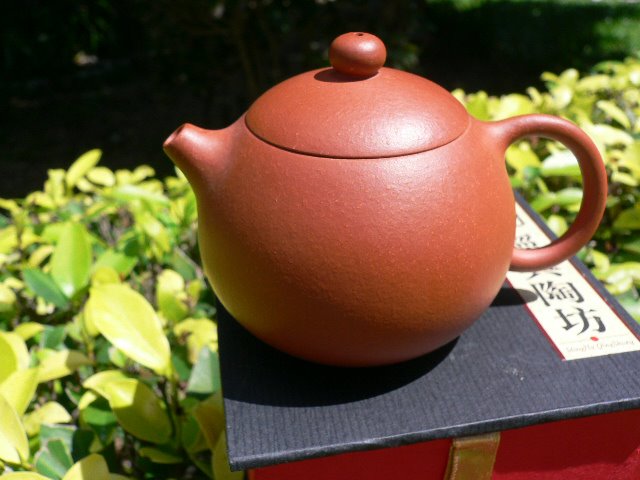
Hummm... Je me sens bien! Ce 6 janvier 2006, j'ai fait coucou aux anges par-dessus les nuages qui nous ont amené la pluie sur Taipei. Voyez mon arrangement ci-dessus. J'ai fait:
- mon meilleur thé, le tuo cha cru sauvage de 1985
- avec ma meilleure eau (l'eau de source puisée mi-juin),
- portée à ébullition dans ma tetsubin japonaise,
- dans ma théière en zisha d'Yixing,
- posée sur un cha chuan antique d'une grande finesse,
- puis versé dans ma vielle coupe bleu-blanche de la dynastie Qing,
- posée sur un autre petit cha chuan de la dynastie Yuan,
- et le tout posé sur le joli patchwork fait main avec des tissus japonais anciens
- et bu en écoutant un CD d'erhu classique.
Je sais que j'avais promis, il y a 6 mois déjà, de faire une description analytique de ce thé. Désolé! C'est encore raté! Je n'arrive pas à me concentrer sur mes impressions. Chaque fois je plane.
Thursday, January 05, 2006
The puer teas striptease
My latest puers bare it all. I bought them 2 days ago with my Christmas cash gifts. But this time, instead of choosing very expensive or very teas, I chose more affordable and ready to drink puers of very reputed makers and good quality. They all come from the China National Native Produce & Animal By-products Import & Export Company Yunnan Tea Branch (CNNP Yunnan Tea Branch), the State company and one is even made by the famous Menghai factory.
1. 1990 raw Fang Zhuan (square brick) from the Menghai region (not the factory). This brick contains leaves of all grades.
Here is the view in the bamboo leaves wrapping 3 bricks together:
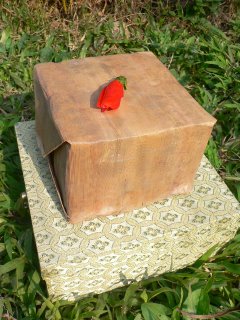 It reminded me very much the smell of tree leaves in the fall, when they are still moist and dry on the ground in misty, foggy woods. It has some fresh taste as well and a strong qi. The mix of grades creates a tea that feels very broad and difficult to grasp. That's why I say there is fog in the forest.
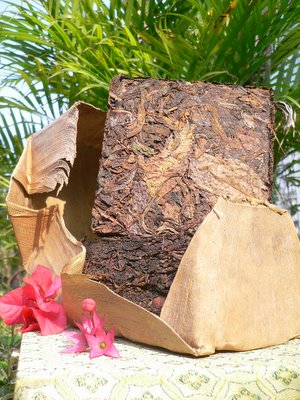
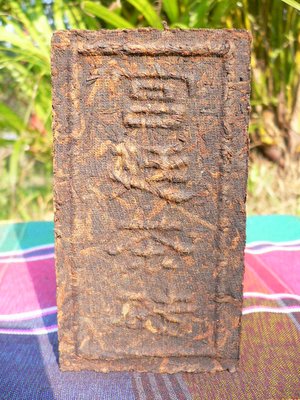
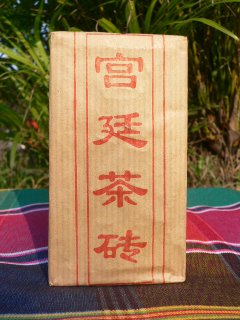 2. This small Gong Ding Cha Zhuan is a lightly cooked pu er of 1988. It's made with tea buds of first grade leaves. That's why it's called Gong Ding, imperial gift. The aromas and the brew are of very high clarity and finesse. After 18 years, the fermentation smells have greatly diminished. The brick is very hard, but once you're able to break the first piece the rest comes off more easily.
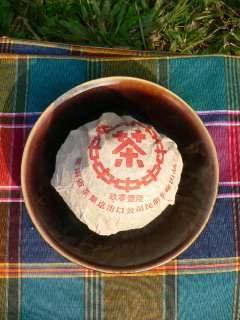 3. This is a cooked tuo cha of 1990. I bought it before Christmas, but didn't have an opportunity to introduce it yet. It is quite special because it's not only made of first grade leaves, but these leaves were harvested from wild trees. This one smells like a very old raw pu er. After 16 years, the bad smells from man-made fermentation have disappeared and it tastes very round and calm. For me, it's the best cooked puer I was given to taste, even better than the Menghai factory cooked puer from the same time.
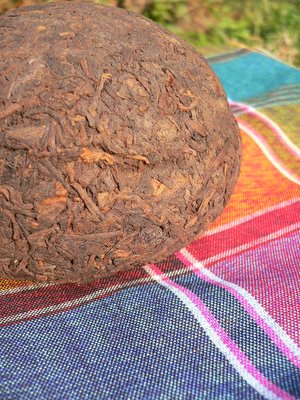
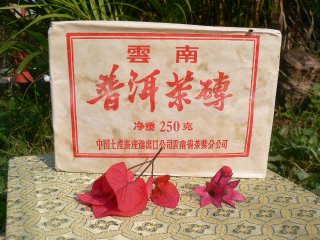 4. This Yunnan Pu Er Cha Zhuan was made in the year 2000. It contains cooked pu er leaves of grade 5. After 5 years of rest, it starts to be drinkable, says my pu er importer. We tasted it together on the very same day and I found it still has a very strong camphor taste (but without the freshness). The taste of fermentation is still very much there, which I don't find very pleasant. But the astringency is completely gone. It is very round and becomes mellow. I guess it will improve as it ages further, but can also already be drunk now in a large teapot. The low price makes it also quite attractive to start with cooked puer.
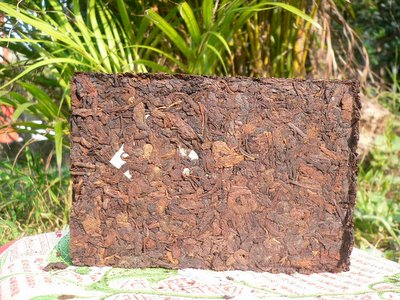
It wasn't the first time that my merchant told me that cooked puer also need to 'age', so I asked Teaparker about it. He told me that cooked puer's purpose is to make puer that be drunk quickly (as opposed to raw puer that ages slowly). The 'problem' is that nowadays the factories use more water than before for this process. This increases humidity and mold in young cooked puer. That's why it's best to wait 4/5 years. Another trick from my vendor is to wash the leaves with tea a first time and even a second time. This pu er can last many infusions anyway!
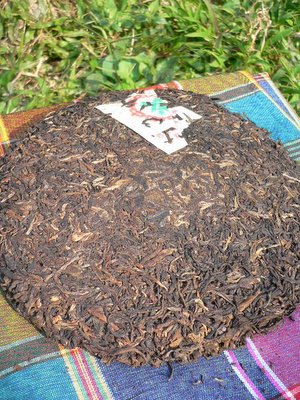
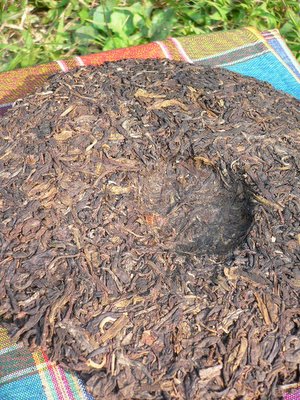
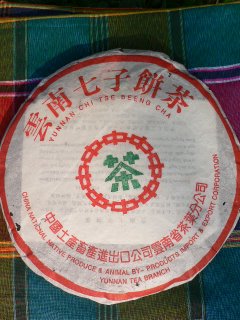 5. This is the famous '7542' raw qizi bing cha from the Menghai factory. This one from the year 1999. The dry smell amazingly already displays nice aging, but it could probably age longer. I haven't tried it yet. It's also the most expensive tea on this post.
Here's a view of the top:
And one of its bottom:
1. 1990 raw Fang Zhuan (square brick) from the Menghai region (not the factory). This brick contains leaves of all grades.
Here is the view in the bamboo leaves wrapping 3 bricks together:
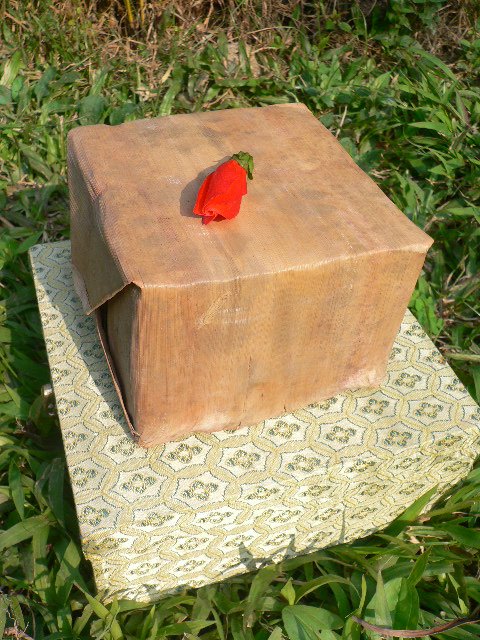 It reminded me very much the smell of tree leaves in the fall, when they are still moist and dry on the ground in misty, foggy woods. It has some fresh taste as well and a strong qi. The mix of grades creates a tea that feels very broad and difficult to grasp. That's why I say there is fog in the forest.
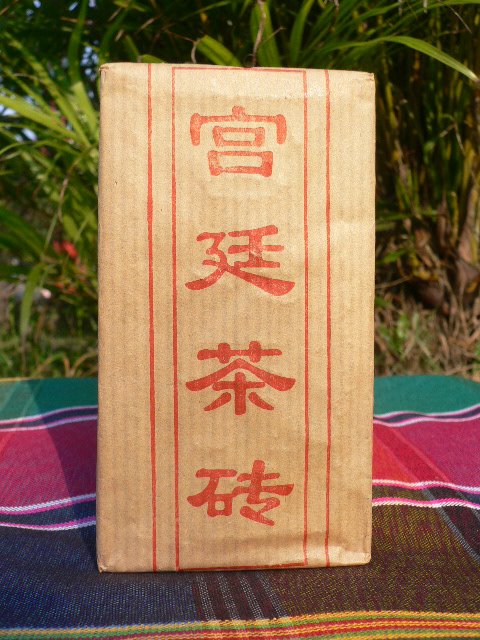 2. This small Gong Ding Cha Zhuan is a lightly cooked pu er of 1988. It's made with tea buds of first grade leaves. That's why it's called Gong Ding, imperial gift. The aromas and the brew are of very high clarity and finesse. After 18 years, the fermentation smells have greatly diminished. The brick is very hard, but once you're able to break the first piece the rest comes off more easily.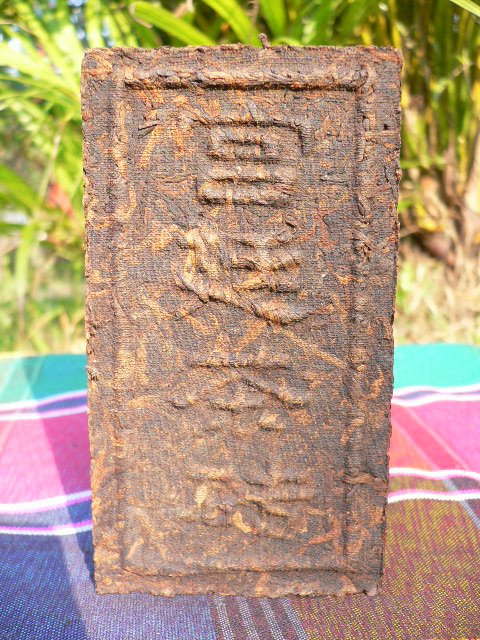
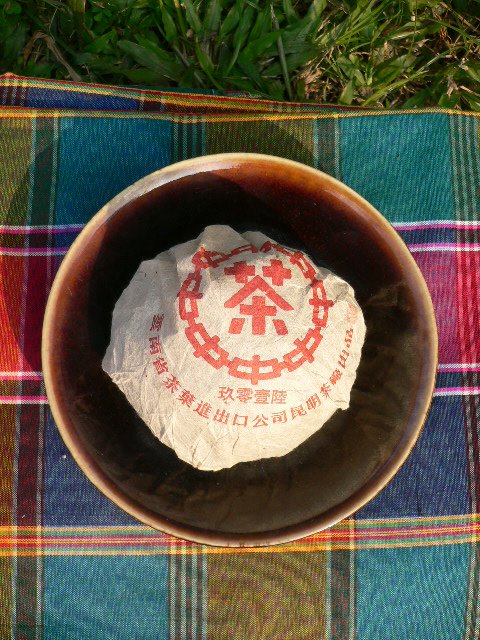 3. This is a cooked tuo cha of 1990. I bought it before Christmas, but didn't have an opportunity to introduce it yet. It is quite special because it's not only made of first grade leaves, but these leaves were harvested from wild trees. This one smells like a very old raw pu er. After 16 years, the bad smells from man-made fermentation have disappeared and it tastes very round and calm. For me, it's the best cooked puer I was given to taste, even better than the Menghai factory cooked puer from the same time.
 4. This Yunnan Pu Er Cha Zhuan was made in the year 2000. It contains cooked pu er leaves of grade 5. After 5 years of rest, it starts to be drinkable, says my pu er importer. We tasted it together on the very same day and I found it still has a very strong camphor taste (but without the freshness). The taste of fermentation is still very much there, which I don't find very pleasant. But the astringency is completely gone. It is very round and becomes mellow. I guess it will improve as it ages further, but can also already be drunk now in a large teapot. The low price makes it also quite attractive to start with cooked puer.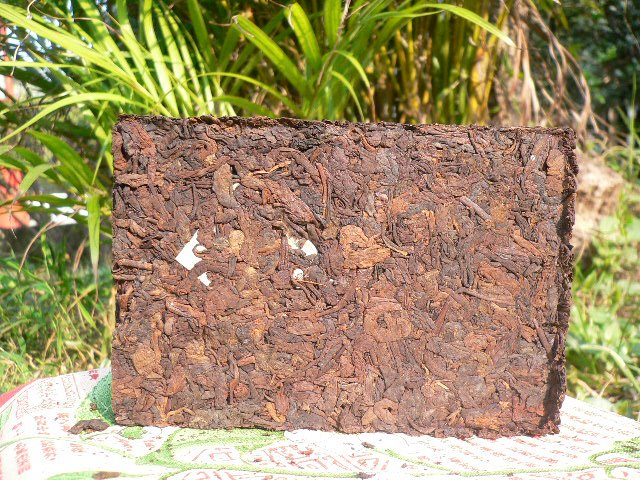
It wasn't the first time that my merchant told me that cooked puer also need to 'age', so I asked Teaparker about it. He told me that cooked puer's purpose is to make puer that be drunk quickly (as opposed to raw puer that ages slowly). The 'problem' is that nowadays the factories use more water than before for this process. This increases humidity and mold in young cooked puer. That's why it's best to wait 4/5 years. Another trick from my vendor is to wash the leaves with tea a first time and even a second time. This pu er can last many infusions anyway!
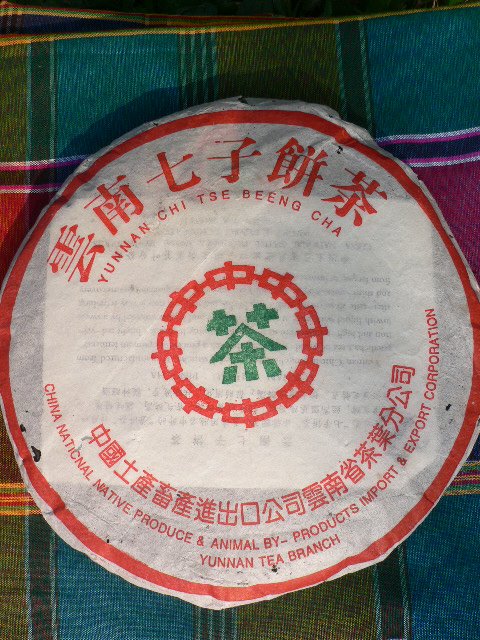 5. This is the famous '7542' raw qizi bing cha from the Menghai factory. This one from the year 1999. The dry smell amazingly already displays nice aging, but it could probably age longer. I haven't tried it yet. It's also the most expensive tea on this post.
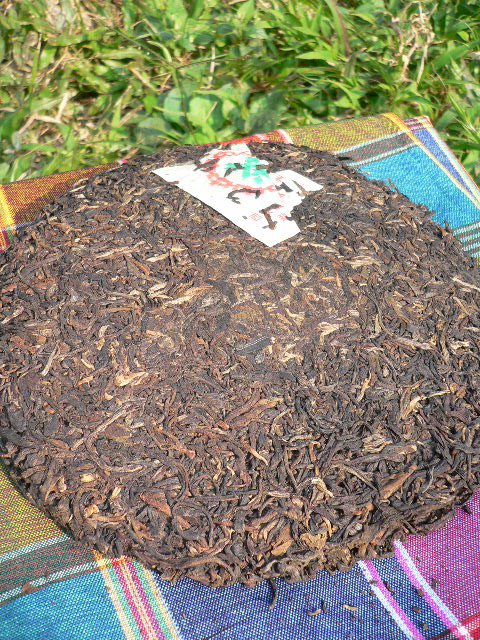
Here's a view of the top:
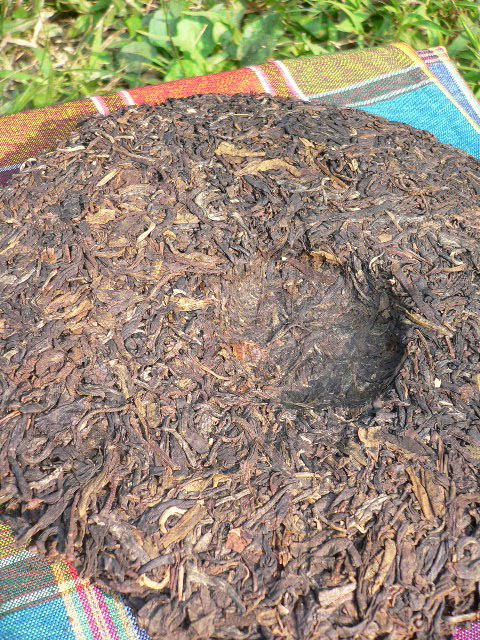
And one of its bottom:
Wednesday, January 04, 2006
Mes cadeaux puer

Dans mes cadeaux de Noël s'étaient glissé quelques petites enveloppes rouges remplies de milliers de dollars ... taiwanais! (1000 dollars Taiwanais = 26 euros seulement!). C'est donc avec ces étrennes que je suis allé voir mon marchand/grossiste de pu er, hier. Mais au lieu de me contenter du meilleur (du pu-er sauvage de plus en plus hors de prix), j'ai décidé d'opter pour des pu-ers de plantation réputés, buvables maintenant, mais point trop chers. La plupart de ces thés sont faits par la China National Native Produce & Animal By-producrs Import & Export Company Yunnan Tea Branch (abréviée CNNP Yunnan Tea Branch), la grande firme agricole d'Etat, l'ancien monopole du régime communiste. Cela est une garantie de sérieux et de qualité. Les voici:
De gauche à droite:
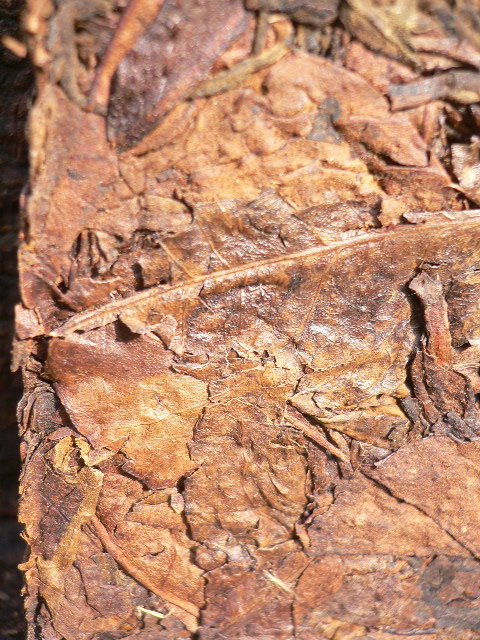 1. Enveloppé dans des feuilles de bambou indocalamus, trois Pu Er cru en Fang Zhuan (brique carrée) de la région de Menghai de 1990. Il est fabriqué par la CNNP de Yunnan Tea Branch). Ses feuilles de toutes catégories (de 1 à 10). Les briques sont emballées par trois dans des feuilles de bambou, sans papier.
Je l'ai déjà goûté 2 fois. Il a un cha chi très puissant qui vous clarifie rapidement la tête. Attention à ne pas en faire trop, sinon c'est la nuit blanche au thé noir! Son arome est celui des feuilles qui tombent en automne. On perçoit justement aussi un peu la fraicheur de cette saison qui prélude à l'hiver. Comme c'est un mélange de feuilles de différents grades, le goût n'est pas tranché clair et net: il est un peu flou, insaisissable, un peu comme une forêt envelppé d'un léger brouillard. Contrairement à la brique de Jiang Cheng sauvage (qui a encore beaucoup de potentiel de garde), celui-ci est déjà bon à boire maintenant.
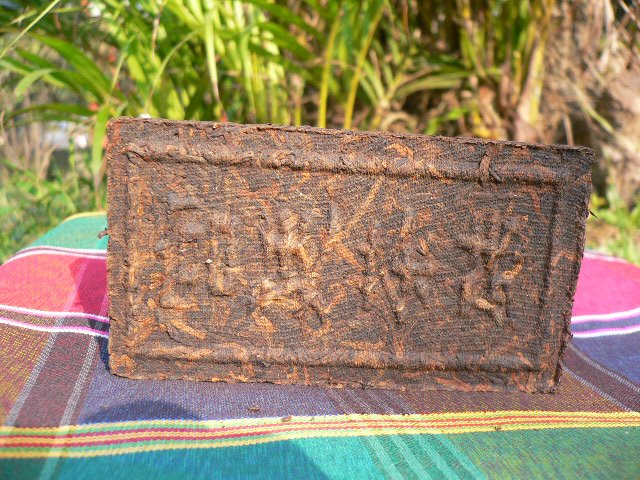 2. Un petit Pu-Er cuit légèrement en Gong Ding Cha Zhuan de 100 gr de 1988. Ses feuilles de 1ère qualité car Gong Ding signifie cadeau impérial. Du coup -je viens d'en boire 3 infusions- le thé a plus de clarté et de finesse. Son arome garde encore un peu le goût de la fermentation, mais pas trop. Les aromes sont plus amples, avec des traces de camphre. Tout comme le précédent, il semble assez costaud pour durer encore de nombreuses infusions.
 3. La qizi bing '7542’ de la firme Menghai de 1999. C'est une des plus célèbres galettes crues de la firme vedette du pu-er (notamment pour les pu ers cuits). Je ne l'ai pas encore goûté, mais son odeur à sec semble prometteuse, même si elle est encore un peu jeune. Faut dire que j'ai fait une petite entorse à mon budget: son prix est bien plus élevé que pour les autres pu-ers.
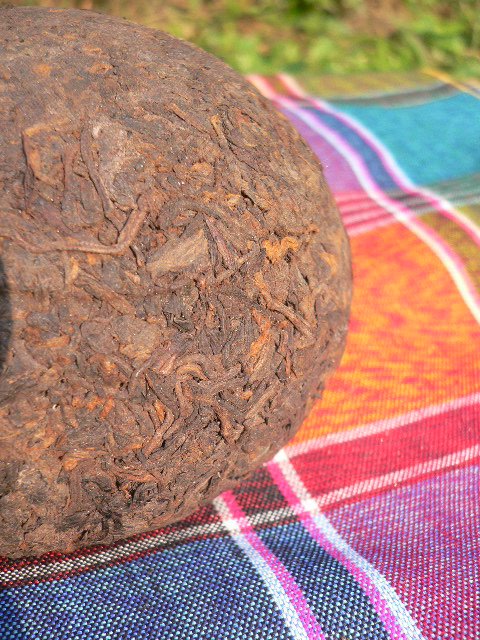 4. Le Tuo Cha est un pu er sauvage (!) cuit, fait avec des feuilles de 1ère qualité en 1990. Lui aussi est fait par la CNNP de Yunnan. Celui-là, je l'ai acheté avant les fêtes et n'avais pas encore eu l'occasion de le présenter. Il a encore plus de finesse et un goût de vieux pu er plus prononcé que le Gong Ding, car son odeur de fermentation a déjà disparu.
Il n'est pas donné, mais pour ceux qui préfèrent le calme des très vieux puers, c'est ce qui se fait de mieux en puer cuit pour les approcher.
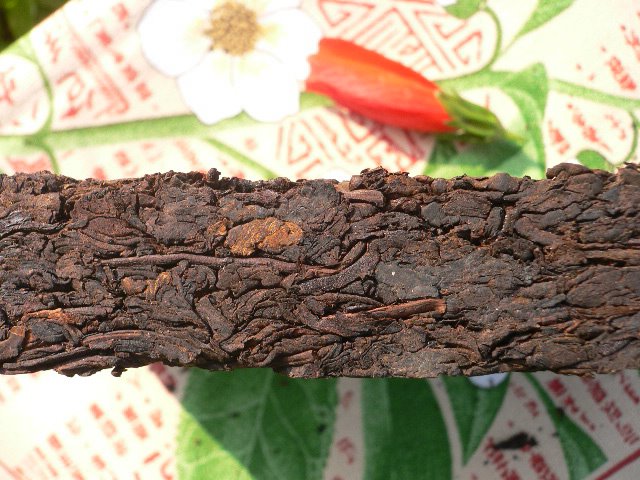 5. La brique cuite d'Yunnan Pu Er Cha Zhuan de 250 gr a été fabriquée en 2000 par la CNNP d'Yunnan Tea Branch. Les feuilles sont toutes de grade 5. Après 5 années de repos, elle est enfin bonne à boire.
 C'est d'ailleurs une question que j'ai posée à Teaparker récemment: le pu er cuit est-il buvable immédiatement ou bien s'améliore-t-il avec l'âge? La fermentation 'artificielle' a pour but de rendre le pu er buvable rapidement (car beaucoup trouvent le pu er cru trop astringent et pas assez digeste). Cependant, les méthodes actuelles de fermentation empoloient plus d'eau que par le passé. Cela a pour conséquence d'augmenter les odeurs de moisi. Le mieux est d'attendre quelques années que ces odeurs disparaissent progressivement. Mon grossiste conseille d'attendre 4 à 5 ans. Cela explique donc que le pu er cuit s'améliore aussi avec l'âge. Mais pas de la même manière et pas aussi dramatiquement que le pu er cru.
J'ai bu de cette brique hier et la trouvai d'un goût prononcé de camphre et de terre, mais sans vraie impression de frais. Plutôt, on a encore le goût de la fermentation durant les premières infusions. (Un truc de mon marchand: il jetta les 2 premières infusions pour laver ces mauvaises odeurs. De tout de façon vous en tirerez encore beaucoup. Il a encore clairement du potentiel pour s'améliorer. Il ne deviendra jamais aussi bon qu'un vieux pu er cru, mais à ce prix-là, c'est un thé qu'on peut boire sans souci en grandes quantités ou pour commencer le pu er cuit.
J'ai plus le temps aujourd'hui. Je vous parlerai de ma petite théière en Duan Ni et de cette vieille assiette à thé un autre jour. Admirez!
Tuesday, January 03, 2006
Cha qi discussion
Did I ever write how readers of this blog are amongst the most enthusiastic and knowledgeable tea fans in the western world. It's a pleasure and a privilege for me to write for and be read by all of you. It gives me the opportunity to exchange lots of ideas and knowledge also through emails. Here are the best pieces of an email exchange I've had with 2 students of Chinese medecine from San Francisco. We are trying to define cha qi:
David:
"Your question is a very simple one, but very hard to answer. Even after 2 years of TCM school and more years of practicing internal martial arts, I have trouble with that question. I've pretty much come to the conclusion that anyone who can give you a definitive answer is wrong. It's much easier to point out Qi than it is to describe what it is.
(...)
Everything has Qi. That is the common bond between all things in existence. Without Qi an object isn't 'here.' Without Qi there isn't such a concept as 'here.'
Ok, beyond the grand cosmic view of Qi, there is the much simplified idea of Qi that is usually referenced in chinese medicine. This is the Qi that provides the spark of life in people... it gives you life, moves your limbs, makes your organs function, your hair grow, protects you from illness, etc. This is the Qi of humans. If you want to know more about this from a much better writer, I recommend reading "The Web That Has No Weaver" by Ted Kaptchuk.
Cha Qi: the qi of tea. I assume all tea has Qi. My guess is that when someone says that a tea has a strong Qi, they are probably talking about how the cha qi interacts with their own Qi. In herbal medicine, herbs are described energetically they move qi up, down, internally, externally, they are spicy, sweet, bland, bitter, sour, they dry, astringe, moisturize, warm, cool, etc. When an herb is used medicinally, its Qi has a certain effect on a person; for instance, an herb that is warm and spicy and goes to the surface (e.g ginger / sheng jiang) will cause a person to sweat. So, my guess is that teas have certain energetic qualities that generate energetic responses in the drinker. Aged sheng puerh has many layers of complexity -- the qi of the original tree (young, old, ancient, plantation, wild, etc), the processing method (sun dried, etc), the aging (wet/dry), and the locale (Yunnan, Hong Kong, Taiwan, San Francisco, etc.) All these qualities combine and are both the result of Qi and a reflection of Qi. A good combination of all these qualities is discernible by the drinker as an intangible quality that is a result of all of this and the interaction with the drinkers Qi."
My addition:
"Some people say that cha chi (qi) is just the effect of caffein in the tea. It goes to your head and then you can't sleep. Some others say the soothing, warming effect comes from the high temperature of the water. Both points play important roles. Some young puers will keep you awake like Italian expressos. Drunk cold, tea doesn't reach so far in your body. However, cha chi is more than that. I recently drank a young puer with strong caffein, but which gave me a headache. My 1990 also has a strong caffein level, but it clarifies my mind and relaxes my body. Hot water's warming effect is far from that. So, I agree with you that cha qi is the sum of everything in the hot tea. And we experience it through the interaction with our senses (and the way our qi is set). Like taking the pulse in Chinese medecine (my father learned both western and Chinese medecine, like you) this takes lots of practice and concentration because we are not used to pay attention to such little variations."
And now Michael:
"I had one thought: when we talk about the qi of tea (“this one has strong/good qi”), we’re of course talking about an essential quality, the presence, the gestalt of the experience of “communing” with the tea. As David suggested, any herb (or for that matter, any natural element) has specific properties, features that are particular and that make it what it is (including regional differences in quality).
What all this makes me think of is the term “shen,” or spirit (or mind, or a number of other possible translations). It’s a term that’s used to describe the overall quality of something or someone—in clinical assessment, in tongue and pulse diagnosis, and in many other contexts. It seems to me that in some ways when we talk about the “cha qi” we’re talking about the shen of the tea—which includes the energy, the appearance, the feel, etc., but more importantly describes its overall presence and our experience of it. Shen is really a refined (more yang) form of qi anyway—just as qi is, in the body, a refined form of essence (jing—for further discussion of jing-qi-shen, I recommend Daniel Reid’s books). As shen relates to the heart, which is the king organ, so shen encompasses all the other aspects of experience; in tea terms, this might mean everything from basic appearance and color and fragrance to flavor and aroma to the feeling/effect to whatever else you can think of.
This seems to me to be why, in gongfu tea preparation, the presentation and intention are so important—it’s not just the tea we’re dealing with, but our interaction with it in the process of brewing and drinking. All of this creates an energetic process, a holistic experience, a kind of shen."
You're welcome to add experience or idea of cha qi as a comment. We may never exhaust the subject, as David says, but I feel we're coming very close!
David:
"Your question is a very simple one, but very hard to answer. Even after 2 years of TCM school and more years of practicing internal martial arts, I have trouble with that question. I've pretty much come to the conclusion that anyone who can give you a definitive answer is wrong. It's much easier to point out Qi than it is to describe what it is.
(...)
Everything has Qi. That is the common bond between all things in existence. Without Qi an object isn't 'here.' Without Qi there isn't such a concept as 'here.'
Ok, beyond the grand cosmic view of Qi, there is the much simplified idea of Qi that is usually referenced in chinese medicine. This is the Qi that provides the spark of life in people... it gives you life, moves your limbs, makes your organs function, your hair grow, protects you from illness, etc. This is the Qi of humans. If you want to know more about this from a much better writer, I recommend reading "The Web That Has No Weaver" by Ted Kaptchuk.
Cha Qi: the qi of tea. I assume all tea has Qi. My guess is that when someone says that a tea has a strong Qi, they are probably talking about how the cha qi interacts with their own Qi. In herbal medicine, herbs are described energetically they move qi up, down, internally, externally, they are spicy, sweet, bland, bitter, sour, they dry, astringe, moisturize, warm, cool, etc. When an herb is used medicinally, its Qi has a certain effect on a person; for instance, an herb that is warm and spicy and goes to the surface (e.g ginger / sheng jiang) will cause a person to sweat. So, my guess is that teas have certain energetic qualities that generate energetic responses in the drinker. Aged sheng puerh has many layers of complexity -- the qi of the original tree (young, old, ancient, plantation, wild, etc), the processing method (sun dried, etc), the aging (wet/dry), and the locale (Yunnan, Hong Kong, Taiwan, San Francisco, etc.) All these qualities combine and are both the result of Qi and a reflection of Qi. A good combination of all these qualities is discernible by the drinker as an intangible quality that is a result of all of this and the interaction with the drinkers Qi."
My addition:
"Some people say that cha chi (qi) is just the effect of caffein in the tea. It goes to your head and then you can't sleep. Some others say the soothing, warming effect comes from the high temperature of the water. Both points play important roles. Some young puers will keep you awake like Italian expressos. Drunk cold, tea doesn't reach so far in your body. However, cha chi is more than that. I recently drank a young puer with strong caffein, but which gave me a headache. My 1990 also has a strong caffein level, but it clarifies my mind and relaxes my body. Hot water's warming effect is far from that. So, I agree with you that cha qi is the sum of everything in the hot tea. And we experience it through the interaction with our senses (and the way our qi is set). Like taking the pulse in Chinese medecine (my father learned both western and Chinese medecine, like you) this takes lots of practice and concentration because we are not used to pay attention to such little variations."
And now Michael:
"I had one thought: when we talk about the qi of tea (“this one has strong/good qi”), we’re of course talking about an essential quality, the presence, the gestalt of the experience of “communing” with the tea. As David suggested, any herb (or for that matter, any natural element) has specific properties, features that are particular and that make it what it is (including regional differences in quality).
What all this makes me think of is the term “shen,” or spirit (or mind, or a number of other possible translations). It’s a term that’s used to describe the overall quality of something or someone—in clinical assessment, in tongue and pulse diagnosis, and in many other contexts. It seems to me that in some ways when we talk about the “cha qi” we’re talking about the shen of the tea—which includes the energy, the appearance, the feel, etc., but more importantly describes its overall presence and our experience of it. Shen is really a refined (more yang) form of qi anyway—just as qi is, in the body, a refined form of essence (jing—for further discussion of jing-qi-shen, I recommend Daniel Reid’s books). As shen relates to the heart, which is the king organ, so shen encompasses all the other aspects of experience; in tea terms, this might mean everything from basic appearance and color and fragrance to flavor and aroma to the feeling/effect to whatever else you can think of.
This seems to me to be why, in gongfu tea preparation, the presentation and intention are so important—it’s not just the tea we’re dealing with, but our interaction with it in the process of brewing and drinking. All of this creates an energetic process, a holistic experience, a kind of shen."
You're welcome to add experience or idea of cha qi as a comment. We may never exhaust the subject, as David says, but I feel we're coming very close!
Monday, January 02, 2006
2006, la suite de mes cadeaux de Noël
Joyeuse Année 2006!
 Ma femme m'a offert ce vacuum sealer qui permet de fermer les paquets de thé hermétiquement sous vide. La fonction de mise sous vide n'est pas aussi puissante que pour les appareils des pros, mais comme je compte surout m'en servir pour mon vieux baozhong en vrac, ce n'est pas un problème (on ne met pas le bazozhong ou les vieux thés sous vide car cela risque de casser leurs feuilles fragiles). Du coup, ce cadeau n'est pas que pour moi, il est aussi un peu pour vous qui me commandez du thé, afin que celui-ci garde toute sa fraicheur et ses arômes.
 J'avais oublié un CD de musique chinoise d'Er-hu. Pas mal du tout. Pas trop d'orchestration et des musiques assez joyeuses qui me font un peu oublier le dernier roman suicidaire de Houellebecq (La possibilité d'un ile), lu récemment. Un bon livre sur notre époque, cependant, mais pas recommandé durant les périodes de doute. Bref, cette musique chinoise céèbre la vie qui coule comme le thé dans ma tasse. Je le mettrais en position 2 ou 3 dans ma liste de CD. Au cas où vous n'arrivez pas à lire sur cette photo, le joueur d'Erhu s'appelle Kan Pai-Lin et il est accompagné par la troupe de musique chinoise classique de Pékin.
 Encore un cadeau de ma mère: cette magnifique linge de table 100% en lin. Le motif est au thème qui nous est chèr: le thé chinois. Mais cette belle petit nappe ne vient pas de Chine pour autant! Elle vient de Ribeauvillé en Alsace, fabriquée par la marque Beauvillé.
Encore une preuve de l'intérêt alsacien pour le thé chinois. J'ai la passion dans mes gènes, et ça ne me gêne pas!
Je vais le montrer à Teaparker à la prochaine occasion. Je suis certain que, comme moi, il trouvera étonnant un tel écho au thé au gongfu cha si loin de Chine.
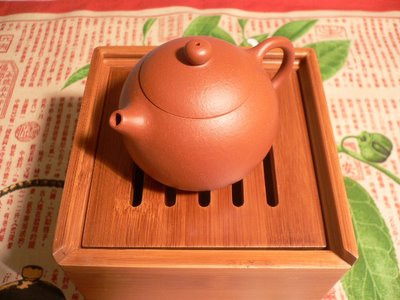
 Ce dernier cadeau n'est pas pour moi, il est pour ma toute dernière commande de 2 petites théières en zhuni. Il s'agit de la boite en bambou. Celle-ci est normalement réservée à une autre théière en zhuni de type baotai, aux parois hyper fines (plus chère et conçue pour le baozhong). Or, cette fois, l'usine en Chine s'est trompé d'emballage et y a mis cette théière dedans. Du coup, comme on est bientôt le Nouvel An chinois, le patron ne change pas l'emballage et c'est une jolie boite en bambou (qui peut aussi servir de plateau pour préparer le thé) qui est offerte avec la théière. J'en ai pris quelques-uns en stock, mais il risque de ne pas y en avoir assez pour tout le monde. C'est le moment pour passer commande!
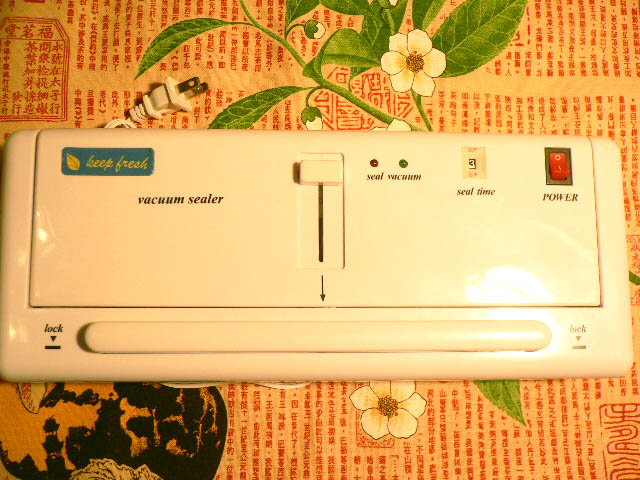 Ma femme m'a offert ce vacuum sealer qui permet de fermer les paquets de thé hermétiquement sous vide. La fonction de mise sous vide n'est pas aussi puissante que pour les appareils des pros, mais comme je compte surout m'en servir pour mon vieux baozhong en vrac, ce n'est pas un problème (on ne met pas le bazozhong ou les vieux thés sous vide car cela risque de casser leurs feuilles fragiles). Du coup, ce cadeau n'est pas que pour moi, il est aussi un peu pour vous qui me commandez du thé, afin que celui-ci garde toute sa fraicheur et ses arômes.
 J'avais oublié un CD de musique chinoise d'Er-hu. Pas mal du tout. Pas trop d'orchestration et des musiques assez joyeuses qui me font un peu oublier le dernier roman suicidaire de Houellebecq (La possibilité d'un ile), lu récemment. Un bon livre sur notre époque, cependant, mais pas recommandé durant les périodes de doute. Bref, cette musique chinoise céèbre la vie qui coule comme le thé dans ma tasse. Je le mettrais en position 2 ou 3 dans ma liste de CD. Au cas où vous n'arrivez pas à lire sur cette photo, le joueur d'Erhu s'appelle Kan Pai-Lin et il est accompagné par la troupe de musique chinoise classique de Pékin.
 Encore un cadeau de ma mère: cette magnifique linge de table 100% en lin. Le motif est au thème qui nous est chèr: le thé chinois. Mais cette belle petit nappe ne vient pas de Chine pour autant! Elle vient de Ribeauvillé en Alsace, fabriquée par la marque Beauvillé.
Encore une preuve de l'intérêt alsacien pour le thé chinois. J'ai la passion dans mes gènes, et ça ne me gêne pas!
Je vais le montrer à Teaparker à la prochaine occasion. Je suis certain que, comme moi, il trouvera étonnant un tel écho au thé au gongfu cha si loin de Chine.
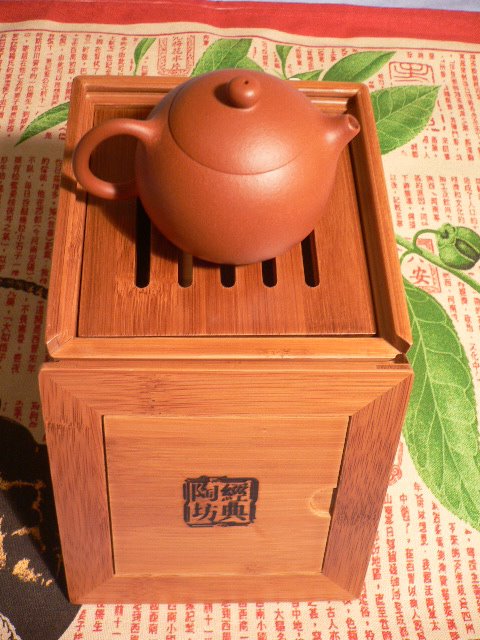 Ce dernier cadeau n'est pas pour moi, il est pour ma toute dernière commande de 2 petites théières en zhuni. Il s'agit de la boite en bambou. Celle-ci est normalement réservée à une autre théière en zhuni de type baotai, aux parois hyper fines (plus chère et conçue pour le baozhong). Or, cette fois, l'usine en Chine s'est trompé d'emballage et y a mis cette théière dedans. Du coup, comme on est bientôt le Nouvel An chinois, le patron ne change pas l'emballage et c'est une jolie boite en bambou (qui peut aussi servir de plateau pour préparer le thé) qui est offerte avec la théière. J'en ai pris quelques-uns en stock, mais il risque de ne pas y en avoir assez pour tout le monde. C'est le moment pour passer commande!
Subscribe to:
Posts (Atom)


 Posts
Posts


