Tuesday, January 09, 2007

Winter 2006 Si Ji Chun Oolong is here!

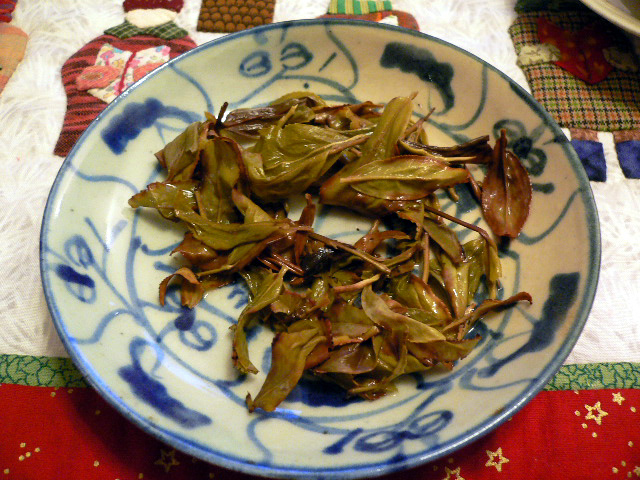
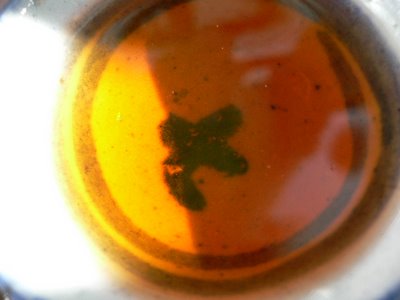
This 4 Seasons Spring (Si Ji Chun) Oolong comes from Ming Jian and was harvested mecanically on November 7, 2006. It is a typical low elevation and low oxidation modern Oolong. Its emphasis is on a very fresh, flowery fragrance with hints of cut grass. This smell disappears very quickly after the cup of tea is swallowed. What remains is a kind of numb feeling of the tongue. It's neither sweet nor astringent.

The brew is nicely clear, transparent. The color is green/yellow and doesn't turn red, even if brewed for long periods of time. Therefore, it is possible to either brew it in a large pot or several times gongfu style. Combined with its low price, it's a good candidate for an everyday light, greener Oolong. Its lack of long aftertaste and long smell would be a defect for a high mountain Oolong. But for an everyday Oolong that you won't prepare and taste with the same intensity and focus, it can actually be an advantage. Better to have a good short flowery fragrance with little aftertaste, than to have an Oolong with a long, but bad aftertaste! This also makes it a good Oolong for beginners: the brewing technique (or lack of) doesn't impact the result too much. Just use just boiled water in a preheated brewing vessel.

Spring freshness is one of main characteristics of Si Ji Chun (hence its name). To feel this freshness, best is to purchase a very recent harvest. 4 Seasons Spring is not a tea that improves with age. That's the reason why I don't always have it in stock, as I try to always offer the latest harvest from either Spring or Winter (the 2 best harvest seasons, even though this tea is picked 4 to 5 times a year!) (Price is the same as the Spring version on my price list).

Friday, January 05, 2007

Dong Ding Oolong d'hiver 2006

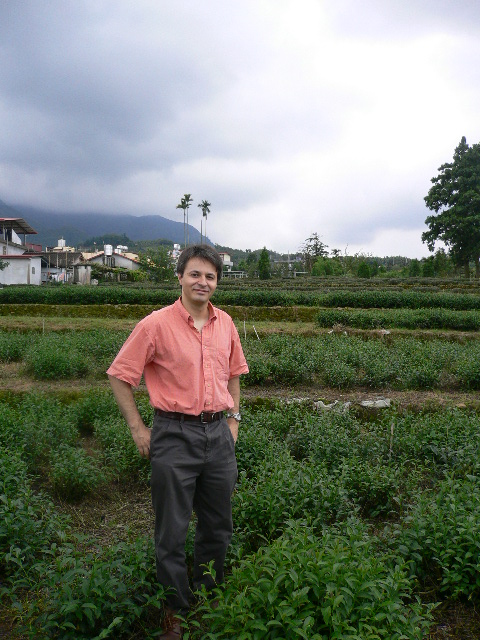
Je n'ai pas eu le temps de prendre des photos de plantation de thé samedi dernier. Le temps était grisatre et les photos n'auraient pas été très réussies. Mais la photo ci-contre de fin juin est quand même pertinente, car je suis retourné chez le même fermier de Feng Huang, l'une des trois communes de l'appelation Dong Ding.

Chez lui, j'ai goûté à ces 3 luanze (qingxin) Oolong récoltés les 10 et 11 novembre 2006. De gauche à droite, nous allons du moins torréfié au plus torréfié. Cela se voit à la couleur de plus en plus foncée, ainsi qu'aux feuilles de moins en moins ouvertes. Ces Oolongs sont également oxidés plus fortement (25% environ) que les Oolongs fleuris, très verts (15-18%) qui représentent la majorité des Oolongs produits (je pense au Si Ji Chun, au Jade et aux Oolongs de haute montagne). Même à Dong Ding on fait beaucoup de ces Oolongs peu oxidés, mais je n'en ai pas sélectionné, car leur goût n'est pas assez typique et intéressant.

A gauche, on trouve donc le moins torréfié. Appellons-le 'verger', même s'il est différent de 'verger de montagne' du printemps 2006 de ma sélection. Ce dernier était très peu torréfié, mais assez fortement oxidé. 'Verger' d'hiver est plus torréfié. C'est un Oolong assez léger et doux. Des notes fruitées au départ et de fleur sur la fin. Mais aussi un peu d'amertume sèche liée à la torréfaction. C'est le plus féminin des 3.

Au milieu, on a le Dong Ding classique. Des odeurs de fruits murs et de marrons. Il a un corps puissant et de la longueur en bouche. Sa torréfaction forte et récente laisse la langue sèche, voire un peu rêche. C'est un peu comme boire un Bordeaux un peu trop jeune.

A droite, je goûte le Dong Ding longue conservation. Sa très forte torréfaction récente est très présente. Mais elle n'est pas extrème comme on en trouve parfois chez ceux qui essaient de contrefaire du vieux Oolong: les feuilles finissent par s'ouvrir et on ne sent pas le charbon. Au contraire, on retrouve encore les fruits murs et une longueur en bouche à la fois sucrée et sèche. Il n'a plus l'élegance d'un Oolong 'verger', mais une force que je qualifierais de masculine et qui rappelle le Cognac. C'est probablement celui qui a le potentiel de vieillir le mieux par lui-même, car sa torrfaction de départ est la plus forte.

Je me suis aussi rendu à la Coopérative des fermiers de thé de Lugu. La compétition de thé de fin d'année venait de se terminer la veille.

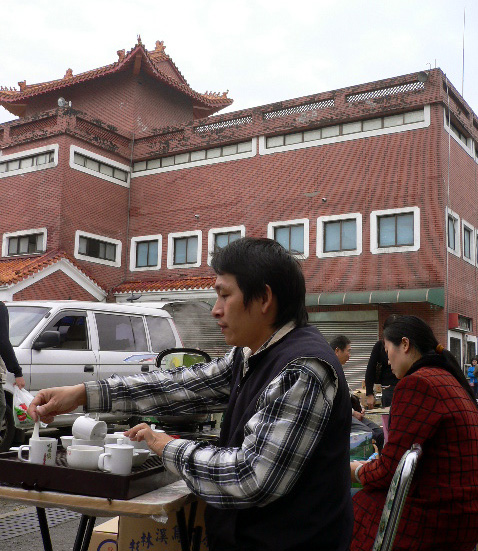
Et sur le parking à l'arrière de la coopérative on trouvait encore de nombreux fermiers en train de proposer leurs thés primés. Un peu comme à un salon de vin, on va de stand en stand goûter aux différents thés (vous remarquerez que ce fermier tient une cuillère à soupe en céramique, l'outil des professionels qui se contentent de sentir le thé).

J'ai d'ailleurs bien aimé l'Oolong de Shan Lin Shi d'hiver de ce fermier. Il l'a oxidé et torréfié de manière plus poussée, un peu à la manière de Dong Ding. Pas aussi fort, car il s'agit d'un Oolong de haute montagne plus délicat, mais le résultat est très fin, fruité et doux.

Si vous êtes intéressés par une dégustation comparative de ces 4 Oolongs, j'ai préparé 18 sets de dégustations de 4 x 30 grammes chacun. Le prix pour ces 120 gr est celui de 75 gr d'Oolong de Shan Lin Shi (pour ceux qui ont ma liste de prix). Vos commentaires et vos réactions à l'impact du degré de torréfaction traditionnelle sur ces thés m'intéressent particulièrement. Autrement, le paquet de 150 gr de chacun des 3 Oolongs de Dong Ding est au même prix que ceux du printemps.

Wednesday, January 03, 2007

A small tea world

I write a big 'thank you' to Adam Teatime (his web name) for meeting me 2 days ago at the Wisteria tea house in Taipei. Thanks for all your tea gifts. It was like Christmas!

But the most incredible thing happened when I spotted the guy next to me on the picture entering the tea house. Readers of the Pu-Erh Tea Community will recognize a frequent contributor (and moderator): Bearsbearsbears! Jason was quite surprised when I called his name and asked him to join us. It had been at least 4 years I hadn't been to Wisteria!

We were having a wild Phoenix Dancong when Jason arrived. That was a find by my Israeli friend who also joined us that night. The yun was very good and each brew was very different. This tea could really take long infusions and was definitely wild. Fragrance was not as strong as for most commercially available Dancongs. This was typically for a fall harvest.

Then we had a 20% oxidized winter 2006 Li Shan Oolong (1800 meters), a sample I had received from a farmer just last weekend. 20% is already a strong oxidation level for high mountain oolong. Instead of being flowery, its fragrance was more fruit and honey. I add honey, because the taste and aftertaste of such high mountain oolongs is so sweet when the oxidation is right (not too low).

We followed with my 2003 wild raw Yiwu qizi bing. I carefully flaked entire leaves and brewed it, like all other teas, in a gaiwan. Very pure taste. Excellent.

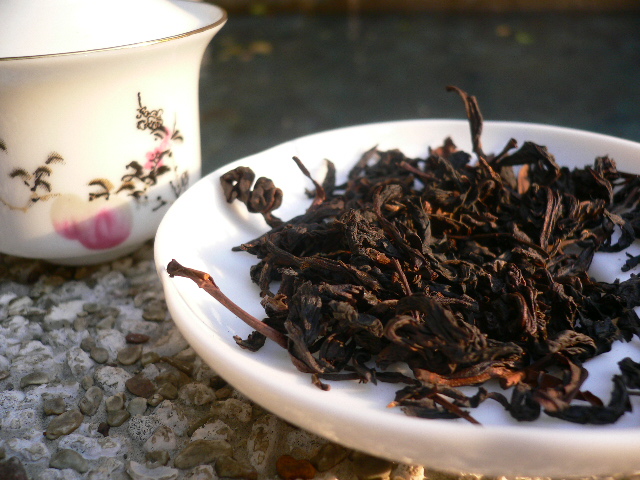
And we ended with my 2005 Oriental Beauty from Hsin Chu. Jason joked this was the best (and worst) Oriental Beauty he ever had... since it was the first time he had some. All sweet, a complex spice bouquet and a long aftertaste.

We were then asked to leave as time flew and the tea house wanted to close its doors (at 11:30PM). It was a magical evening of sharing and enjoying tea among tea friends! Thanks.

Tuesday, January 02, 2007

Une excellente année 2007!


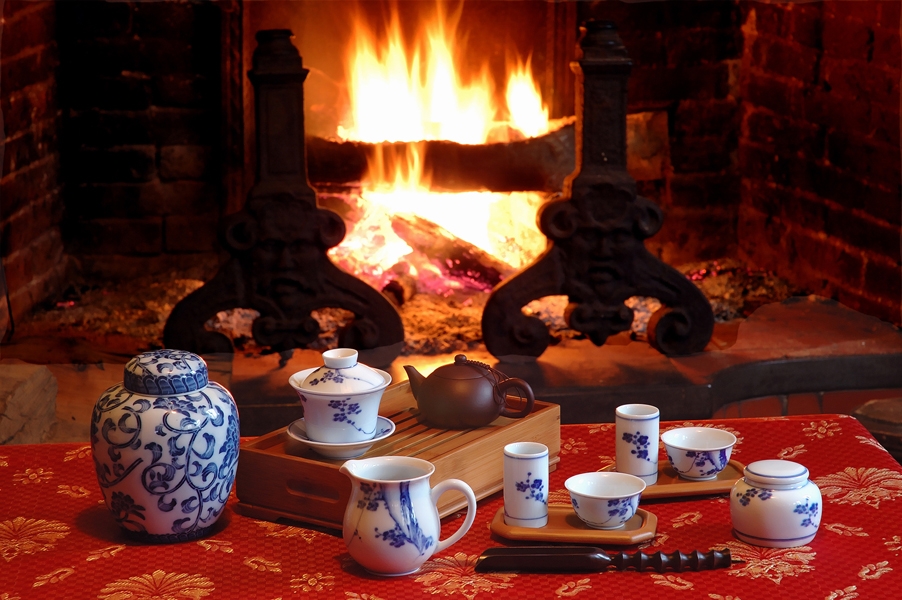
Pendant que vous passiez votre Réveillon devant votre cheminée (voir la belle photo qu'un lecteur m'a envoyé ci-dessus), j'étais à Taichung et en profitai pour aller à Lugu chercher des Oolongs d'hiver. Mon ami fermier de Feng Huang (tout près de Dong Ding) a fait 3 très bons Oolongs dans la tradition de Dong Ding. J'en reparlerai prochainement. J'ai aussi renfloué mon stock avec un Oolong Si Ji Chun de plaine de Ming Jian récolté à la mi octobre.

J'ai encore acheter d'autres Oolongs d'hiver, mais je préfère les déguster chez moi, avec mon matériel afin de mieux les comparere entre eux avant de vous en parler. Sinon, l'excellente nouvelle de mon petit voyage, c'est que mon marchand de Taichung avait encore 1 kg d'Oriental Beauty de Hsin Chu de 2005 dans son stock. Je pensais sincèrement qu'il avait vendu ce petit reste depuis ma dernière visite. Eh non!

Friday, December 29, 2006

Christmas scents

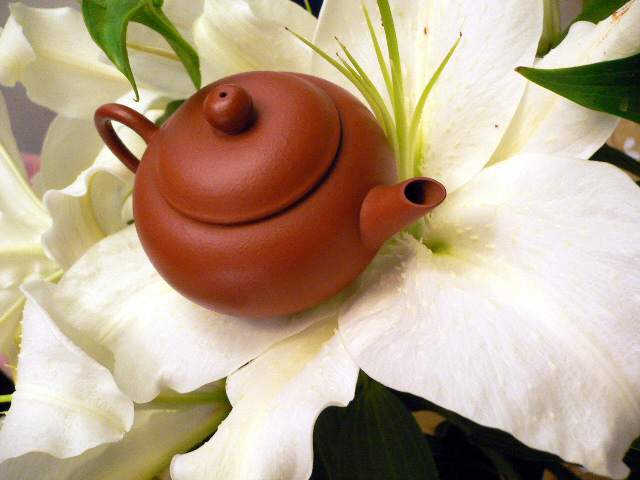
One of my Christmas pleasures, besides excellent tea, foie gras and Alsace Gewürtztramminer is a bouquet of white orchids. They look so pure and big. And their sweet smell is so powerful that I can smell them even before I open the outside door of my apartment. It's heaven. No wonder 5 stars hotel like the Grand Hyatt often use them in their reception halls. Luxury for the nose. During the week this bouquet lasts, I feel less the need to brew light Oolongs. The nice smell is simply there and doesn't need much gongfu. Besides, with cold weather, I'm more in a mood for roasted Tie Guan Yin or cooked puerh to keep me warm.
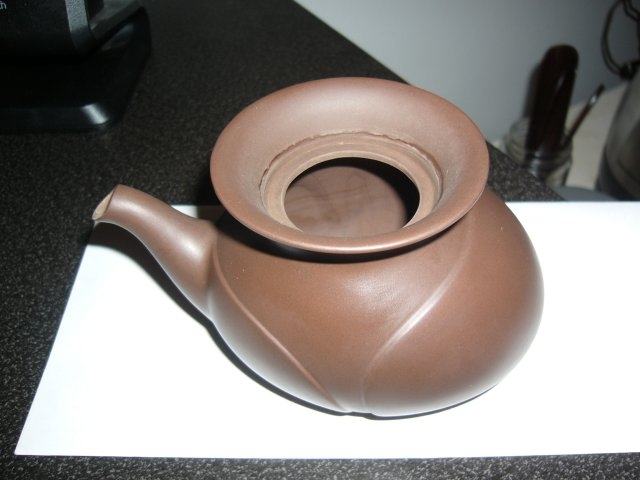
The flowers are so strong and big that they can hold my Baotai zhuni Shui Ping teapot: (Don't try this stunt at home. We decline responsibility for any loss or consequential damages.)


Speaking of scents, Eitan, a reader in Seattle wrote me that: "I own a zisha pitcher (not a teapot) that I too often leave overnight with it's lid on when there is still moisture inside. Because of this there is a faint mildew smell in it, and I am afraid it affects the tea's smell and taste. Is there any way to get rid of this smell?"

I have often mentioned that glazed ceramic is neutral and therefore more suited to handle different teas. This is true for the gaiwan, but also for the pitcher and for the tea cups. So, first of all, I would advise Eitan to replace the zisha pitcher with a glazed one, especially if he uses it for various teas.

Having said that, it can be interesting to use a zisha (or any unglazed clay) pitcher and/or cups for their unglazed properties. If the clay is good (difficult to judge from a picture) than it can actually enhance the taste of some specific teas. I'm thinking more of cooked puerh or roasted Oolongs. Best is to test with tea or water to find out.

So, here is how I would cure the pitcher:
- Rinse it with hot water,
- Use a melamine magic sponge and some water to clean the surface of the pitcher,
- Rinse it again with boiling water,
- Dry it under the sun for a day.

If the bad smell persists, then I'd alternate several hot and cold rinses. If the tea that comes out of this pitcher is still not better than from a glazed pitcher, then throw it away.

Tuesday, December 26, 2006

Wu Yi Yan Cha: Bai Ji Guan

Pour les fêtes, je me suis permis de faire l'un de mes thés les plus précieux. J'en avais déjà bu auparavant, et j'aurais mieux fait de me relire avant cette session. En effet, j'ai commis l'erreur de ne pas mettre assez de feuilles pour ma théière en zhuni Xishi de 15 cl (J'ai du en mettre 2 grammes seulement!). D'habitude, meilleur le thé, moins on en met et plus on laisse infuser. Mais parfois la longueur d'infusion n'arrive pas à compenser complètement le trop peu de feuilles. Le thé n'atteint pas tout son potentiel. Ce Bai Ji Guan, par exemple, est un thé assez léger et il a des odeurs fraiches incroyables. Bizarrement, sec il me fait penser à des herbes de Provence fraiches comme le thym ou la sauge. Et en bouche, c'est doux et sucré comme du caramel!
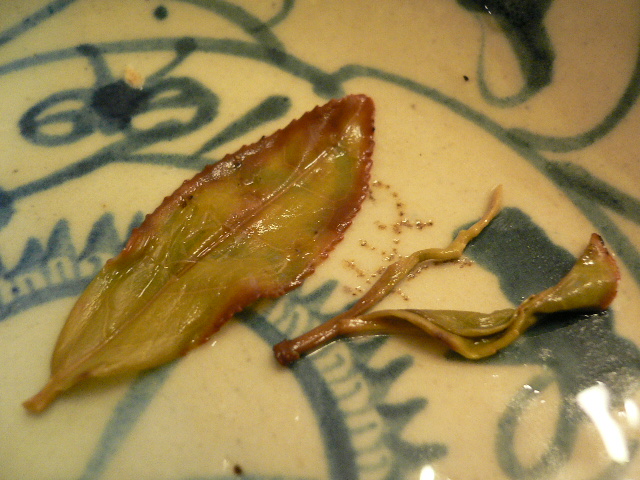
Pour compenser mon manque de feuilles, je n'ai alors rempli ma théière qu'à moitié d'eau bouillante et ai fait de longues infusions. J'ai réussi à obtenir pratiquement ce que j'avais goûté avec Teaparker. Mais je n'ai pas pu tirer beaucoup d'infusions avec cette méthode. Cela m'a appris que certains thés ont besoin d'une certaine concentration pour s'exprimer pleinement. Alors la prochaine fois que je sortirai ce 'Champagne' de thé, je lui ferai honneur en le dosant copieusement, quitte à prendre le risque de l'extase et de l'overdose.En attendant, admirons ces feuilles de Bai Ji Guan. Ce sont de vrais petits bijoux. Elles sont toutes si jeunes et tendres. Leur couleur vert clair et leur positionnement particulièrement dressé vers le ciel (sur l'arbre) leur a donné leur nom: crête de coq blanc (Bai Ji Guan).

Le gongfu cha est-il élitaire?

C'est un reproche ou un commentaire que j'entends parfois en Occident. Pour simplifier, il y aurait le thé aromatisé (plus ou moins) artificiellement bon marché vendu au plus grand nombre d'un côté, et les thés chinois et japonais, préparés lors de cérémonie compliquées, voire spirituelles, de l'autre. De plus, les pratiquants de gongfu cha parlent un langage qui emprunte beaucoup au chinois ou au japonais. Cela crée un jargon qui établit comme une barrière pour les non initiés. Exemple: "Le hungpei de mon Oolong de Dong Ding est sublime. Des aromes de miel et de pêche se dégagent de mon zhong. Le huigan est immédiat et le yun n'en finit pas..."

Examinons cette question d'un point de vue asiatique. L'histoire du thé en Chine est difficilement dissociable de celle des empereurs chinois. Boire du thé devint vite un de leurs divertissements favoris. Durant les dyansties Tang (thé bouilli) et Song (thé vert en poudre fouété), la préparation du thé était somme toute fastidieuse et véritablement réservée à la noblesse et aux riches marchands.
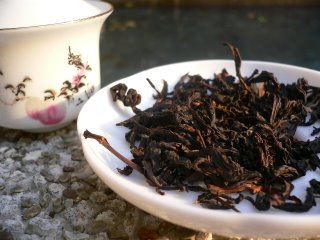
Il est donc intéressant de remarquer que c'est l'empereur Hongwu (premier empereur de la dynastie Ming), issu de la paysannerie, qui interdit le thé compressé. De part ses origines modestes, il voulait rendre le thé accessible au plus grand nombre. Ce fut chose faite, car le thé fut désormais simplement infusé à partir des feuilles en vrac.

Ainsi, dans la Chine du sud, le thé en gongfu cha est pratiqué par toutes les classes sociales. Durant les années 1970, les citadins taiwanais ont même boudé le thé, jugé trop commun et ringard à l'époque. Heureusement, la culture et la pratique du gongfu cha ont su se renouveller et trouver un second souffle à Taiwan. Au Japon, par contre, la pratique du thé vert battu avec un chasen (fouet en bambou) dans un bol remonte à la dynastie Sung, et continue d'être l'apanage de l'élite du pays.

Le gongfucha à Taiwan et dans le sud de la Chine dépasse en popularité le vin en France. Presque tout le monde en boit. Bien sûr, comme pour le vin, les plus fortunés achètent des thés plus chers, souvent meilleurs, mais pas forcément. En effet, contrairement au vin, il est presque impossible de classifier les thés chinois aussi rigoureusement. Il en suit que le prix du thé n'est pas autant corrélé à sa qualité intrinsèque que le vin. Il y a même une étrange solidarité ou connivence entre les vrais amateurs de thé et certains fermiers/marchands traditionnels: certains thés ne sont pas vendus au plus offrant, mais au plus connaisseur. Plus vous montrez que vous appréciez et que vous vous connaissez en thé, meilleur le thé qu'on vous proposera, et les prix ne seront pas spécialement plus élevés. Et s'ils le sont, un tel marchand aura été heureux de vous en faire boire quelques tasses gratuitement, juste pour le plaisir de vous voir apprécier ce qu'il a de meilleur.

Le gongfu cha n'est pas une cérémonie de thé faite avec pour but d'épater la galerie. Cela est parfois le cas, notamment quand vous en voyez une pour la première fois. Mais ce n'est pas le but premier. Le but est tout simple: obtenir le meilleur résultat possible avec le thé et les ustensiles qu'on a à sa disposition. On pratique autant le gongfu cha pour ses amis, invités que pour soi-même.

Notons aussi que l'équipement de base, une théière ou un zhong, une tasse et de l'eau chaude, est accessible à tous. Les possibilités de raffinement sont infinies, mais elles importent moins que le thé qu'on utilise.

En buvant un sachet de thé rouge avec du sucre et du lait dans un restaurant italien hier soir, je me suis dit que cette façon de le préparer est aussi une forme de gongfu cha. Sans sucre et lait, ce thé était imbuvable! Les occidentaux savent (plus ou moins) comment préparer le thé rouge (aussi appelé 'noir' par ceux qui ne connaissent pas le puerh cuit) en sachet bon marché. Faire l'apprentissage des techniques pour réussir les autres thés chinois demande un petit effort supplémentaire. C'est un peu comme apprendre à préchauffer son four pour faire une tarte, quelle vaisselle utiliser selon qu'on mange des escargots, une soupe ou des huitres ou bien combien de temps cuire ses nouilles pour qu'elles soient al dente.

L'apprentissage de ces connaissances, de cette culture du thé chinois fait de vous des privilégiés en Occident car vous y êtes encore peu nombreux. Pratiqué avec passion et avec goût, on peut presque trouver tout les plaisirs dans le gongfu cha. Mais, à la base, cela reste une activité populaire, accessible à tous.

Sunday, December 24, 2006

Joyeux Noël and Merry Christmas!

On est jamais trop jeune pour commencer à boire du thé en gongfu cha!
Nous vous souhaitons de joyeuses fêtes!

Thursday, December 21, 2006

Théière zhuni Baotai

Merci à Sacha pour sa fine analyse de ma fine théière.

The sense of smell can be trained

A study shows that humans can be trained to track smells. The important finding about the study is probably not the potential use of man's nose to detect bombs (the authors probably thought of Rob Schneider, in 'the Animal', sniffing drugs in somebody's butt at the airport).

What I found interesting, for us tea drinkers, is that people trained to follow a track of smell were performing this task twice as fast after just 2 weeks of training. This shows that a little training for our nose can result in big improvements.

So, next time someone wonders what you're doing when sniffing the lid of the gaiwan, the tea leaves, the (full or empty) tea cup, just say you're training your nose like people go to the gym to train their muscles! The more often you do that, the more your brain will learn to analyze and differentiate the tea fragrances.

What happens when you have done that for 30 years? Then, maybe, you will be like my tea professor, Teaparker and have a foolproof nose. Here is one of my many experiences that he has well trained his nose:

Last month, a tea merchant in Taipei gave me a sample of Oriental Beauty for Teaparker to test. He told me this tea's little secret: it is the highest quality, organic Oriental Beauty (Fall 2006) that he has made from his tea plantation in ... Mainland China. He showed me other grades of Chinese Oriental Beauty. Some were really cheap, but the one he gave me to test was just slightly cheaper than Formosa Oriental Beauty. At the next tea class, I gave Teaparker the tea and just said 'Here is a tea I found recently'. He had a quick look at the leaves, then smelled my sample and said: "This is Oriental Beauty, but -a short pause, thinking- this one does not come from Taiwan. Besides, it doesn't smell right."

Just smelling the tea was enough to tell him the origin! And he was also right that this tea was not good, despite its high price.

I brewed these 3 Oriental Beauties at home, from left to right: Mao Ho OB from Pinglin (Summer 2005), this China OB (Fall 2006), Hsin Chu OB (Summer 2005) the one I had previously in my selection.

Brewing parameters: 4 grams for 5 minutes (a testing parameter).

The Mao Ho OB made a pretty orange. The smells are a little wild like in a wet forest, lightly smoked and only then comes the more characteristic OB sweet and a little sour smell. I felt some closeness to Ai Jiao and Shui Xian Oolong. Contrary to other Wenshan OB I tasted before, it was not thin and fragrant. This one has a quite long aftertaste.

The China OB was a little brown and a little less clear. The fragrance was what one expects of a very concentrated OB, but actually almost too much. Something artificial, like sweet-sour candies. Bad. From a taste point of view, the sweetness in the beginning transforms into a metallic astringency. The tongue feels heavy and uncomfortable.

The Hsin Chu OB remained my clear favorite. A shiny red color in the cup. In its second year, new spices like cinnamon are emerging and add complexity to a tea that seems never ending. Excellent. This is how OB should taste. (Too bad my stock is depleted!)

Conclusion: Train your nose and you will be able to tell between good and bad teas! (Hat tip to Lewis Perin for the article.)