Friday, November 22, 2013

Winter light

Days are short, grey and cold. To find hope in the future, we turn to what we can most depend on. Faith, family, love. The cold seasons are a time to focus our attention on what's really important, on what we value most. It's time to come back to the cocoon, spend more time in the warmth of our home.
Tea is a wonderful way to spend quality time at home in winter. Similarly, the mood is less about trying new things for discovery's sake. To find joy in darkness, we choose teas that we treasure, leaves that that contain wonderful and harmonious flavors. They are our treat, our little pleasures. They boost our spirits and guide us on the path of refinement.

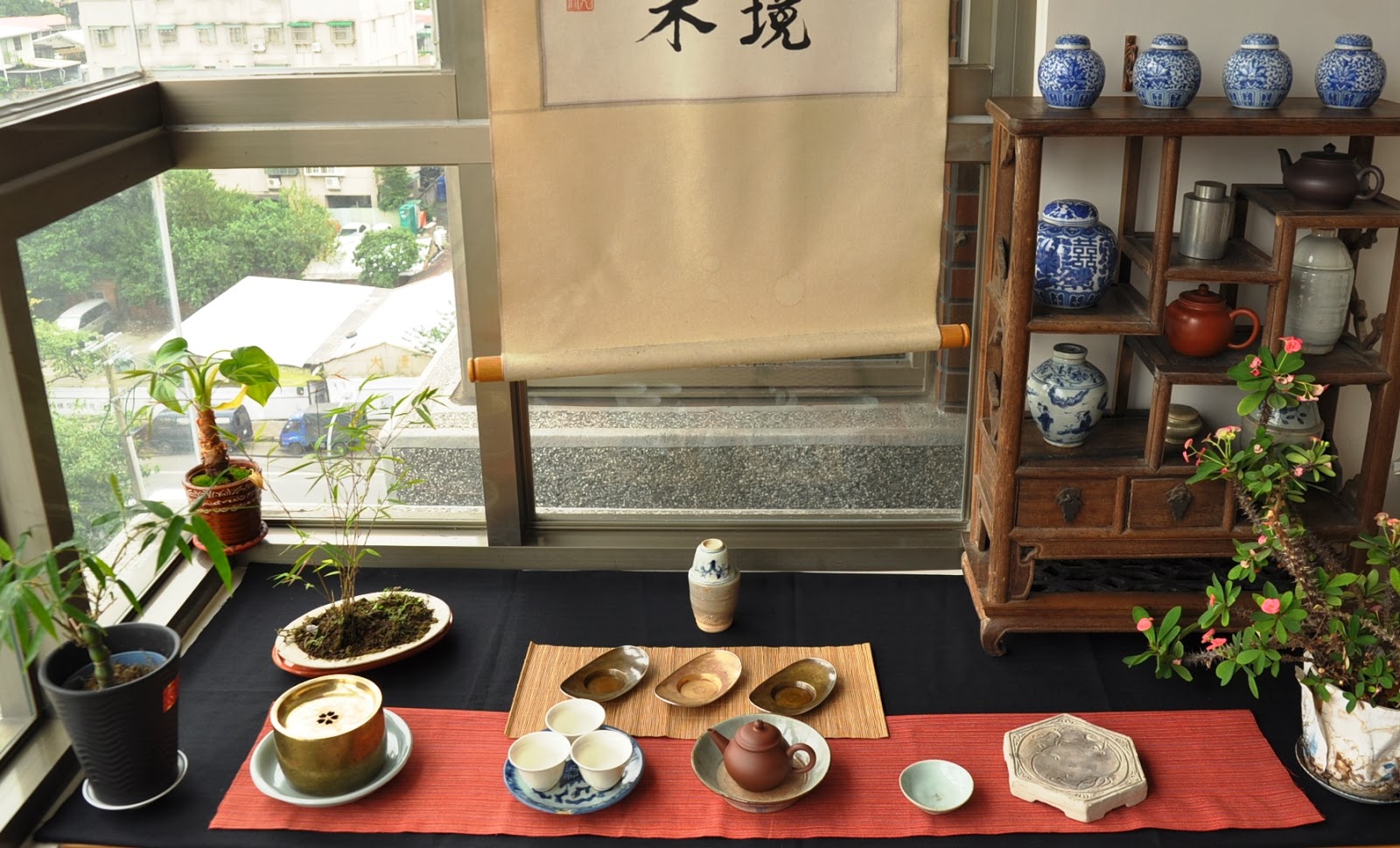
During last tea class, we even lit a charcoal fire in a white Nilu. This adds more warmth in winter. The flames were so strong, Teaparker recommended we wait until they calmed down before starting to heat the water!

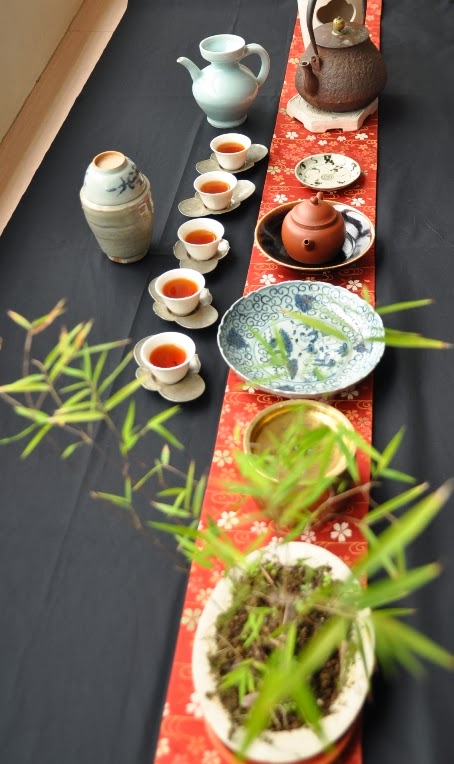
I brewed a Wu Yi Shui Xian from last year in this pear shaped zhuni teapot.

A cup of bliss.

A light in the dark.

Wednesday, November 20, 2013

Oded Tzur Quartet, musician and tea lover

An Israeli saxophone player inspired by Indian music and Chinese/Taiwanese tea: only in New York will you find such a creative combination! His music can be slow and relaxing (like his Song of the silent dragon) or more jazzy, but the sound of his saxophone is very unique and almost hypnotizing. Its 'voice' seems to penetrate your soul!

Oded is doing some crowdfunding to record an album and make a videoclip. His appeal starts with a view of some qingbai 'singing' cups that should feel quite familiar... He's even offering an introductory tea class for High Mountain Oolong for pledges of 75 USD or more! (This applies mostly for NYC, where he resides).

Music can add a powerful new dimension to tea drinking. I'm looking forward enjoying tea with Oded Tzur's music!

Thursday, November 14, 2013

Cutting Out the Middleman

The Internet lets consumers bypass local tea shops in Europe or America in order to purchase directly from Asia. For top grade teas, this is often a necessary purchasing strategy, because only very few tea shops carry this level of quality in the West.

With easy air travel to Taiwan, it's even possible to cut out Asian big city retailers and visit tea farmers near their plantations! Western tea fans visiting Taiwan can now easily purchase from the source, the original maker directly! This is probably the dream journey for many tea fans: visiting tea mountains and purchase tea from a farmer.

This is what J. has been doing the last 2 weeks approximately. Today he came to see me and I asked him to bring a couple of teas he purchased here. I should add that J. is quite an experienced drinker, as he works in a tea shop in the US that serves loose teas from all over the world.
He tells me that one of the teas he bought is a Da Yu Ling Oolong from this winter harvest (end of October). To see how his purchase went, we set up 2 mirror Chaxi opposite from each other. J brewed his and I brewed mine (from this spring) with the same water, the same gaiwan, same time... Such direct comparison between 2 teas is the fastest way to let the teas tell you which one is the best.

A search of excellence is what Da Yu Ling and Lishan Oolongs are all about. Theses plantations are located above 2000 meters elevation. The trees grow under extreme conditions so that they would produce the finest High Mountain Oolong possible. A Da Yu Ling shouldn't disappoint.

J's brew had a darker yellow color, some dry to bitter notes and lacked flowery fragrances. Mine was lighter, but felt much more mellow, smooth and had an elegant flowery fragrance. The quality difference was obvious and I let J and his friend put words on it first. The different season isn't what was causing this roughness.

In a second match up, we brewed J's leaves again versus my Lushan Oolong. This other spring Oolong is, like J's, also packed in a plastic foil that says Da Yu Ling! The famer told me it's from Lushan, but packed it in this pack, because another customer wanted it packed like this. In this case, again, my leaves performed better, smoother than J's. This led us to have serious doubts about the actual origin of J's leaves.

This is a very familiar experience, I told J. I've met other tea travelers who felt disappointed by the Oolongs they purchased from farmers. For most customers, cutting out the middleman means that they are looking for a better price. That's the reason why farmers usually start with brewing their low quality leaves to retail customers, I think. If the customer is happy with the price and thinks the tea OK, then he can quickly make the sale. The farmer will only propose better leaves if the customer shows his disappointment with quality and his willingness to pay more. But if the buyer has never experienced a top quality Da Yu Ling, he is likely to be satisfied with lesser leaves.

Disintermediation (cutting out the middleman) works best with commodities, products that are easy to understand and identify. For regular teas, this might be the case, but I think that rare and fine Oolongs require the expertise of well trained tasters.
J mentioned a second tea he had purchased just yesterday, in Yingge: a 1980s raw loose puerh from Menghai tea factory. What a coincidence! I also have a loose puerh fitting this description in my selection. I was curious to compare both and we proceeded to make another parallel brewing (using only very few leaves).
2 Loose puerhs

Left: my 80s puerh. Right: J's
J's dry leaves have a more uniform reddish color. My leaves look less dull and have more varying colors.

J's brew is darker and his open leaves looked all slightly burned. My brew is lighter and some big leaves unfurl well and almost green again.

J's brew has a cooked puerh smell. Its taste is quite sweet and round, but with a short aftertaste. My puerh has more freshness, vibrancy. The aftertaste is long and lively.

The difference in both brews indicate that J's tea isn't what the seller claimed. It's a partially, lightly cooked puerh that tries to mimic a genuine 30 years old puerh. If you haven't had a real old sheng before, you wouldn't notice it as easily in this comparison.
Real sheng vs fake
Correct standards are essential when you want to learn about tea. Don't cut out your middleman until you know as much as him/her about tea! Otherwise, you will end up with teas that will confuse you, because they are not what they claim to be.
Free like a butterfly, know what you want and find the sources that provide the most satisfaction!

Thanks to J for sharing his teas and meeting me.

Tuesday, November 12, 2013

Inspiration d'automne

La réalisation d'un Chaxi peut donner lieu à une grande créativité dans la réalisation du Chabu, le tissu sous lequel on dispose les accessoires. Le rythme des saisons est l'une des toutes premières sources d'inspiration.

Ce dimanche, une amie Taiwanaise nous montra sa dernière création: un chabu aux couleurs des citrouilles-lanternes de novembre!

Les motifs sont festifs et chaleureux. La couleur de la citrouille est assortie au thé choisi pour l'occasion: un zhengshan xiaozhong! Cette correspondance ne tient pas du hasard. Elle fait parti de ce processus créatif qui cherche à insuffler du beau, de la joie en harmonie avec le thé infusé.
(De mon côté, ayant pratiquement vendu tout mon stock de Chabu, je suis retourné chercher de nouveaux tissus hier! Vous verrez les résultats ces prochaines semaines.)

Friday, November 08, 2013

Kiss of the Phoenix

This Chaxi finds its inspiration in Lu You's 'Phoenix hairpin' poem. This Sung dynasty poet had been married to Tang Wang when he was young, but his mother forced them to divorce. Years later, both had remarried and he met her by chance in a park. Both realized they were still very much in love with each other, but now their love was impossible. So both regret their mistake and the lonely, sad life they have lived since. Lu You wrote 'Phoenix hairpin' right after seeing Tang Wang again:

Pink soft hands, yellow rippling wine,
The town is filled with Spring, willows by palace walls.
The east wind is biting, happiness is thin,
heart full of sorrow, so many years apart.

Wrong, Wrong, Wrong!

Spring is as of old; the person is empty and thin.
Traces of tears show through the sheer silk.
Peach blossoms falling, glimmering pond freezing,
The huge oath remains, the brocade book is hard to hold.

Don't, Don't, Don't!
釵頭鳳

紅酥手,黃縢酒, 

滿城春色宮牆柳。
 東風惡,歡情薄,
 一懷愁緒,幾年離索,
 錯,錯,錯。 

春如舊,人空瘦, 
淚痕紅浥鮫綃透。
 桃花落,閒池閣,
 山盟雖在,錦書難托,
 莫,莫,莫。
Tang Wang answered with a poem of her own, based on the same structure as Lu You's:

The world unfair,
True manhood rare.
Dust melts away in rain and blooming trees turn bare.
Morning wind high,
Tear traces dry.
I'd write to him what's in my heart;
Leaning on rails, I speak apart.
Hard, hard, hard!

Go each our ways!
Gone are our days.
My sick soul groans like ropes of swing which sways.
The horn blows cold;
Night has grown old.
Afraid my grief may be descried,
I try to hide my tears undried.
Hide, hide, hide!
 (Translation source)

世情薄,人情恶,
雨送黄昏花易落。
晓风干,泪痕残,
欲笺心事,独语斜阑。
难!难!难!


人成各,今非昨,
病魂常似秋千索。
角声寒,夜阑珊,
怕人寻问,咽泪装欢。
瞒,瞒,瞒!

 
A cleaned and an original state copper chatuo.
The 2 poems have been beautifully intertwined in this song. My idea was to bring their love even closer with a tea that gives a feeling of a (French) kiss! That's why I thought of my spring 2013 Concubine Oolong from Feng Huang.

I'm matching this Oolong with my Yixing zisha Xianpiao teapot on a Qing dynasty tea boat, and 3 ivory color 'flower' cups on a qinghua plate or on their copper chatuo (saucers).

Old accessories add dimension of time that passes, memories that accumulate... I also see this feeling of layers from the bamboo mat or the red fabric I'm using as a Chabu. This fabric brings a very feminine and elegant element to the Chaxi. Its echoes the presence of a lady, while the metallic saucers, the waste bowl and the grenade/jar point to a man who also spent time in the military.


The tastebuds in the mouth vibrate in a long and sweet aftertaste. Ripe red fruits from a natural garden make their presence felt in my nose and on my palate for a long time. A warm and comfortable sensation builds up from the stomach and manages to make me sweat!

It's a deep and long French kiss. Slow like the tempo of this song. The bitterness of the grief and regrets adds depth to the sweet feeling that arises from these cups of tea.
Sung dynasty poetry manages to say so much with so few words.
A well brewed cup of good tea can also concentrate many flavors and feelings. The aromas linger deeply, like the words of this song. This is 'Yun', an aftertaste that resonates and doesn't seem to disappear.
Enjoy the music together with the tea, and let all your senses feel the love!

Tuesday, November 05, 2013

A scent of gooseberry in my Oolong!

Yiguang shan Oolong plantation
The human nose (and brain) can distinguish up to ten thousand different scents! This makes our sense of smell so important when we taste a tea. Last week, I marveled how my wild Dian Hung reminded me of black currant. Today, I want to introduce you to a tea that brings back memories of gooseberries!

Tea: Luanze (qingxin) Oolong

Origin: Yiguang shan, between Zhushan and Shan Lin Shi, Taiwan

Elevation: 700 meters

Harvested by hand on March 31st, 2013

This is a fresh, unroasted Oolong. (In my selection, I also have a medium roasted version - called Hungshui Oolong - made from leaves from the very same batch).

This tea doesn't qualify as a high mountain Oolong. The elevation must be 1000 meters or more. From the dry leaves, it's not so easy to tell, because at 700 meters, the climate starts to feel mountainous. Even the dry smell of the leaves doesn't indicate this would be a low elevation Oolong.

The brew has a good clarity and lack of turbidity. The taste has a typical Taiwanese Oolong mellow/sweet characteristic. No bitterness. It's just not as powerful as a Shan Lin Shi or Alishan Oolong. (But we can compensate this by using more leaves for our brew.)

This kind of fresh, hand harvested spring Oolong already qualifies as an above average Oolong compared to what we can find on the market nowadays. (Many stores here sell cheap, imported Oolongs from Vietnam... or you may even find artificially scented Oolongs). What makes this Oolong special for me, is that, for the first time, I found a scent of gooseberry in the brewed cup! Scents and memories are always personal, so, here, the smell of this tea reminded me of gooseberries. I used to eat them directly from the bushes in my parents' garden when I was a kid. These bushes have been uprooted some twenty-five or thirty years ago and I haven't had a gooseberry since. But the memory of this fruit is still vivid and this tea brings back this feeling of playing as a child in my garden in summer.
These kinds of personal connections make smell of tea a very personal affair. It's therefore very difficult to judge a tea objectively just by its scent. The pleasantness of a certain smell varies from person to person. The smell characteristics we can argue objectively are the intensity and purity of the scent. If the scent is very strong and barely changing, then we may conclude that it's artificial. This is not the case with this Oolong: the fresh gooseberry scent is due to the almost magical combination of climate, soil, plant, oxidation and drying.

The size and shape of the unfurled leaves give us the best indication of the elevation of this plantation. We can also see the oxidation level by noticing the red color of the edges of the leaves. This Oolong isn't too green and this is also what made it suitable for roasting.
The best way to start brewing this Oolong is to use more leaves (compared to a high mountain Oolong), a 'dancing leaves' first pour and shorter brewing times. It's a good everyday fresh Oolong, or a tea to practice quick brewing. And it's also very insightful to compare this fresh Oolong with its roasted version.

Disponible: Le livre du thé, d'Okakura Kakuzô

J'ai le plaisir de vous annoncer que j'ai ajouté Le livre du thé, de poche (à couverture dure) à ma sélection. Il y est au prix de 12 Euros (au lieu de 12.9 Euros).

Thursday, October 31, 2013

2 infusions d'Oolong de Lishan en vidéo

Le choix de la bouilloire se fait en fonction du thé qu'on infuse et comment on va l'infuser. Ici, je veux déguster mon Oolong de Lishan (2200 m) du printemps 2013. C'est un Oolong de haute montagne peu oxydé et non torréfié. J'utilise un gaiwan en porcelaine de 13 cl, car ses grandes feuilles ont besoin d'une certaine place pour s'ouvrir. Quelle est la bouilloire qui lui correspond le mieux? Et pourquoi?

1. La taille
A un petit gaiwan ou une petite théière, correspond une bouilloire de petite taille. C'est plus léger et donc facile à manier. Cela permet un meilleur contrôle du flux de l'eau chaude.

2. Le bec
La forme du bec de la bouilloire détermine comment l'eau sortira. La vitesse peut se moduler avec notre geste et l'inclinaison, mais le flux sera plus ou moins facile à contrôler. Ainsi, les becs droits des 2 premières bouilloires en avant-plan permettent un flux rapide et direct. Le bec courbé de la tetsubin, au contraire, permet de très bien contrôler un débit lent.

3. Le matériau
L'eau bouillante voit son goût modifié par le matériau de la bouilloire. La bouilloire en céramique sans émaille donne une eau plutôt plate et ronde. La tetsubin ajoute du corps et du moelleux. L'inox tend à vite 'étouffer' l'eau. L'argent donne le plus de pureté et de vitalité.

Pour ces 3 raisons, ma petite bouilloire en argent avec un bec court et droit convient le mieux au caractère frais et énergisant de mon Oolong de Lishan. Je viens juste d'y porter mon eau à ébullition. Voyons comment j'infuse la première infusion:

L'infusion est un concentré de finesse, de fraicheur et de force. Le caractère de Lishan s'exprime de manière puissante et harmonieuse. Un printemps délicieusement fleuri me chatouille les papilles!

A chaque infusion, il s'agit de considérer l'état des feuilles, leur niveau d'ouverture pour déterminer comment verser l'eau bouillie. Quant à la durée d'infusion, elle dépend aussi de vos goûts personnels. Laissez-vous guider par vos impressions sur la dernière infusion pour faire la prochaine.

PS: J'ai aussi ajouté une vidéo d'infusion en tetsubin de mon Dian Hung à mon article récent

Tuesday, October 29, 2013

Petite théière Yixing


En fouillant dans mes armoires, j'ai trouvé une autre petite théière Yixing de forme plate à vendre:

Poids: 89 grammes
Contenance: 80 ml (8 cl)
Glaise hungni dense (dure), cuite à haute température.
Petit trou unique (pas de filtre interne, mais ce n'est pas nécessaire vu la petite circonférence du bec.
Le couvercle a de longues parois internes et est étanche. (On peut couper son écoulement  fin et gracieux en bouchant le trou du bouton sur le couvercle).
Convient aux Baozhongs, Oolongs de Wuyi ou aux puerhs crus.
Etat neuf.
Son prix en Euros est le dernier nombre à 2 chiffres (+ transport).

Monday, October 28, 2013

The scents of tea

One of the things that makes natural tea so fascinating is its smell. Each tea has its own. And there is no generic tea smell. And if you want to describe the smell of a particular tea, you'll end up using the scents of flowers, fruits, forests, meat, wood...! The scent of tea is particularly hard to grasp, because the essence of tea is to absorb the scents of its surroundings (soil, climate, neighboring plants...), its production process and its storage. There's so much we can tell from the smell of tea!

And the impact of a scent on our brain is unlike any other sense: there's no secondary center in the brain to analyze the sense of smell. The scents engrave directly in our memory. That's why we access directly into our memory when we smell a particular fragrance. This experience can help us recall certain moments of our childhood, when, for the first time, we have encountered a smell for the first time.

Sometimes, I struggle naming the smell of a tea. This was long the case with my 2011 spring wild Dian Hong, one of my favorite red tea.

It's very sweet with ripe fruits. It reminded me of a warm ice cream! I kept on having a memory of ice cream with this tea! This didn't make much sense. Nothing felt cold in this tea. On the contrary!  

Last Friday, after this very relaxed, calm brewing, I found the answer!

This shiny and tasty little cups of tea had a fragrance of black currant!
I guess, the very first time I had this fruit was in the form of an ice cream, or maybe even as a warm sauce on top of the ice cream?! I feel a relief in identifying this fragrance, at last. I'm also transported back in time to my first spoon of black currant!
With this memory, my mind makes further connections: a happy meal, a special occasion, Christmas! (la buche glacée, the desert of Christmas meal).

My tea happiness is multisensory:

- the colors are powerful, shiny and warm,

- the baroque music is peaceful,

- the scent of black currant evoques pleasant memories,

- the sweet and refined taste of the tea lingers on my palate.

This moment doesn't seem to end. Each cup and each brew renews the pleasure of combining all these feelings into one wonderful experience. The pictures tell this story better than my words. Now, as I'm writing, I go into an analytical mode examining what happened to me with each sense. But during the chaxi, the moment of enjoying the interaction between tea and teaware, the interaction of the senses, everything melts into a unique moment of happiness.
The tall 'flower' shaped 'ivory' porcelain cup helps to retain the heat better than a wide cup. With the cooler temperatures, I find it a good idea to switch to this kind of cup.
Once emptly, these cups concentrate the scents of the tea like a wenxiang bei (tall and thin smelling cups). This scent is the most evanescent and another cause for amazement. How can an empty cup still smell so good and for such a long time!
The secret of this amazingly graceful red tea is the quality of its material: mostly wild (old trees) puerh buds that have been processed into Dian Hung!