Monday, May 19, 2014

Chaozhou gongfucha brewing, step by step


The Chaozhou Gongfu Cha brewing method originated during the Qing dynasty (1644-1911) in the eastern Guangdong province, next to Fujian. The tea used was roasted Oolong, preferably from the Wuyi mountains.

Chaozhou Gongfucha was necessarily brewed for 3 persons (like bridge is played by 4 people). If more people wanted to drink tea, they'd have to set up their own set (for another group of 3 people)... This method has greatly influenced the way tea is currently brewed in Taiwan and China. In a previous article, I have presented each item of the Gongfu cha set. Let's see how to use it!

First, water was boiled in a clay kettle (diao), heated by glowing hot charcoal in a Nilu.

This hot water is then poured on the zhuni teapot and then inside it and also also in the bowl (Chaxi):
This hot water in the bowl is used to preheat and wash the teacups. Using 2 fingers, the brewer turns the cup(s) in the hot water behind the teapot
The third cup is handled alone. What's important when handling all the cups is to only touch the outside walls of the cups. Touching or holding the cup's inside would be seen as a mistake, since the goal is to clean the cup.
The hot water inside the teapot is emptied in the cups. That's when you see if you have a good fit between the size of your teapot and the size of your cups:
The empty teapot floats on the water in the bowl if it is light enough and a real Shuiping (water balanced)! This is where this teapot quality came into play. The lid either rests on the Jianshui (waste water bowl) or on the cups. The dry leaves were stored in the pewter caddy and we put them now in the teapot with our hand, in the middle of the teapot. In case of Wuyi Yancha, we would first crush 30% of the leaves and then add 70% of whole leaves on top in order to produce a very strong brew:
The boiling water is poured onto the leaves:
No rinsing. The tea was top quality. While the leaves brew, the water is emptied in the Jianshui.
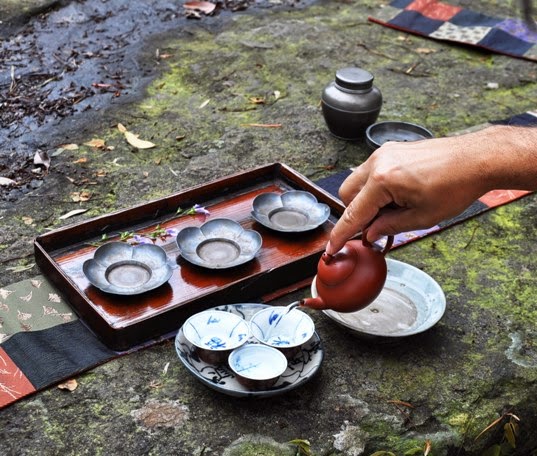
As I prepare to pour, I slowly let my teapot glide over the rim of the Chaxi in order to leave any water inside the bowl. It's also possible to use a piece of fabric to let the teapot rest a couple of seconds to dry its bottom:
The tea is poured in the cups: 1, 2, 3, 2, 1 in order to make the brew even:
The cups are placed on their pewter saucers:
The tea is then presented to the guests on a tray (cha pan):
The guests drink their cup of tea in three sips at least (not in 1!), because they wish to enjoy the taste rather than just drink to quench their thirst. (品 means tasting and this Chinese character is composed of 3 mouths).
For this Chaozhou Gongfucha demonstration, I've used my winter Shan Lin Shi strongly roasted Hungshui Oolong. Fittingly, the sun came out as we were enjoying this tea and shone its bright and warming light!

Friday, May 16, 2014

Un parfum de Renaissance du thé à Penn State

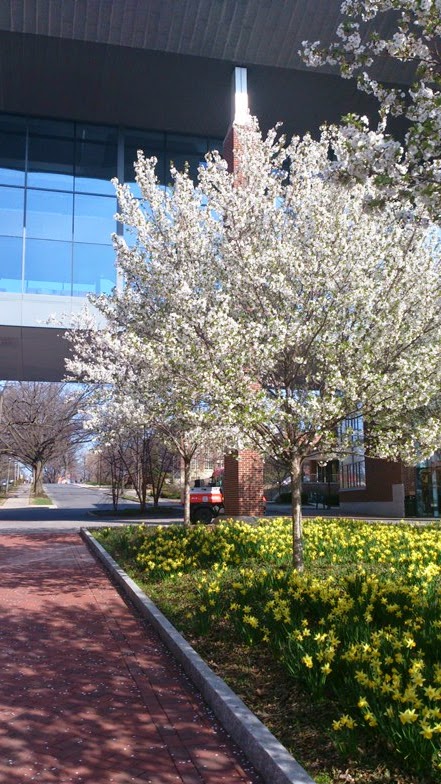
Fin avril, le Tea Institute de Penn State University (PSU) a organisé une série d'événements pour la préservation et connaissance de la cérémonie régionale du thé de Chaozhou, connue également comme gongfu cha. Pendant ces 4 jours, je fus l'interprète de Teaparker auprès du public Américain et des nombreux étudiants du Tea Institute. Au second jour, l'Institut fit une dégustation publique sur ce pont en verre, "Gateway to the Sciences" (voir ci-dessus). De là, nous avons une magnifique vue sur les arbres en fleurs du campus.
Jason Cohen, fondateur du Tea Institute
Le printemps se manifeste dehors, mais aussi au travers de ces Chaxi fleuris. J'y vois un signe annonciateur d'une renaissance du thé de qualité en Occident. La Renaissance européenne eut lieu grâce à un retour à l'éducation classique des oeuvres latines et grecques. C'est en s'appuyant sur l'expérience du passé que de nouveaux progrès furent possibles. Cette propagation du savoir (merci Gutenberg) eut lieu dans les universités d'Europe.
Pour le thé, je vois le Tea Institute de PSU suivre une démarche similaire. Cette année, ils ont demandé à Teaparker de leur enseigner le Gongfu cha de Chaoshan, tel qu'il fut pratiqué durant la dynastie Qing (1644-1911). Il s'agit pour eux de bien comprendre le passé afin de pouvoir mieux comprendre le thé d'aujourd'hui et lui donner une nouvelle impulsion. Chaque élève devient un ambassadeur et diffuse son savoir et son expérience par des événements 'live' ou bien par blog (comme votre serviteur).
Pour donner une impression forte et un arrière-goût long et puissant, c'est mon Hungshui Oolong 'fort' de Shan Lin Shi de cet hiver que nous avons choisi d'infuser lors de cette dégustation. Etudiants et spectateurs se sont relayés pour préparer ces feuilles, aidés des conseils de Teaparker.
La lumière du prinemps rencontre la finesse d'un Oolong de haute montagne et sa torréfaction amplificatrice d'arômes doux. Un rien d'imagination catapulte nos sens au milieu d'une nature en fleurs. 
Cette expérience a bien plu à tous les spectateurs. Et cette instructrice Japonaise Omotesenke en a gardé de beaux souvenirs!
(Note: le site Tea Masters avait un bug, mais il est maintenant résolu! Merci pour votre compréhension et patience. Pour se connecter, il faut utiliser www.tea-masters.com au lieu de l'adresse www.tea-masters.com/en)

Thursday, May 15, 2014

Spring 2014 Baozhong: 4 years old Wenshan plantation


Cultivar: Qingxin (ruanzhi) Oolong
Harvested by hand: April 29th, 2014
Origin: A 4 years young plantation near Pinglin, Wenshan

Elevation: 400 meters
Process: Lightly oxidized Baozhong, very light roasting


Brewed in a porcelain gaiwan with boiled water and poured in classic qingbai cups. The small Chabu is green with intersecting lines and it is on the black side of a classic sized Chabu. I'm using a Jianyang bowl for the waste water. This creates a powerful contrast underlining a fresh spring feeling.

The leaves are big, dark green, without stems. Their dry scent is light, flowery and reminds me a little bit of vetiver fragrance.  

This Baozhong can be ordered on my new site. Its presentation there may feel dry and impersonal compared with what I used to do on my blog. Actually, the way I brew and review it on my boutique is like a judge at a tea competition: I use a white competition set, 3 grams and brew for 6 minutes. You can see pictures of the dry leaves, the brew and the spent leaves. My notes are those for the tea brewed that way. The goal is to let the leaves speak for themselves. This brewing technique isn't about getting the best out of the leaves, but it aims at getting almost everything out at once in order to better understand its qualities and defects. I think this professional and objective approach is best suited for my tea boutique.
How to brew the leaves to perfection takes a life-long learning! That kind of pursuit and knowledge is best passed through my blog, I feel. For instance, pouring directly with a gaiwan in teacups isn't just about saving the cost of a pitcher, it teaches concentration and dexterity.
 The brew is bright and clear. The scents are like fresh lilies.
The taste is zesty and sweet. The mouth feels fresh and continues to salivate. The aftertaste is pleasant and fresh. The overall feeling is cooling and young. This comes from the fact that this plantation is only 4 years old and it was just started to be harvested last year. New plantation soil is naturally rich and requires little fertilizer, which gives a clean taste in the mouth.
I chose this green fabric for its many thin, intersecting lines. Spring tea is what makes my path meet many of you. I feel very fortunate for all these positive interactions. That's also why I want to continue my blog. Selecting and purchasing tea should be done very critically and objectively. But with the right tea, good knowledge and practice, tea can be so much more than just a hot beverage!
Healthy tea leaves

Wednesday, May 14, 2014

New York, top of the world


Après 4 jours de présentations à Penn State, Teaparker, son assistante et moi sommes allés passer un jour à New York avant de retourner à Taiwan. Notre petit séjour dans cette métropole cosmopolite m'a laissé de nombreuses impressions.

Ayant peu de temps à notre disposition, nous avons essayé d'en profité le plus possible. Par exemple, nous avons diné au restaurant 3 étoiles Per Se. Certains plats de leur menu dégustation étaient mieux réussis que d'autres, mais l'ensemble était très bon et bien accompagné d'une bouteille de Sancerre (Domaine François Cotat, "Les Monts Damnés" de 2011). Ce vin blanc léger, mais profond, accompagnait, sans les dominer, les différents plats cuisinés très fins de ce menu. Arrivés à 21h, nous avons savouré chaque bouchée et avons terminé les derniers, à 1 h du matin! Au milieu du repas, nous avons demandé et obtenu une grande théière en verre remplie d'eau bouillante. Cela nous a permis d'infuser un excellent Wuyi!

Le service fut très professionnel et courtois. Mon seul motif de déception furent les desserts trop sucrés. Autant nous avions le Sancerre et de l'eau pétillante pour contrebalancer les goûts intenses des plats salés, autant il manquait une boisson capable de redonner une impression de légerté à notre bouche. Heureusement qu'il nous restait un fond de théière, mais je me demande comment font les autres clients qui n'amènent pas leur propre thé! Voilà un potentiel d'amélioration: faire des desserts moins sucrés et/ou proposer un thé qui prolonge le goût tout en redonnant une impression clean et fraiche.

La vue du 30ème étage de la chambre d'hôtel donne sur Central Park.  Les sirènes résonnent dans les rues et on sent la ville vibrer d'énergie. Comment rester soi dans un tel environnement grisant et sans limites? Avec un bon thé, pardi!

A deux pas de la 5ème avenue et de ses boutiques de luxe, ce ne sont pas les tentations qui manquent. Mais je ne vois nulle trace de vrai thé ici. Même cet hôtel huppé ne propose que du thé en sachet! Je comprends que cela prendrait trop de temps et d'effort pour expliquer au client normal comment bien infuser du thé en vrac.

Le vrai luxe ne réside pas dans l'achat d'un objet, aussi cher soit-il, mais dans l'appréciation de cet objet. Les amateurs de thé sont tous des gastronomes qui aiment son bon goût, sa préparation, ses ustensiles... Aussi, le thé de qualité reste un des luxes les plus abordables financièrement et les plus personnalisés.

Mais c'est un loisir qui demande du temps, de la patience et produit rarement une grande excitation. Son bonheur est souvent raffiné et subtil. Nous sommes loin des plaisirs modernes, clinquants et superficiels.
De plus, le thé permet de garder le contact avec la nature, même au sein d'une grande métropole. 
Buddha Dipankara, dynastie Wei du nord (386-534)
Et une visite au musée Metropolitan nous rappelle opportunément que le bonheur véritable est intérieur et spirituel.

Thursday, May 08, 2014

Chaozhou Gongfu Cha tea set

The first accessory of Chaozhou Gongfu Cha is the basket or piece of furniture that contains all the equipment. Having everything in one place simplifies the transporation of the set. There's a beautiful example of a red cabinet on Teaparker's site. What I use most of the time is this ancient lacquered bamboo basket:
One set of accessories we need for a traditional Gongfu Cha concerns the fire:
- 火筷, ,Huǒ kuài. These metallic 'fire chopsticks' are used to handle the charcoal. They can be made of silver, but these ones are made of copper. The place for the hands is shiny and obtains a nice patina with time:
With the sticks, the tea person would insert the charcoal (taken from a box called Wufu) and put it in the Nifenglu/Nilu (brazier). This white one from Fujian is particularly beautiful. Symbols of clouds are carved on the lid. During use, this lid is removed and can be used either as a resting place for the kettle or as a stand for the brazier. In a poetic way, the clouds suggest the idea of wind that would help keep the charcoal burning.
But if the wind remains imaginary, then the brewer would use a bamboo fan like this one. It may look small, but it will produce a good airflow if handled properly. The trick is to move it up and down.
The goal is to get the water to a boil thanks to a kettle (玉書煨/Yù shū wēi). This antique one is made of very thin zhuni clay:
This particular shape is called 穿心銚/Chuān xīn diào, because the heat is conveyed through the heart, the middle of the kettle:
It's like having a chimney in the middle of the kettle! This increases the surface that is in contact with the hot air rising from the charcoal and heats the water faster than with a flat bottom. It's also a shape that only a very skilled potter could make.
After the utensils for the fire, we can turn our attention to the actual tea ware. We start with the pewter tea caddy that would contain roasted Wuyi Yan Cha.This antique one is decorated with calligraphy and has been lacquered:
Then we have the teapot, called Meng Chen Guan, referring to the famous Yixing teapot maker. The best teapot for Chaozhou Gongfu Cha was Yixing zhuni, and that's what we have here.
The teapot is placed in a deep bowl called Chaxi:
Then we have a plate for the cups called Cha dian. Here, this plate matches the Ge Yao, broken pieces style, celadon of the bowl:
The porcelain cups are necessarily 3 and are called Ruò shēn bēi, referring to the famous teacup maker Ruò shēn:
The cups will be placed on pewter cha tuo for serving. It will look like a flower:
And the cha tuo with the cups are placed on a cha pan. This one from the 1970s is lacquered as well, a technique that was very appreciated in China during the Qing dynasty:
Finally, we also have a small waste water bowl called 健水./Jiàn shuǐ made of pewter. This material was very appreciated by the tea brewers, because its gloss would change over time. This gives a feeling that the tea ware is alive and that it's improving with age. The traditional design of the the holes refers to the shape of old Chinese coins. This symbol is very suitable on a Jiàn shuǐ, because water is also a symbol for money, wealth:
In a future article, I plan to demonstrate and further explain how to use a Chaozhou Gongfu Cha set to prepare tea according to tradition. I think this could interest my readers. If I am wrong (and I can't be right all the time: nobody's perfect) please give me your feedback. I always appreciate your comments!
I hope you have enjoyed the beauty of this remarkable tea set. It is now the property of the Tea Institute at Penn State.

Wednesday, May 07, 2014

The Tea Masters boutique opens!

After 9 years and 10 months of blogging, I'm glad to announce that I have set up a web boutique to simplify the ordering process for the teas and teaware from my selection.
I have also simplified my shipping costs: a flat rate up to 100 USD for airmail and up to 200 USD for EMS. Above those thresholds, the shipping is free! The site can convert USD prices into GBP, CAD, AUD, CHF and Euros. This means you can pay directly with your currency (via Paypal) without additional exchange rate costs.

The www.tea-masters.com boutique remains a personal endeavor. Studying, practicing and mastering tea requires a very personal involvement. We create a connection between tea and oneself. Such tea experience opens doors to delicate flavors, friendships, culture, aesthetics... and ultimately happiness. That's what I wish to continue to share with all of you!

Dans un mois et une semaine, ce blog soufflera ses 10 ans d'existence. Je suis heureux de vous annoncer un peu de changement avec la création d'une boutique en ligne. Elle est uniquement en anglais, mais je ne crois que cela ne devrait pas trop poser de problème à mes lecteurs polyglotes!
Elle devrait simplifier la procédure de commande et donc aussi permettre des prix plus compétitifs. Je simplifie aussi les frais de transport: il y a un prix fixe jusqu'à 100 USD par avion et 200 USD par EMS. Si la commande dépasse ces seuils, alors le transport est offert! Grâce à l'informatique, il est désormais possible de convertir le prix de mon site en GBP, CAD, AUD, CHF et Euros. Ainsi, en payant par Paypal (et votre carte de crédit) vous n'aurez pas besoin de payer des frais de change supplémentaires.

www.tea-masters.com est une boutique, mais le thé continue de rester ma passion. L'étude, la pratique et la maitrise du thé demandent une implication personnelle. Une connection se crée entre le thé et nous. Cette expérience ouvre des portes vers des saveurs subtiles, les cultures d'Asie, la beauté, des amitiés... et le bonheur. C'est ce que je veux continuer de partager avec vous!

Sunday, May 04, 2014

Distinguer le vrai du faux

 L'un des premiers cours de Teaparker au Tea Institute de Penn State fut consacré à la dégustation de 2 thés de Wuyi. L'un est Yan Cha véritable et l'autre est une contrefaçon bien torréfiée. Après avoir fait sentir les feuilles sèches, la classe était partagée en deux entre ceux qui aimaient l'un et ceux qui aimaient l'autre.

Deux étudiants ont ensuite infusé ces 2 thés en gaiwan à tour de rôle. Après dégustation, un grand nombre avait changé d'avis et préférait maintenant le faux! Ce fut une surprise intéressante. Elle avait deux explications: l'étudiant qui infusa le Yan Cha ne réussit pas aussi bien son infusion que celui qui infusa le faux. De plus, ce n'est pas un hasard si ce genre d'Oolong bien torréfié continue de bien se vendre depuis plus de 100 ans. Même si ses feuilles ne viennent pas de Wuyi, sa torréfaction bien maitrisée lui donne des saveurs intenses et chocolatées qui plaisent à un large public.
Les thés de Wuyi sont toujours récoltés en très faibles quantités et constituent la famille de thé la plus difficile à comprendre. Pour Teaparker, c'est un thé post doctorat! Une des clés pour les déguster est leur aftertaste. Il est puissant mais aussi clean et raffiné. On retiendra 4 caractères chinois pour caractériser le Yan Cha: 岩骨花香 (Yán gǔ huāxiāng), un corps de roc et une odeur de fleurs.岩骨花香

Thursday, May 01, 2014

The 2014 PSU Tea Institute Chaozhou Gongfu Cha event at the Palmer Museum of Art


April 4th, 2014. The first day of the 2014 Regional Tea Ceremony Exhibition was held at the Palmer Museum of Art. In the entrance, Tea Institute members greeted the visitors with a cup of tea brewed on a Chaxi like this one.

The day started with a guided visit of the museum. Then, Teaparker made a first presentation about the evolution of tea preparation through the Chinese dynasties. This helped give a better context to this year's exhibition that focuses on Qing dynasty (1644-1911) Chaozhou Gongfu Cha.

Teaparker's lecture shows how people prepared tea during each dynasty. The 3 Sung dynasty tea bowls on display in the Palmer museum helped us better relate to how tea was made during that dynasty (960-1279). Teaparker even showed videos of himself performing Sung dynasty tea in Europe, China and Taiwan. This style of tea vanished in China, but has been well preserved in Japan.
Chaozhou Gongfu cha is a style that originated during the Qing dynasty. The tea it uses is partially oxidized and well roasted Oolong tea. This tea process was invented in Wuyi, Fujian, during the Qing dynasty. That's why Gongfu Cha finds its origin in the Qing dynasty, but not earlier.

As tea fans, we love to see antiques in a museum and understand their function, but we even prefer using them with fresh tea! What's wonderful with tea is that the knowledge we gain can be turned into practice.
The second lecture on that first day was the presentation of the Chaozhou Gongfu Cha set that the Tea Institute has acquired. For many Tea Institute members, the first unpacking and display of this set was one of the highlights of these events. It felt like Christmas with one accessory more beautiful than the other!
Regular readers of my blog are probably familiar with several of these items. The 2 accessories we see less often are the fan and the copper chopsticks to handle the burning charcoal and the bamboo fan to heat the charcoal in the Nilu. (See below)
I will describe each item in more detail in a future article. I will also explain and show how Institute members learned to use this set, using the original Chaozhou Gongfu Cha brewing process. For now, let's just enjoy the glow and beauty of this Chaozhou Gongfu Cha set.