Sunday, December 18, 2005

The way to hold a Yuan dynasty tea cup

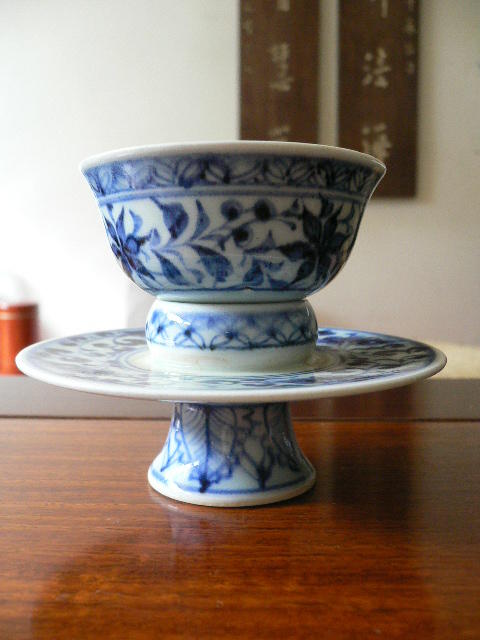
Faced with this beautiful reproduction of a Yuan dynasty cup (1277-1367), one wonders: how should I hold it? What do I do with the cup holder on which the cup rests?

Before I answer these all too important metaphysical questions for Chinese tea lovers, let me first give more information about this amazingly beautiful tea cup. More pictures of the cup here.

Only one similar genuine antique exists in a Chinese museum (I think it's Taiwan's National Palace Museum and while you are on that site make sure you don't miss viewing the video 'Old is New' in Quicktime format). It served as a template for the shape and one design of the drawings on the cup. This cup is actually part of a set of 8 cups. The other designs are also replicates of actual ancient Yuan Dynasty designs (as found in books edited by museums).

The cups are made and painted by hand (la pei) using the very same techniques as seven hundred years ago by pottery craftsmen that have specialized in these old techniques. That is why the production time is kind of slow: it took half a year to make five sets of eight cup each. I've asked how much such a set would cost (the first five sets have already been sold out): approximately 3,000 euros! That's a lot of money for 8 cups! However, last time I looked at the price of Meissen tea cups with plate (the fancy 'english tea' ones, not the ones I have) I saw that 1 cup can cost as much as 1,800 euros! So, while expensive, it is still relatively normal. I think I will see if my fellow tea students are willing to buy a set together with me so that we can buy 2 each.

I had the pleasure and honor to drink from it today again. The porcelain feels very hard, heavy and has a very high degree of concentration. The glazing is smooth and feels like the best old tea cups I have. The color of the tea is clearer and shinier than in other tea cups. Even the smell is better, richer and more fragrant! And now that I know how to hold it correctly, I felt like in tea heaven, just like an imperial official in a yamen (townhall) taking a rest from his daytime duties...

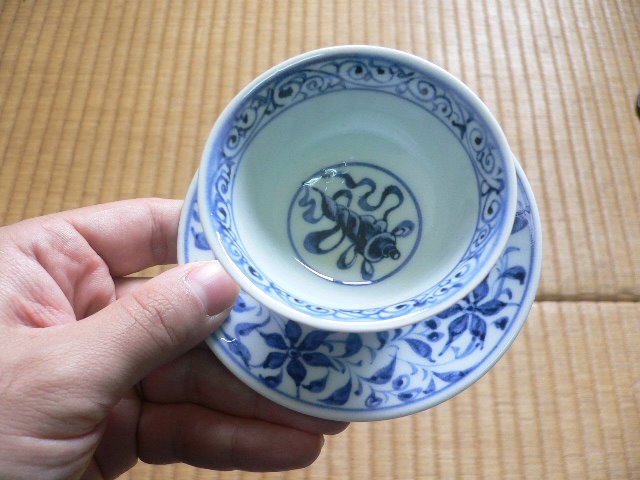
So, what's the correct way to hold it? Used to western tea plates, I guess that modern people would instinctively hold it like this (wrong) way:

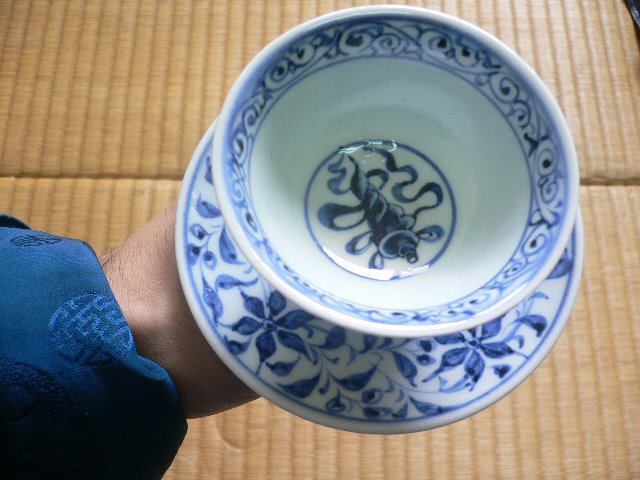
Teaparker found the correct answer in a one of thos big art books printed by a researcher working in a Chinese museum. I don't have the reference of the book, but I did take this picture:


And so, when you hold the cup from the bottom, and you look at your cup, this is what you see:
Thursday, December 15, 2005

Tea Masters vu sur le Net

On parle beaucoup de thé (chinois) et (donc aussi) de Tea Masters sur le forum de HardWare (le guide du HardWare et de l'optimisation PC). Les branchés informatiques ont, peut-être, plus que d'autres, besoin de la culture ancienne du gongfu cha pour alterner avec le monde virtuel et futuriste des réseaux et des écrans plats.

Vous y lirez notamment les compte-rendus de dégustation de plusieurs de mes thés par Trajan qui m'en a commandé récemment.

Wednesday, December 14, 2005

Tea set design


Tea is a pleasure for our 5 senses (and more), as I have shown in my lessons. Our eyes also participate. Here is an example of how a simple black quilt and a nice set-up of your tea ware will create beauty and harmony. Let the artist in you express himself/herself!

Tuesday, December 13, 2005

Economiser du chauffage en buvant du thé

Maintenant que les températures externes de Taipei sont aux alentours de 15 degrés (au-dessus de zéro), mais vivant dans un appartement sans chauffage (comme 99% de la population), rien de tel que boire un bon thé chaud pour se réchauffer. Je vous propose 3 petits trucs de maitre de thé pour vous permettre de réduire la température de votre pièce (et donc votre facture de chauffage) sans vous refroidir.

Les 2 premières recettes sont de Teaparker:
- Au lieu du traditionnel gingembre cuit avec du sucre roux (j'en ai parlé l'an passé), il propose une petite variation: coupez des tranches fines de gingembre frais et ajoutez-les aux feuilles de thé rouge (Darjeeling d'Inde, par exemple). Faites l'infusion. Sucrez si besoin. Le gingembre donnera son côté épicé et vous dégagera le nez et la gorge. Le dosage est délicat et dépend de la force du thé et du gingembre. L'idéal est de pouvoir sentir pareillement le thé et le gingembre,

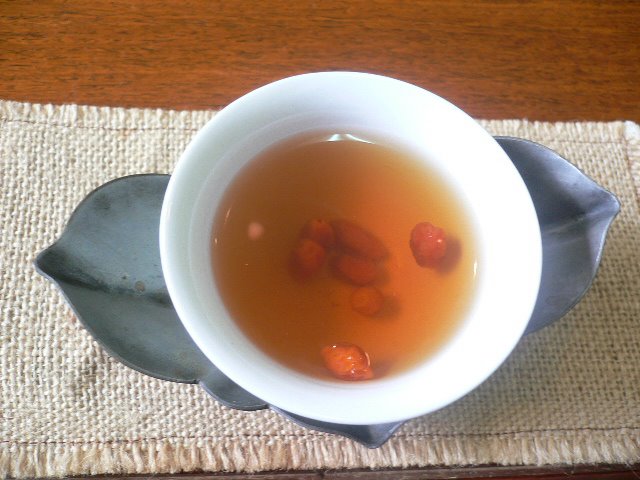
- Faites revenir des petites dattes rouges sèches (hong zao) avec du sel sur une poêle à sec. Filtrez le sel. Préparez un thé rouge (Oriental Beauty, Darjeeeling) et ajoutez-y les dattes. Pas besoin de sucrer. Une combinaison fine et harmonieuse. Dosage: 10 gr de dattes pour 75 cl de thé.


- Boire les thés hyper torréfiés, favoris des vieux buveurs de thé chinois. J'en ai encore fait l'expérience dimanche dernier. Je me rendis dans un vieux magasin tenu par un patron de plus de 80 ans. J'y achète mon très bon tie kuan yin et il m'avait offert un oolong hyper torréfié pas cher du tout. Un tel thé pourrait passer pour un vieux thé taiwanais, torréfié de nombreuses fois. Je retournai donc pour en savoir plus sur ce thé mystérieux et très bon (bien qu'il ait été hyper torréfié, il n'a pas l'odeur désagréable de charbon brulé qu'on trouve chez les apprentis torréfacteur). En fait, il s'agit d'un Tie Kuan Yin de Nan Yan à Anxi dans le Fujian, la région d'origine du patron. On l'a redégusté ensemble à sa manière: fort comme un café! La chaleur de la torréfaction semble se propager dans la gorge et dans l'estomac. Ce n'est pas tant un thé à boire avec le nez qu'avec la gorge.

Dans cette catégorie de thés torréfiés on trouvera donc les vieux oolongs et baozhongs, la plupart des tie kuan yin, le Shui Xian... J'en bois au moins un tous les jours de froid actuellement. Résultat: pas un sou ne part pour le chauffage et j'ai une bonne excuse (en plus) pour boire du bon thé!

Friday, December 09, 2005

Geisha, the tea mistress

Today, the movie Memoirs of a Geisha is released in the US. For the occasion, CNN Europe aired a little video about real aspiring Geishas (called Maiko) in today's Japan. They have to learn many skills and lots of Japanese traditions to be able to achieve their goal: entertaining the Japanese man. One of the skills they have to learn is that of the Japanese tea ceremony.
CNN then provided these 2 figures:
- 1000 dollars for an hour with a geisha,
- 500,000 dollars to complete the training in Japanese tea ceremony.

For them, the conclusion was: let's spend an hour with a geisha. She can teach the tea ceremony and it will be cheaper than going to a tea master! While attractive, there are several flaws in this demonstration.

First, with all they have to learn (kimono folding, makeup, tea, singing, dancing...) geishas don't have much time to learn english. You'll have trouble learning the ceremony from them unless you speak japanese yourself. (The same can probably be said of Japanese tea masters, though).

Second, I don't know where they get the figure of 500,000 USD, but it can't just be the teacher's fee. I guess it also includes the cost of the tools, the tea, trips to tea farms, pottery makers, museums... Also, my experience of learning from a Chinese tea master (much cheaper!) shows me tea is the kind of study one starts but never finishes. There is just too much to learn. A geisha may know how to make a perfect Japanese ceremony with all the ins and outs (sorry, this joke was just too tempting!), but she probably won't teach you the historical backgroung, how this technique was invented in China during the Sung dynasty, tea production methods...

Third, it's not because both a visit to a geisha and to a tea master carry a high price tag that you can trade one for the other easily. For 'open-minded', well-paid journalists at CNN, a visit to a geisha may sound like a good deal... but only if you close your eyes on the moral and social consequences of such an action. Imagine how your wife (or mother) would react when you say: "I'm going to see a geisha to learn Japanese tea ceremony. At 1000 dollars an hour, it's really a good deal!"

In conclusion, I recommend that you save both the trip to the geisha or to expensive Japanese tea masters. If you want to start to learn the skill of Chinese teas, the best is to spend an hour reading and practicing the tea lessons I have written in this blog. It's completely free and nothing to be ashamed of.

Thursday, December 08, 2005

Musique chinoise pour le gong fu cha


Les lecteurs qui m'ont acheté du thé savent combien la musique chinoise classique peut agrémenter une séance de gong fu cha. Ajouter une dimension musicale à la dégustation d'un pu er sauvage ou d'un oolong torréfié permet de rapidement se sentir en harmonie avec soi-même et le thé. Je le conseille pour se relaxer, pour se concentrer ou tout simplement pour rêver.

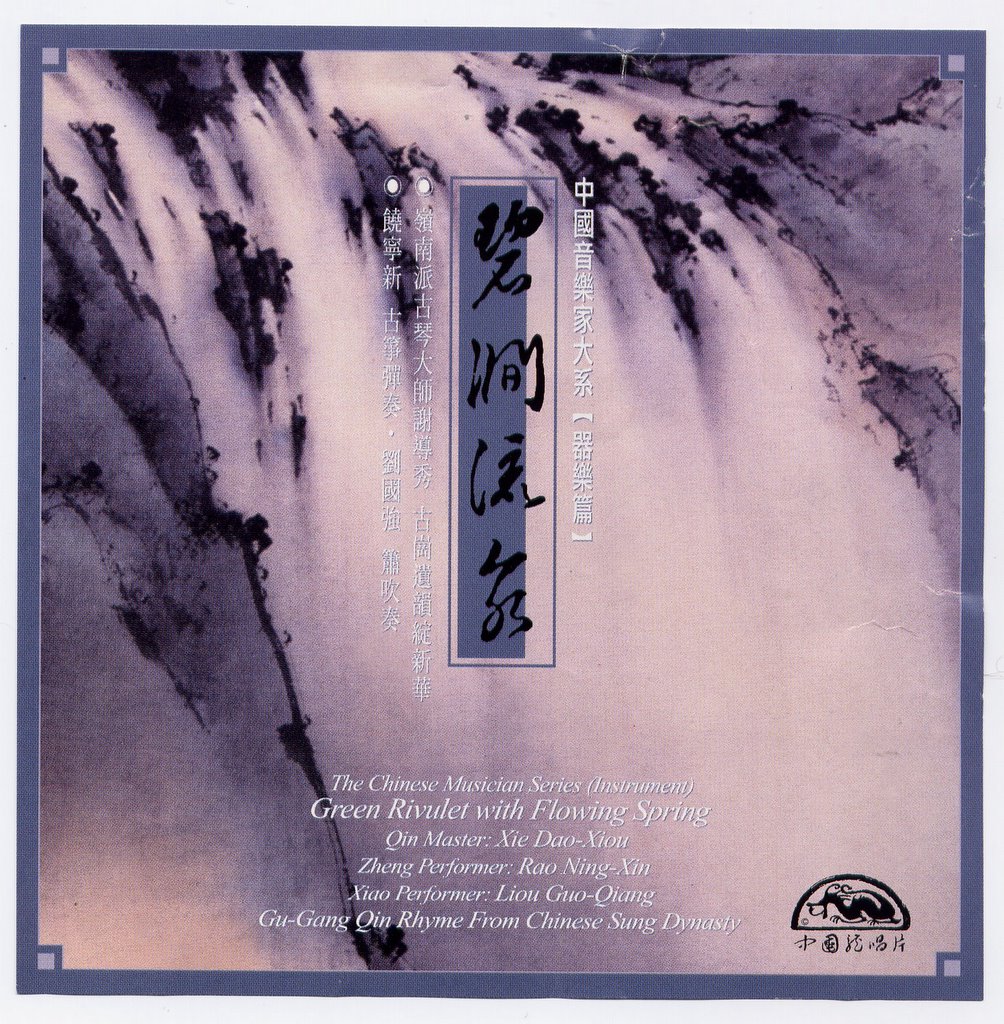
Les instruments de musique chinoise sont nombreux. Je partage l'avis de Teaparker que le guqin est un des plus beaux. C'est d'ailleurs l'instrument principal sur le CD dont vous voyez la couverture. On y entend aussi du zheng et du xiao. La musique de ce CD date de la dynastie Song (960-1279). C'est mon CD préféré pour le thé. Je trouve que la musique classique chinoise est bien meilleure que les pseudo musiques chinoises qui utilisent un mélange de vieux instruments et de synthés. C'est ce qu'on trouve surtout dans les rayons New Age des magasins de musique. J'écoutais cela aussi au début. Mais depuis que j'ai découvert cette collection instrumentale, je préfère l'original aux imitations! Je vais surement bientôt aller rendre visite à cet éditeur. Il n'habite pas trop loin de chez moi. J'ai bien envie de lui acheter d'autres CDs de cette collection (pour mon Noël). Je pense que je vais ajouter les meilleurs à ma sélection pour vous permettre aussi d'écouter cette excellente musique.

Il y a encore une petite anecdote à propos du guqin: le musicien place d'habitude un encensoir devant son guqin et fait bruler de l'encens pendant qu'il en joue. C'est Teaparker qui me l'a montré sur une photo. D'après les connaisseurs, l'encens permet au son de mieux se propager dans l'air!

Wednesday, December 07, 2005

Tea videos

Tea Arts blog was so kind to send me this link to lots of videos of Chinese tea brewings (in Windows Media format). I hesitated a litte before posting this link on my blog. You will (mostly) see how Chinese tea is performed for the tourists. Lots of costumes, slow movements, relaxing music...

It's hard for me to take these completely seriously. On the other hand, I did like some of the music played (Line 3, 7th video from the left: the guy in white). I believe that this way of preparing tea can be as effective a relaxation as taichi, but not in front of a public or a camera. And it's also a reminder that the surroundings have an impact on your mood and the way you appretiate your tea. Outdoors are often great (but try to get far away from noisy roads!). And indoors, a simple, classic design will let you better relax than heavily decorated rooms. You will also notice that the set up of your tea table is very important: if you are right handed, for instance, than the hot water should be placed close by on your right so that you don't have to make large movements to get it.

Tuesday, December 06, 2005

Tea Masters: Newsletter No 1


Are you among the happy few who have received it? If not, just send me an e-mail at: stephane_erler@yahoo.com

Je viens d'envoyer la Newsletter à mes lecteurs les plus fidèles. Si vous désirez vous aussi la recevoir, envoyez-moi un e-mail à: stephane_erler@yahoo.com

Monday, December 05, 2005

Meissen and Jing De Zhen

This picture shows my modern Meissen Chinese tea cup with its ancestor. Yep! The cup on the right is an original end of 17th Century old tea cup from Jing De Zhen, a famous pottery town in China. It is to Porcelain what Yixing is to teapots. That is where Meissen got its technology to make white porcelain. And, as you can see, the design of these 2 cups shows how related their story is.

Thursday, December 01, 2005

Recyclez vos feuilles de thé!

Teaparker nous rappelle que le thé est un produit de l'harmonie entre l'homme et la nature. Pour respecter cette harmonie, l'amateur de thé est invité à adopter un comportement responsable de minimisation et de recyclage des déchets. A commencer par le thé!!

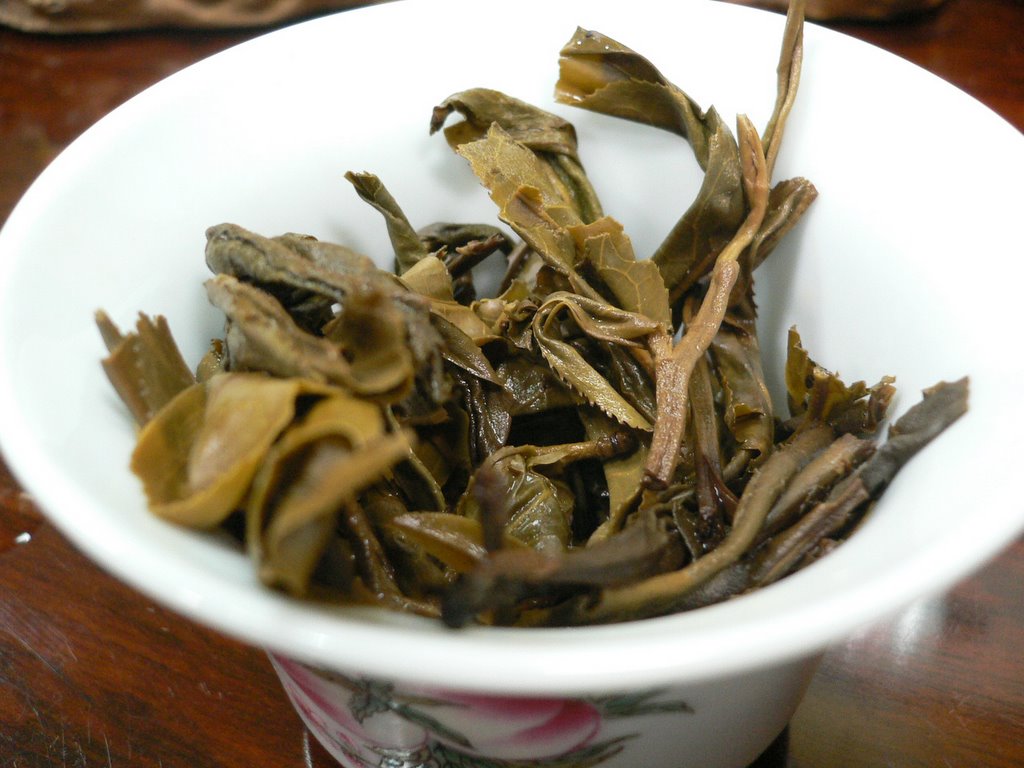
Un premier moyen d'utiliser le thé infusé est de le mettre sur une petite assiette et de le mettre dans le frigo pour filtrer les mauvaises odeurs. Je vais essayer ce truc aujourd'hui avec mon oolong de haute montagne, mais cela me semble très efficace car les thés chinois ont la propriété d'absorber les odeurs environnantes.

On peut aussi utiliser l'eau 'usée' durant une pratique de gongfu cha pour arroser ses plantes vertes. Cette eau contient de nombreux minéraux et est un engrais naturel. Et un autre engrais est celui que vous obtenez en compostant les feuilles usées à la sortie du frigo. Ne les jettez pas à la poubelle, mais dans un endroit dédié dans votre jardin.