Friday, January 04, 2019

Dong Ding Dong Ding Dong Ding

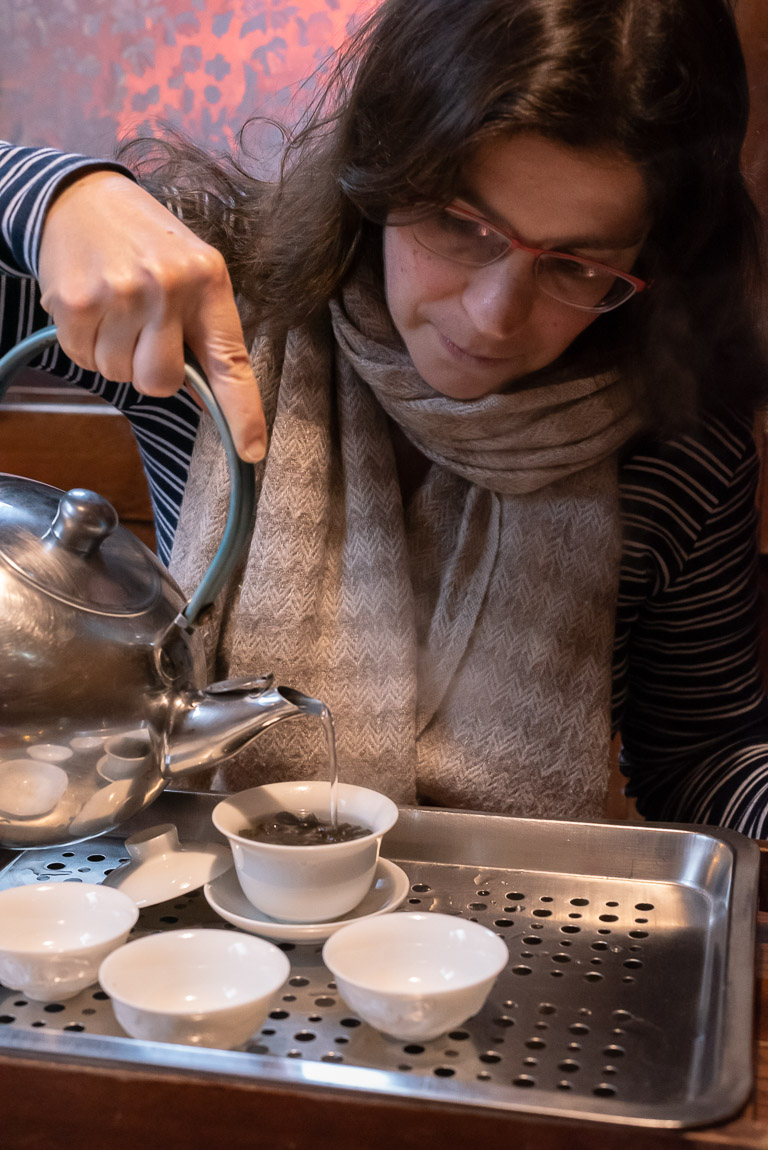
Have you heard the bell ring? Christmas vacation is over and we're back in tea class! Sarah and Rattana are back in Taiwan and have asked me to teach them about Dong Ding Oolong. So, I chose several teas to explain what Dong Ding tea is all about.
We started with this Hung Shui Oolong from Feng Huang, winter 2017. This is an excellent example of what a Dong Ding Oolong is and should taste like. The cultivar is Qingxin Oolong and it's grown in Feng Huang, one of the villages that are part of the rather small Dong Ding area. The winter season and the spring season both see the Dong Ding Oolong take place. It was created in 1976 by the director of the Taiwan Research and Extension Station (TRES, Taiwan's tea research institute) to raise quality by using a standard taste close to that of WuYi Oolongs (which were not available in Taiwan at the time, due to the ongoing conflict between China and Taiwan.) The reason for choosing this Hung Shui Oolong is that it comes closest, in my opinion, to the ideal Dong Ding Oolong: the roasting hasn't burned the leaves and they still unfold very nicely. The aromas have been positively impacted by the roasting. There are scents of walnuts, chestnuts, but also fresh fruity smells. And the taste is both long and sweet. This batch is less roasted than typical competition Dong Ding Oolongs.
 The next tea on our list was the spring 2016 Hung Shui Oolong from Alishan. The purpose of this tea is to understand that Dong Ding Oolong has become so famous in the 1980s, that such teas were (and still are) produced all over Taiwan. That's why the name Hung Shui Oolong has come up to describe an Oolong that has been produced with a typical Dong Ding Oolong process. This one comes from Alishan, from a higher elevation than the Dong Ding area. It's also made from Qingxin Oolong leaves. Using high mountain leaves is a strategy used to make finer and more powerful Hung Shui Oolong. That's why most teas that win the Dong Ding Oolong competition don't come from Dong Ding, but from Shan Lin Xi or even Lishan! What's also interesting is that this Alishan Hung Shui Oolong has a stronger roast, which adds even more dark aromas to the brew.
The varying roasting level is what makes Oolong so complex and so fascinating. Other teas are not roasted, but simply dried. Thanks to the roast, new flavors appear. The brew become malty and reminds us of a brandy! This also has a big impact on how the leaves are best brewed. That's what Sarah and Rattana could learn and practice with me. (I explain the brewing in my TeaMasters guide to Brewing Oolong tea, which I offer for any order of 60 USD or more.)
It's SO good!
Then we tasted a very similar tea: this summer 2018 zhuo yan Oolong from Yong Lung in Dong Ding. Zhuo yan means jassid bitten. The difference with the first Hung Shui Oolong is not the roasting (this one also has a light to medium roast), but the season: summer. Because it's produced when the temperatures are higher, the oxidation level is slightly higher. The fragrances are much fruitier and sweet than in the spring or in winter. This is also a Dong Ding Oolong: it comes from Dong Ding and is processed like a Dong Ding Oolong, but the summer season has a tremendous impact on the brew.
2010 fall OB
We then proceeded to taste this 2010 fall Oriental Beauty Oolong from Hsin Chu. With this tea, I wanted to show the similarities and differences to the previous summer zhuo yan Oolong. There are 3 main differences: 1. the cultivar, qingxin dapang instead of qingxin Oolong, 2. the higher oxidation for Oriental Beauty and the shape and size of the dry leaves.

The zhuo yan Oolong from Yong Lung is like a bridge between Hung Shui Oolong and Oriental Beauty Oolong. So, tasting an Oriental Beauty just after the zhuo yan Oolong (or a concubine Oolong, which is not the same) helps to clarify the characteristics of each type of Oolong.

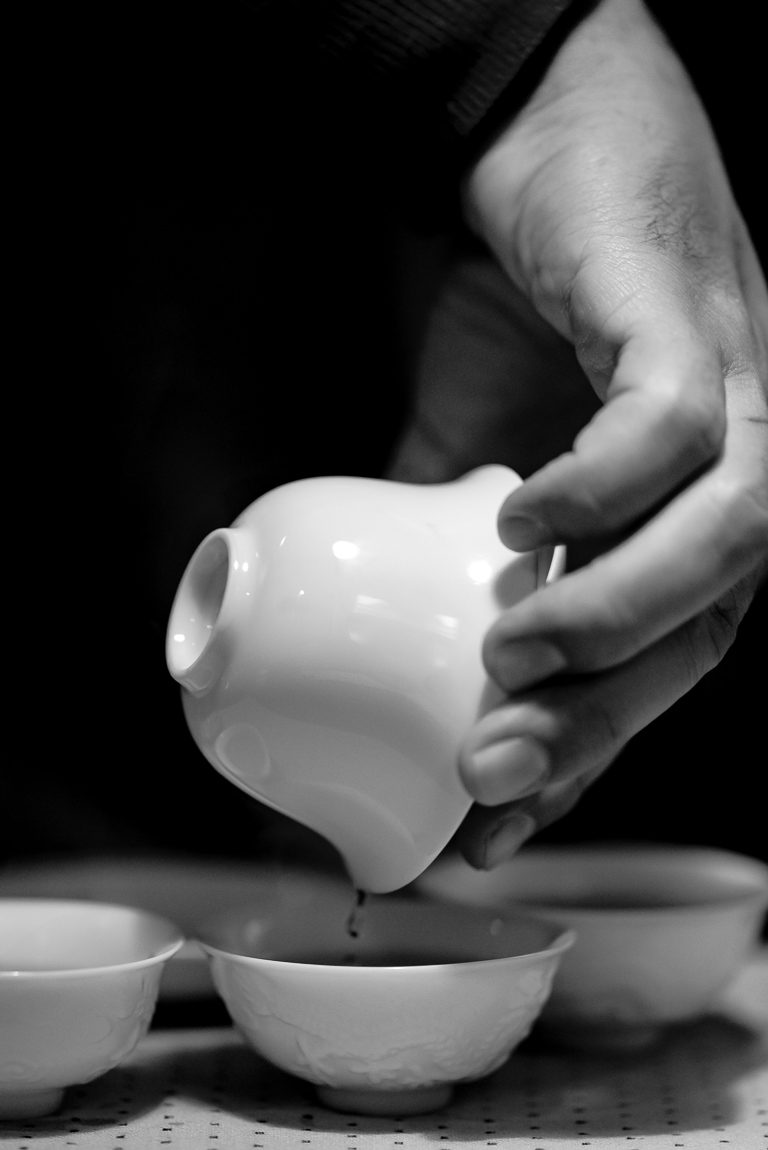
This was really a class, because we only used this ivory white porcelain gaiwan. An Yixing teapot could have given us a deeper and smoother taste, but the porcelain gaiwan brings more clarity and truth to the aromas.

Before I mention the next Oolong we brewed to conclude this lesson, I want to point out that these 2 and the following pictures were taken by Rattana with my Nikon D750. He's an accomplished professional photographer and I'm very grateful for the art he has created and his permission to share his photos here.
The most liked picture of 2018 is a black and white picture and these look stunning! The white porcelain enhances the purity of this tea experience!
It also makes sense to use black and white now, because we tasted this aged 1999 Hung Shui Oolong from Yong Lung (Dong Ding) as our last tea.
It takes us back 20 years ago. We notice that the leaves are mostly single, ie not attached to one another on a stem like nowadays. The look of dry leaves is already more refined!
Their aged aromas are very different from a newly roasted Hung Shui Oolong. It's difficult to describe. In wine, they are called tertiary aromas, scents that are not the result of a specific process, but of time. The taste is smoother, less powerful also.
But the character of Dong Ding remains the same.
Brew after brew and cup after cup.
I hope you all had a great start in 2019! I couldn't have dreamed a better one myself. Thank you Rattana for capturing the beauty of this dark dragon!

Thursday, December 27, 2018

The year 2018 in 12 pictures

For big format viewing, I recommend you view this article on my photo blog. Please vote for your favorite picture on my Facebook page. This will help me determine which picture should become next year's tea postcard.

December. Ming style tea.

November. Mon nouveau livre numérique est arrivé!

October. The living dead puerh from the early 90s

September. Fushou shan and Tian Chi Oolong gardens


August. Lishan Oolong Chaxi


July. Beauté orientale d'été 2017


June. Existenzmaximum @Alishan


May. Spring Alishan Harvests


April. Printemps 2018


March. Sunset Chaxi among the corals


February. Sunset on lotus lake in Kaohsiung.


January. Wisdom and Peace


Click on these links for the pictures of 201720162015201420132012201120102009 , 2008 and 2007.

Wednesday, December 26, 2018

The top 10 articles of 2018

Spring 2017 wild gushu puerh
I wish you all a wonderful Christmas and year end festivities! This is a great time to enjoy quality teas from morning to evening! Red teas pair desserts well. Hung Shui Oolongs work well as aperitifs to open up your appetite and wild puerhs give energy to stay up late!

Usually, I rank my 10 best articles according to the number of views counted by Blogger, my blog host. However, this year, I noticed something very strange. All my articles before March 17, 2018 had 1500 to 4000 views. After that, the view count has tumbled to 300 to 1000 views per article! Such a dramatic drop of readers should have had a negative impact on tea sales, but they remained stable and even increased slightly to a new high in 2018! I conclude that a lot of views in the past were generated by bots, fake accounts. Since a lot of advertising money is paid on the basis of clicks and views, I suppose there was fraud to artificially increase the number of views of websites. Apparently, Blogger (and its parent company Google) have become better at detecting this fraud.

This is another good reason why I don't do any online advertising, buying search terms in Google or promoting posts on FB. Since the start, I have only counted on word of mouth and positive reputation to attract new customers. This means I will always count on you, my dear readers, to like and/or share my articles on your social media networks. And this means that I have to earn your trust and interest with quality content, nice photographs and, most importantly, great teas! Thank you for all your support: this blog would cease to exist without you!

Here are the best articles of 2018:

10. Les plantations de Shizhuo à Alishan. With breathtaking pictures of several high mountain tea plantations.

9. The many faces of spring. When tea meets a shan-shui painting.

8. The ultimate tea ware collection of Chinese emperors eBook is available! From Tang to Qing dynasty, see the tea ware collection from the National Palace Museum in Taipei and Chiayi. This eBook is my FREE gift for any order in excess of 200 USD.

7. The process of Wenshan Baozhong tea. A step by step report about how Wenshan Baozhong is made.

6. Magnifying the beauty of tea. True beauty comes from within the leaves.

5. The 2000th article: a tea class about Chaxi. The celebration of a milestone.

4. The pitfalls of discussing puerh prices. Only an educated buyer can be a smart buyer.

3. Dong Ding Finesse. A view of Qilin lake.

2. Débuter 2018 par un puerh de 1988. Un thé d'amitié universelle.

1. Tea photography clues to select an online tea seller.  Some advice for buying tea online.
Spring 2017 wild gushu puerh

Friday, December 21, 2018

Between light and darkness


With this Chaxi, we can see why each of my Chabu has a black side: black provides a great contrast to tea ware. White cups shine when hit by light on top of black fabric. It's also a good reminder that in the duality of light and darkness, the best part, the colors happen at the edge between them! In this sense, finding the middle of the road between light and darkness means emphasizing the colors! Maybe that's why we like our Christmas decoration bright and colorful during the dark time around the winter solstice! With this Chaxi, the contrast of light and darkness lets the colors come to life! It all starts with the green jade hue of the Qingxin Oolong leaves from BiLuXi, spring 2017. They breathe a Christmas feeling, because these dry leaves have notes of pine trees (which grow around the plantation!)
The brew is cristal clear and the taste is both smooth and deep. The sun shines in the cup and in the leaves. The freshness is still there, but it's the sweetness that dominates.
I decorated this Chaxi with my mother's quilt, because it helps me feel closer to my family in Europe. I also chose it for its snow (I miss snow in Taiwan!) and the nice contrast on the black background. And I also love this picture of 2 people walking through snow to go to a lonely church. Their walk is difficult, but they have a light and can see where they are heading.
 And, believe it or not, I have just realized now that I made these 2 shots at the exact right time: the light coming through the window left this shadow of a cross on this quilt. What a fitting sign for Christmas and this picture in particular!
Have a joyful and colorful Christmas time with sweet and pure Oolong tea!

Thursday, December 20, 2018

L'harmonie comme principe de beauté et du Chaxi


 Un changement de temps radical m'amène à choisir un tout autre thé que dans mon dernier article pour mon nouveau Chaxi aux couleurs de Noël. Un magnifique soleil nous comble de sa lumière et de sa chaleur. Et comme c'est l'hiver, ce soleil amène un temps sec similaire à celui de la montagne. Voilà pourquoi j'ai envie de déguster mon tout dernier Oolong de haute montagne d'hiver: ce Qingxin Oolong de Long Fengxia, la plus haute section de Shan Lin Xi, récolté le 26 octobre 2018. Les feuilles sont de couleur de jade. Certaines sont d'un vert plus foncé que d'autres: leur ensoleillement ne fut pas pareil. Les parfums sont très floraux et fins, mais un peu moins expressifs qu'au printemps.
Cette théière Yixing en glaise zhuni fait bien ressortir toute la finesse des arômes dans l'infusion. L'écoulement est net et je verse directement dans les coupes sans mettre une goutte à côté! C'est un petit jeu de maitrise de la théière qui aide à se concentrer. J'en reparlerai dans un autre article dans quelque temps.
Aujourd'hui, j'ai envie de vous parler d'harmonie. Et cette harmonie serait globale. Elle ne se contente pas d'harmoniser le temps d'infusion avec la quantité de feuilles, le choix de la théière en fonction des feuilles, le choix des feuilles en fonction de la saison ou de l'ambiance, le choix des coupes pour le thé infusé...  Toutes ces harmonies, on va essayer de les harmoniser entre elles et chercher de nouvelles harmonies dans chaque objet qu'on met sur son Chaxi, sur l'endroit qu'on lui choisit... La jarre blanche avec sa décoration ressemble à une fleur et évoque la fraicheur d'un pic de montagne enneigée. Le petit bonsai se transforme en sapin de Noël. Le roi mage de l'Erzgebirge est un objet souvenir qui donne corps aux traditions de ma famille côté allemand... Et comme musique de fond, je joue l'oratoire de Noël de Bach.
 Toutes ces harmonies autour de l'infusion d'un thé sont un effort de faire le meilleur choix possible avec ce que l'on a. La beauté du tout ne vient de la perfection d'un objet en particulier ou d'une prise de vue plus réussie qu'une autre. Une recherche de perfection viendrait, j'ai peur, glacer le Chaxi. Il ne s'agit pas de fixer les choses pour n'obtenir qu'une photo parfaite, mais faire en sorte que l'infusion du thé devienne un spectable beau à chaque moment! Et parfois on voit apparaitre des images qui ressemblent littéralement à un ange qui passe!
En chinois, on parle de "Yin-Yun", "d'interaction unifiante", selon François Cheng. Cette expression explique bien l'action que nous essayons d'accomplir avec le Chaxi. De plus, il est intéressant de noter que yun est le mot caractère qui signifie la rime poétique et l'arrière-goût, le goût de la longueur en bouche pour les dégustateurs de thé en Chine.
En effet, le goût et les arômes qui nous restent longtemps en bouche (pour un bon thé) sont comme un écho, une rime aux premières saveurs des premières gorgées. Une coupe est bonne quand ces notes persistent en s'affinant et en devenant douces (au lieu de devenir amères ou s'arrêter rapidement). C'est cela aussi l'harmonie qu'on cherche à créer dans la coupe, puis en bouche!
Dans ce Chaxi, on a un sujet puissant: Noël, une fête ancienne, la célébration d'une naissance, le divin qui se fait homme. Voici des thèmes qui ont une puissance évocatrice  extraordinaire. C'est autant d'énergie qui est insufflée dans ce Chaxi. Notre harmonie globale, toutes nos interactions unifiées, prennent encore plus de sens si elles sont portées par un thème fort, une raison d'être.
 Et puisque je viens de parler d'énergie et de souffle, sachez que ces 2 concepts sont liés dans l'expression Qi-Yun chinoise (où le Qi est l'énergie et le Yun est le rythme, la rime). C'est donc une énergie qui se transmet, qui interagit. Dans le Chaxi, c'est le feu qui permet à l'eau de bouillir, qui permet à l'eau d'infuser les feuilles et en extraire leurs arômes, qui permet de verser le thé dans les coupes, qui nous renvoient la belles couleur du thé et qui nous donne un plaisir qui se propage dans la bouche et dans tout le corps...
 Est-ce trop ésotérique? L'explication théorique peut le paraitre, mais je trouve que le thé est une bonne application de ces concepts de Yin-Yun et Qi-Yun. Harmonie et souffle.
Revenons donc un peu sur terre avec ces magnifiques feuilles très faiblement oxydées dont la finesse et la fraicheur sont révélées par la pâleur de l'infusion.
 Cet Oolong de haute montagne fut un délice plusieurs fois répété. Vive la période de l'Avent! Le thé prend encore plus de saveur.
"Le souffle devient esprit lorsqu'il atteint le rythme."

Tuesday, December 18, 2018

More Christmas feeling with my OB from 2000

 The Christmas tree is decorated and ready to serve as a huge bonsai for my Chaxi!
Special moments call for great teas. Here, I brew my top Oriental Beauty from Hsin Chu from the year 2000! When you think about it, this year is particularly full of meaning, because it celebrates exactly 2 thousand birth years of Jesus! But beyond the number of years, the pairing of tea with Christmas works on several levels:
1. a highly oxidized tea that brings warmth in December,
2. an aged tea that has a special aftertaste and complex scents. It is more than what it appears to be. It has an extra, invisible, almost miraculous dimension that fresh teas rarely have.
3. it's aged, but still powerful. It withstands time like the Christmas tradition.
4. its flavors bring joy!
5. its brew is so pure, so perfect! It shines like gold, like a star in the night!
 Imagine you want to celebrate the gift of life and nature with a meal: you wouldn't go to a fast food and bring back a bunch of burgers, fries and soft drinks! Junk food may be convenient, but it would go against the spirit of nature! Think of this logic when choosing a tea for this special time of the year! I recommend avoiding artificially flavored teas, tea bags or mass produced teas...
 With Christmas, we celebrate hope and a promise of redemption for all. This tea gives me a glimpse of what paradise may taste like!