Thursday, August 31, 2006

Du thé en pleine forme

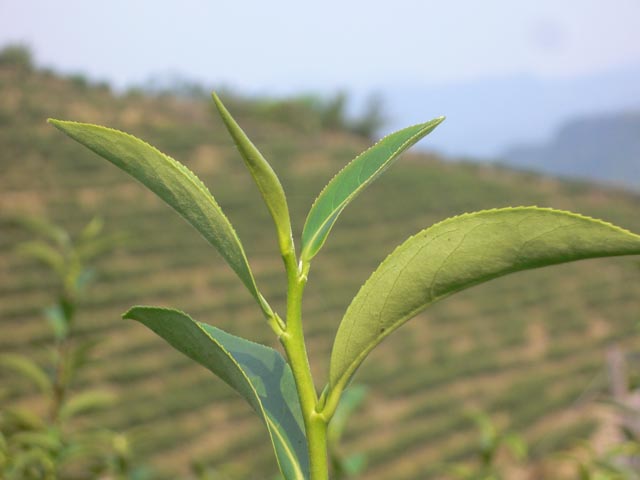
J'ai une petite gastro qui m'empêche de boire du thé cette semaine. Cela et le magazine de thé en préparation expliquent pourquoi je fais une petite pause sur mon blog. J'en profite pour vous montrer rapidement que le thé peut aussi tomber malade. Ainsi, on voit assez clairement sur la première photo comment les feuilles qui pointent vers le ciel se portent bien. Mais sur la photo du bas, les feuilles sont presque horizontales et se sentent patraques.


This last picture shows an example of 'sick', strengthless Oolong tea leave. Healthy leaves should point to the sun.

Friday, August 25, 2006

Celebration!

As I was preparing this post, my blog has reached a new mark, 50,000 visitors! I feel very honored to know so many gongfu cha enthusiasts have made my blog a source of information about Chinese tea. Thank you for your continuous trust and support.

This is also a good time to announce that one of my readers has recently asked me to contribute some articles for a new tea magazine (coming out in October). I'm currently quite busy working on this project and have less time for blogging. But this means an added opportunity to research the world of Chinese teas, and this knowledge will benefit the blog too over time.

My last celebration comes from my latest aquisition of a new hare's fur Jianyang cha zan. I'm definitely done mourning my previous bowl now. This reproduction looks as well made as the previous one I had.

Wednesday, August 23, 2006

Yingge tea shop


I liked this Yingge ceramic shop a lot. Here, the artists plunge deep in China's past to recreate beautiful, old looking, simple objects for our tea pleasure. With such accessories, you don't just smell the delicate fragrances of tea. With your senses you fly further than the fields of flowers and orchards, further than the forests of Yunnan and the mountains of Formosa. It's your whole soul that travels through time and space. It is looking for its old self and finds it in a small Chinese town some 200 years ago. Which town? I don't know. It's time for another cup of tea...

Monday, August 21, 2006

Un zhong en or d'Yingge

J'ai visité Yingge hier et suis tombé sur cette curiosité: un zhong/gaiwan/gaibei décoré avec une lourde couche d'or 24 carats et peint à la main. J'ai demandé le prix, à tout hasard: 8,000 New Taiwan Dollar.
Me croyant intéressé, la vendeuse a commencé à négocier et était prête à descendre jusqu'à 6,000 NTD (150 euros). C'est très joliment fait, inspiré de la période Ming , mais qui osera s'en servir pour y faire son thé?

Saturday, August 19, 2006

Wen Shan tea

I wish you a nice weekend with this picture I took today near Pinglin. I drove up the mountains on this sunny afternoon. I thought I was in heaven. A landscape with tea fields is just beautiful. They don't seem as intrusive as fruit orchards and blend in well with the rest of nature. I actually hadn't realized how near all these fields are from Taipei. I'll definitely make this a 'go often' destination for future weekends.


Today was also a very good day to get some mountain spring water. It hasn't rained much in recent days, so that the spring water came out very pure and cool. You can actually see my canister and the water pipe abve and behind the butterfly!

I'm looking forward making my tea with this spring water. It tasted so sweet this afternoon...

(You have guessed that I also used the journey to restock my Baozhongs! So, I have the 'subtropical forrest' again. I also got a sample of an Oriental Beauty of 2006. I wonder how it compares to my 2005 Hsin Chu Oriental Beauty I also recently repurchased.)

Thursday, August 17, 2006

A new tea blog

Imen has come up with a very good name for her tea blog: Tea Obsession.
Let's all wish her a quick recovery of her broken little finger.

Tuesday, August 15, 2006

Petite jarre à thé antique

Je vous présente ma dernière acquisition personnelle: une toute petite boite en céramique verte (céladon). Elle date au moins de la dynastie Yuan (1277-1367). En fait, vous aviez déjà vu deux de ses soeurs ici et là. Elle fait parti d'un lot de 5 que Teaparker nous a déniché chez un antiquaire. Une pour chacun de ses étudiants.

C'est l'occasion de vous rappeler (une raison) pourquoi le céladon (vert) est une des couleurs favorite des Chinois pour le thé. C'est la couleur de la nature, des feuilles et des forêts. Et par le thé, boisson faite de feuilles, nous 'communions' (pour prendre un mot chargé de spiritualité) avec la nature.

Le temps lui a donné de si jolies rides...
Si l'intérieur et la partie visible sont émaillés, le bas du couvercle et de la jarre ne le sont pas.

Comme je l'ai déjà expliqué, ce genre de petite jarre n'est pas fait pour la conservation du thé sur de longues périodes. D'ailleurs le couvercle n'est pas étanche du tout. On l'utilise plutôt comme accessoire pour le thé que l'on va faire tout prochainement. Contrairement aux sachets plastiques modernes, un tel objet a toute sa place sur un plateau à thé. Les grandes jarres, elles, ont plutôt vocation à contenir du thé sur le moyen-long terme et à orner les étagères. Ici, j'ai rempli ma petite jarre d'un peu de Long Jing, mais on pourrait aussi bien le remplir de matcha. Le céladon sur un tissu noir est du meilleur effet.

La forme de cette jarre antique continue d'influencer les jarres modernes. C'est très clair quand on la compare à la forme ronde d'une des mes petites jarres contemporaine d'Yingge peinte à la main sur un motif Shan Shui, montagne et rivière (eau). Existe aussi avec des motifs de lotus coloré ou qinghua , ou de fleur de prunus.

Monday, August 14, 2006

Der traditionelle Oolong

Bei Tee erleben findet man einen sehr ähnlichen Artikel über die Bedeutung des Röstungsprozess beim Oolong. Am selben Tag hatte ich auch darüber berichtet. "Les grands esprits se rencontrent", ein Treffen großer Geister!
Uebrigens, mein Da Yu Ling (2650 m) aus 2004 schmeckt nach einer sehr süßen und reifen Honigmellone. Mein Dong Ding Oolong aus 2003 schmeckt eher wie Pfirsisch. Die Geschmacksrichtung ist die selbe, reife, süße Früchte, aber die Geschmackspalette bleibt trotzdem offen und variiert.

Friday, August 11, 2006

Fun tasting notes

Here a link to a review of... not tea, not wine either, but Italian milk!

Incredible 'traditional' Oolong

Last Tuesday was Chinese Father Day (each year on August 8, because the 8th day of the 8th month is pronounced Ba Ba or Papa). So, as a way to celebrate, I had the afternoon off and did what I like most: searching excellent tea. Teaparker had recently given me the coordinates where I could buy some Da Yu Ling Oolong from the highest plantation (2650 meters). A friend in NYC had asked me for this tea some time ago, and so I had one more reason to go.

I was lucky: a thunderstorm had kept other customers away and I was alone with the owner. He only had 300 grams of this highest Da Yu Ling left. And it turned out that these were not 2006 or 2005, but spring 2004 harvest leaves. (This year was very rainy and the quality of most late harvested Oolongs was average because of this. That’s why he only had bought very little Da Yu Ling this year and that was already sold out). Anyway, I bought the tea without tasting, fully confident in the reliability of this tea merchant (friend of Teaparker). But actually, I should have tried it first. This would have avoided me calling him 2 days later.

Yesterday, I sat down to taste this ‘top of the world’ Oolong and chose to compare it to my other Da Yu Ling (2200 meters), a very green, lightly oxidized high mountain oolong with a fresh lavender fragrance. I thought ‘top of the world’ would be in the same category, just more concentrated and powerful. It turned out to be very different. The leaves were red on the edges and the color of the tea in my cup was gold instead of green. This is a classic Dong Ding taste, not a high mountain taste. It does taste very good, though. In terms of quality, it reminded me of a third place competition Oolong from Dong Ding I received 3 years ago. The Da Yu Ling was even purer.

On the phone, this master explained again what we had talked about the other day in his shop. He makes all his oolongs according to more traditional process parameters. That means a stronger fermentation and, often, but not necessarily, a longer, low fire roasting. While most of the high mountain oolong on the market is very green (low fermentation and almost no roasting), he insists that this is not how Oolong should be made and taste. First, such oolongs are usually rough on your stomach. Second, their aromas tend to be short lived: once the pack is opened, the leaves will loose their freshness within 6 months. Said differently, this means that, unlike puerh, such leaves won’t improve with time. Third, such oolongs are sought after for their fine fragrance, while traditional oolongs are strong on a lingering dry and sweet finish.

He is one of the few tea makers to use these traditional parameters with high mountain oolongs. This is quite daring. There are the risks and additional costs associated with spending a longer time oxidizing and roasting the tea. A little mistake could ruin very expensive leaves. So, his tea ends up being relatively more expensive than mainstream ‘green’ Oolong. While I agree with him that this is also a characteristic I like and often prefer, I also like the modern tasting high mountain oolongs, especially in summer.

As I was on my way out, he asked me to stay a little longer to smell a 10 year old Oolong from Li Shan. It was kept in a rough clay jar with black glazing. Guess how this traditionally processed smelled? Like brandy. Had he opened a bottle of German brandy, the smell would have been the same. I usually encounter this very smell in chocolate with alcohol. I swear I’m not making this up. He said he could only achieve this post fermentation result because he used the highest quality leaves with sufficient fermentation and roasting. (The jar was already sold out and didn’t belong to him anymore).

This was a very good way to prove his point. With such teas age is indeed much less an issue. Count on me to pay him another visit and see which of his (older) high mountain Oolongs I could add to my selection.

Actually, most of my Oolongs are already more ‘traditional’:

- 2006 Spring Ali Shan roasted Jinxuan Oolong (1400 meters)
- 2006 Spring Feng Huang, Dong Ding Oolong ‘classic’ w/light roast
- 2006 Spring Feng Huang, Dong Ding Oolong ‘fruity’ w/stronger oxidation
- 2005 Summer Guei Fei, Concubine Oolong from Dong Ding
- 2005 Summer Oriental Beauty from hsin Chu county
- Spring 2005 Top grade Tie Kuan Yin from Fujian, Mainland China.
- Spring 2005 strongly roasted Tie Kuan Yin from Anxi, Fujian.
- Spring 2005 strongly roasted Shui Xian from Wu Yi Mountain.
- 2006 Spring Top grade ‘subtropical forest’ Baozhong.
- 2006 Spring Top Grade Qizhong oolong.
- 2006 Spring Top Grade Shou Cha.
- 1980s top grade luanze Oolong from Dong Ding,
- 1960's old medium grade Wen Shan Baozhong,
- 1960s top grade Wen Shan Baozhong.

The following are the ‘modern’, light Oolongs:

- 2006 Spring Da Yu Ling Luanze Oolong (2200 meters)
- 2006 Spring Tsui Feng Luanze Oolong (2000 meters)
- 2006 Spring Shan Lin Shi Luanze Oolong (1650 meters)
- 2006 Spring Si Ji Chun Oolong from Ming Jian
- 2006 Spring Tsui Yu, Jade Oolong from Ming Jian
- 2006 Spring high quality ‘lily flower’ Baozhong.