Cela fait 19 ans que je prends des cours de thé, car je n'étais pas satisfait de la qualité des infusions que je faisais. Si je continue de suivre des cours, c'est que je trouve qu'il y a toujours moyen de s'améliorer et d'en apprendre plus sur le thé. Si vous suivez ce blog, j'imagine que la raison vient de l'inspiration, des connaissances et un exemple de pratique (notamment par le visionnage de mes infusions en vidéo) que vous y trouvez. Le but de mon blog est de partager ce que j'apprends afin de vous aider à progresser. Ce n'est qu'avec une bonne maitrise de la technique qu'on arrive à bien infuser son thé et donc à en tirer toute sa valeur.
Si on ne sait pas préparer son thé, il vaut mieux rater une infusion de feuilles qui valent 20 cents que des feuilles qui valent 2 Euros! Seul un bon savoir-faire permet que l'infusion de ces feuilles soit plus de 10 fois meilleure que les premières.
La pratique du thé est un apprentissage de l'humilité et de la responsabilité. D'abord de l'humilité, car les infusions vraiment parfaites sont rares si on a eu la chance de faire des expériences exceptionnelles et d'avoir placé la barre très haut. Même quand le thé est bon et qu'on est content du résultat, on peut toujours se demander comment le rendre encore meilleur.
Mais quand l'infusion n'est pas bonne, il s'agit d'effectuer une enquête à la Sherlock Holmes pour comprendre d'où vient le problème. Accepter sa responsabilité est le meilleur moyen pour progresser. A partir du moment où l'on se cherche des excuses au lieu d'explications, on fait mauvaise route.
- Ce n'est pas mon jour!
- Je n'ai pas fait attention!
- Ce thé s'est gâté depuis que je l'ai acheté.
- C'est la faute à mon thermomètre que je ne retrouve pas.
...
En fait, aucune excuse ne tient la route. Dans la préparation d'un thé, tout est de notre responsabilité: le choix du fournisseur des feuilles, le choix du thé qu'on prépare, comment on l'a conservé, l'eau, la bouilloire, la quantité de feuilles, la force de l'infusion, sa durée, le choix de la théière ou du gaiwan, le choix des coupes....
Infuser le même thé en groupe permet de constater combien notre contribution est importante dans la qualité de l'infusion. Rarement deux infusions ont le même goût, la même harmonie des saveurs, la même profondeur... Ainsi, rien que la manière d'infuser un thé a un impact énorme sur le plaisir qu'on en retire.
Ici, devant le lac Sun Moon, je ne disposais que de ma théière en argent pour infuser mon thé. Je l'avais choisie pour ce voyage parce qu'elle est bien moins fragile qu'une théière Yixing. Par contre, elle accentue les défauts et les qualités des feuilles infusées. C'est pourquoi, j'ai non seulement choisi un excellent puerh cru du début des années 1990, mais j'ai utilisé peu de feuilles. La couleur et la clarté de l'infusion montrent combien cette session fut une réussite malgré la contrainte de la théière. Ainsi, même si on ne contrôle pas toujours tout (dans l'hôtel, je n'avais pas non plus ma tetsubin ou mon eau habituelle), l'important est de se concentrer sur les paramètres qu'on maitrise pour s'adapter le mieux possible au caractère du thé.
En conclusion, la pratique du thé est un enseignement de sagesse, car on y apprend que l'on reçoit dans l'infusion tout ce qu'on y a mis. La vie et les élections sont pareil. Moins on fait d'effort, moins on doit s'étonner que la situation n'évolue pas dans un sens positif pour nous. Le succès n'est jamais assuré même avec beaucoup de travail et d'expérience. Mais la défaite et le déclin sont quasi certains si vous ne prenez pas vos responsabilités au sérieux.
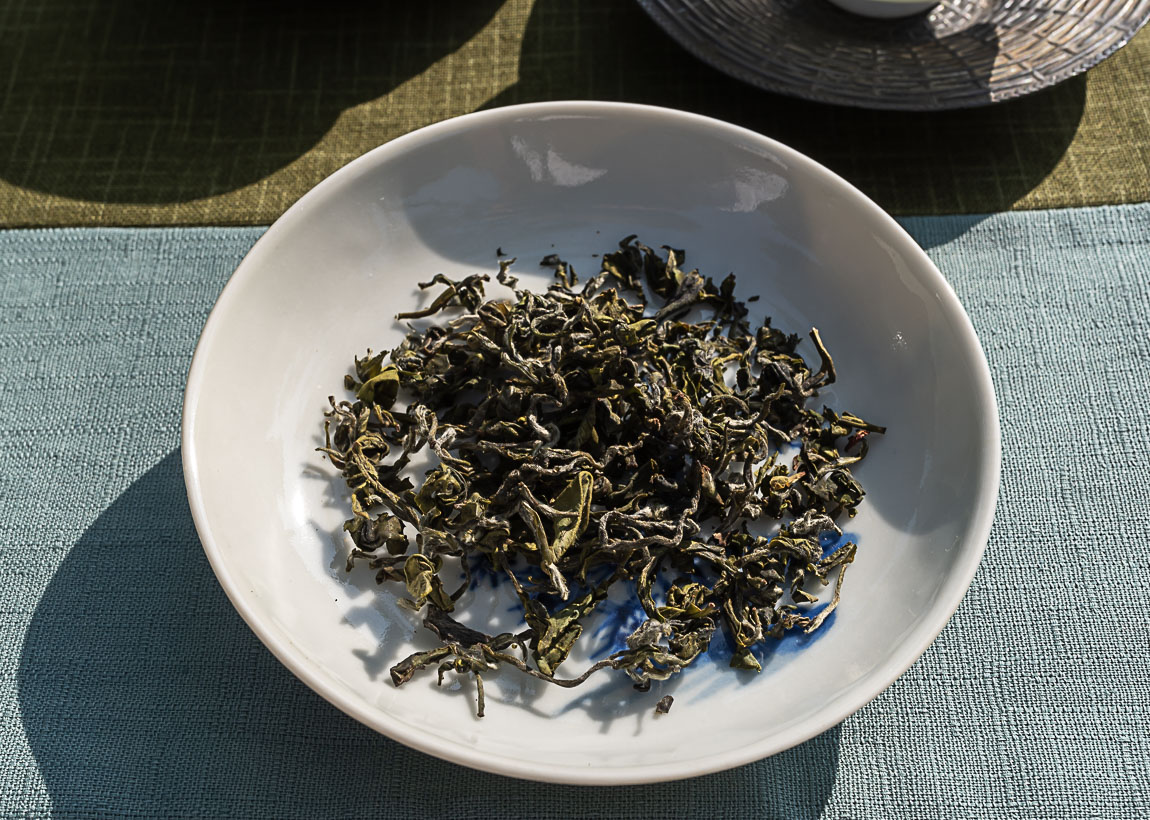
A Chinese garden is probably the best place to enjoy a green tea in spring. So, you can imagine my joy of preparing this fine BiLuoChun in the Lin Garden in New Taipei City!
Green tea is the most ancient type of tea. It used to be broken in fine pieces and cooked with some salt during the Tang dynasty. Then it was turned into even finer powder and whisked during the Song dynasty. It's only since the Ming dynasty that whole leaves of green tea are brewed, either in big teapots or, later, in gaiwan and now in glass. Some even use a silver teapot for green tea!
What is, then, the 'traditional' way of brewing green tea? Is there a 'modern' or 'progressive' way?
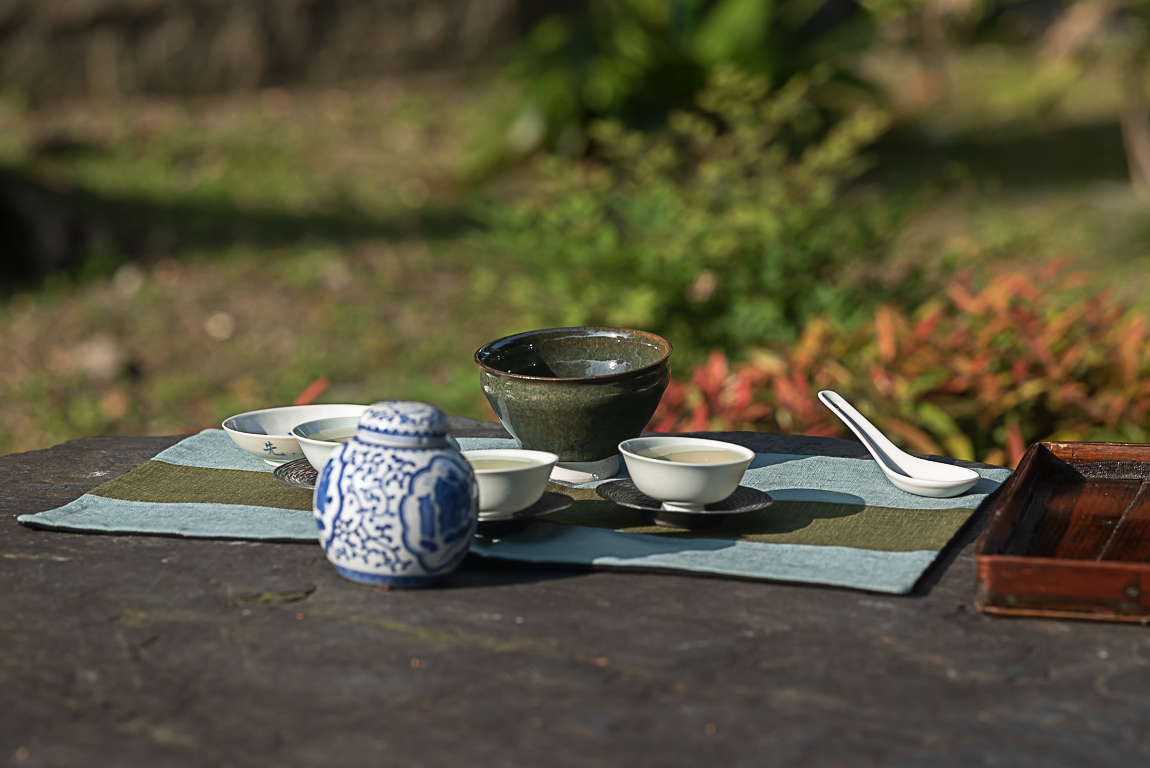
Here, for instance, you can see that I chose to use a large, dark green glazed porcelain bowl to brew my green tea. So, is there an ideal way of brewing green tea? How do we find it?
These are the questions I'll try to answer in my next video tea class on FB. You may register here to see it live and be able to ask your questions at the end of my class. Or, you'll be able to see it on my YouTube channel afterwards.
Thanks for your interest for my selection and for the tea education I provide. Let's enjoy the lively freshness of spring!
Ces 2 dernières semaines, le puerh sheng était le sujet central de mes cours de thé vidéo. Lors du premier cours, j'ai surtout parlé de définition et d'histoire, bref de la théorie sur ce thé fermenté. Voyez ici:
L'une des choses à retenir, c'est que durant la période de monopole de la production du puerh (1950-2000), il n'y avait qu'une seule firme, la CNNP, qui produisait du puerh. Elle disposait de plusieurs manufactures à cet effet (Menghai, Xiaguan, Kunmin...), mais les puerhs qui furent produits étaient toujours des assemblages (sauf rares exceptions). Certains de ces assemblages sont très renommés et collectionnés (7542 et 8582 sont probablement les plus célèbres pour la période 1975-2000).
L'assemblage du puerh est similaire au vin. Pour un vin de Bordeaux, par exemple, le producteur peut mélanger du Merlot, du Cabernet Franc et du Cabernet Sauvignon pour obtenir une bouteille de vin de Bordeaux aux arômes équilibrés. Dans le puerh, l'assemblage peut se faire sur 3 dimensions. La plus importante est de catégoriser les feuilles récoltées par taille (les bourgeons sont les plus précieux, car les plus concentrés). On catégorise aussi les feuilles par origine (lieu ou type de plantation: les théiers anciens sont les plus précieux). On catégorise aussi par saison (le printemps est la meilleure saison, mais on peut aussi ajouter des feuilles d'automne dans un mélange).
Une bonne recette qui permet un bon assemblage permet de créer un équilibre harmonieux et de produire un seul thé en grande quantité. C'est sûrement une bonne méthode pour obtenir un thé de qualité moyenne à bonne, mais si l'on veut aller plus loin dans la pureté et la précision, alors l'assemblage devient un frein à la qualité.
Or, il se trouve que depuis la privatisation de la production et de la vente du puerh, les nouveaux producteurs (de qualité) se sont surtout mis à produire des puerhs issus d'origines de plus en plus précises, et avec une attention toute particulière aux feuilles de gushu (de vieux arbres).
Depuis 2000, on est donc dans cette phase de quête de qualité et de pureté dans le haut de gamme du puerh. C'est passé par la mise en exergue de nouveaux terroirs (Lao Banzhang, Bing Dao...), de la parcelisation des anciens terroirs (de la région d'Yiwu on est passé à ces différents villages...)
Voici pour le cours théorique. Mais pour mieux comprendre, il est indispensable de passer aussi par la pratique, par l'infusion. Ce fut fait dans ce second cours:
C'est mon puerh sauvage de Lincang du printemps 2006 que j'ai dégusté face à la caméra.
2019 Lancang Puerh
Depuis 2006, les puerhs gushu, d'arbres anciens, voient leurs prix s'envoler. Ce puerh gushu de Lancang de 2019 est un bel exemple de cette qualité et pureté auquel on a maintenant accès. Et après 3 ans, l'infusion est encore plus harmonieuse!
This year's spring has a late start in Northern Taiwan. In 2021 and 2021, the second day of harvest were as early as March 4th or 6th. This year, the first day of harvest happened on March 13th! Usually, I would wait for the second day of harvest, because it's a little less expensive and still very good. However, this year, the weather bureau is forecasting a week of rain and clouds. By the time the plantation can be harvested again, I'm afraid that the leaves will have had too much time to grow and loose their concentrated scents. That's why, exceptionally, I've selected this very first batch of BiLuoChun from spring 2022! If you enjoyed the 2021 BiLuoChun, you'll love this year's even more!
I'm glad to be back on the ground, in the tea plantations. And I've brought some pictures so that you can better understand how the tea is made.
As you can see, the leaves are harvested by hand. Yesterday, there weren't many trees left to harvest. That's why there were only 2 people harvesting, an older lady and the owner of the field himself! This shows also that there is a real worker shortage for this delicate and tiring job.
Behind the farmer, we can see a large bush with light green leaves. This bush is filled with a kind of very fragrant yulan flowers. The scent of these flowers lingers in the air and I can still smell it in the brew of BiLuoChun!
From the picture below, you can see that the son has taken over the processing of the leaves from his father. He has the tough task of drying, stirring the leaves in a room without air conditioning. This detail is very important. With air conditioning, a producer can maintain the same temperature and a low humidity during the whole production season. This allows him to work with a SOP, a Standard Operating Procedure. But if there's no A/C, then the producer can't use a SOP. He has to work with his senses, smelling and feeling the leaves with his nose and hands! That's real gongfu!
All in all, the farmer only produced 18 pounds of this First Batch BiLuoChun. Enjoy its freshness by ordering it early!
Après la lecture du 'Rêve dans le Pavillon rouge' de Cao Xueqin, le plus grand roman classique chinois, je m'embarque, cette année, dans un des plus importants roman français de tous les temps: "A la recherche du temps perdu" de Marcel Proust. J'avais lu Le Rêve en 2021 en compagnie de mon groupe d'étude du thé sous la direction de mon maitre de thé Teaparker. Pour La Recherche, je rejoins un groupe dirigé/animé par Olivier Delasalle, un amateur de thé que mon blog et la providence ont mis sur ma route. Afin de rendre la lecture de ce long, très long roman plus aisée, Olivier Delasalle a établi un plan de lecture d'une soixantaine de pages environ chaque semaine. Au bout de ma première semaine, j'aimerais vous parler d'un des épisodes les plus connus de tout le livre: celui qu'on appelle 'la madeleine de Proust'. En fait, il serait plus juste de parler de 'la madeleine et l'infusion de Proust'! De quoi s'agit-il? Sur 3 pages, le narrateur fait une découverte qui l'enchante: en buvant un thé accompagné d'une madeleine, la combinaison de ces arômes lui permet de se rappeler un moment de son enfance. Cela lui fait l'effet d'une machine à remonter le temps!
Malheureusement pour nous, amateurs de thé, il ne nous dit pas quel thé il buvait avec sa madeleine. Il n'est même pas certain qu'il s'agit de thé, mais dit que cela pourrait aussi être une infusion de tilleul. Néanmoins, cette infusion occupe une place importante dans cette découverte, car le mot 'thé' revient 8 fois en l'espace de 6 pages.
J'avais donné l'explication de cette relation entre odeurs et souvenir dans cette vidéos. A 80%, nos souvenirs du passé sont rattachés à une odeur. Ainsi, l'un des grands plaisir de la dégustation d'un thé, c'est que les senteurs des feuilles ou de l'infusion nous rappellent un souvenir et nous fassent voyager dans le temps et l'espace.
Dans une autre phrase précédent cet épisode, le narrateur nos dit que sa grand-mère "eut loué plus volontiers une propriété où il y aurait eu un pigeonnier gothique ou quelqu'une de ces vieilles choses qui exercent sur l'esprit une heureuse influence en lui donnant la nostalgie d'impossibles voyages dans le temps."
Je crois que cela décrit bien ce que certains de mes Chaxi employant de vieux accessoires à thé essaient de stimuler: un voyage dans le temps qui n'est pas si impossible que cela si on sait bien harmoniser les accessoires avec les odeurs de certains thés! C'est aussi une des raisons pour lesquelles j'aime tant aller déguster du thé dans les parcs traditionnels chinois de la maison Lin de Banciao!
What's the point of having a fast car if you just use it to drive to work downtown at 50 km per hour most of the time? Even though I can barely watch this video, because it makes my hands sweat and I think of what could go wrong, there's a certain logic of wanting to push a fast to its limits! (Note: my son showed me this video and I forbid him to ride a scooter! I also told him that Bugatti was originally a car company founded near Strasbourg in Alsace, my home region!)
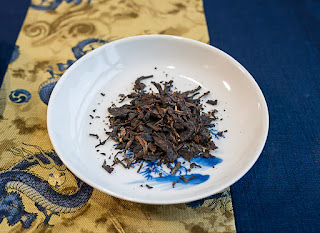
2003 wild Yiwu sheng puerh
The brewer of loose tea faces a similar situation as the owner of a Bugatti Chiron. If he wanted to brew an insipid cup, he would have purchased a cheap tea bag. But if he went through the trouble of purchasing quality loose tea, he's expecting something different, out of the ordinary.
He wonders not how fast can it go? But how good and how powerful can it taste? Unfortunately, most brewers don't realize that the Autobahn to test your tea is not an unattainable dream land, but it's easy to do at home!
The goal of this test brew is not to obtain the most comfortable cup, nor the smoothest. No, the goal of this test is to push your leaves to their limits and get the most flavors out of them. The goal is to better know your tea. How far you can push it? How strong a cup can your leaves brew? How smooth and sweet will it stay in the process? Or how bitter or astringent will it turn out to be? This is a moment of truth. Do you want to know if your leaves are a Bugatti, a Ferrari, a Porsche or simply a Toyota Prius or a Lada?! Are you ready to learn to evaluate tea quality with your own eyes, nose and taste buds? Or do you prefer to continue to believe the beautiful stories that are told by some vendors?
Here's how you can push your tea to its limits:
1. Preheat your tea vessel well. It's like an engine, it performs best after a warm-up!
2. Measure a small and consistent weight of tea leaves. The largest tea competition in the world, the Dong Ding tea competition, uses 3 grams only. It makes sense to be consistent, so that you may also compare different teas with this method.
3. The same competition uses boiling water to brew the leaves. The higher the water temperature, the more flavors come out.
4. As for which vessel to use, the Dong Ding Oolong competition uses a porcelain competition set that has a volume of 115-120 ml. You can replace it with a porcelain gaiwan. Porcelain has the advantage of being neutral and less expensive than Yixing. It's ideal for beginners and people who don't own many Yixing teapots. However, if you can also replace it with your dedicated teapot for this kind of tea. This should help extract more flavors than porcelain.
5. Brew for a long period of time in order to extract a lot of flavors from the leaves. It's more important to be consistent and stick always to the same time. The standard of the Dong Ding competition is 6 minutes.
Le titre de cet article reprend une partie de la phrase inscrite sur la théière en porcelaine Dehua (dynastie Ming). Ces calligraphies sont finement exécutées et ne sont visibles que si l'on regarde la théière de près et que l'éclairage est bon. Sinon, on ne voit rien. Ce genre de décoration quasi invisible permet de laisser à la théière sont apparence de pureté blanche.
Une calligraphie bien réalisée est en soi une réalisation artistique. Calligraphier sur de la porcelaine est bien plus difficile que sur du papier. Il n'y a aucune place pour l'erreur. On sent ici que la calligraphie de style cursive a été réalisée en toute décontraction, en harmonie avec son propos. Il est donc d'autant plus étonnant et admirable de ne pas faire étalage de cette maitrise et cette beauté! Vous serez peut-être étonnés de savoir que la phrase complète inscrite sur cette porcelaine est "ces senteurs de vin apportent un immense bonheur" (Jiu xiang jiang hong fu). Pourquoi la calligraphie mentionne-t-elle le vin et non le thé? La raison est que dans ces temps anciens, les accessoires en porcelaine étaient polyvalents. On pouvait aussi bien s'en servir pour le vin que pour le thé. Sur certaines coupes Ming, on peut même lire les 2 caractères (thé et vin), et dès les Song, un poème de Du Lei dit que le thé remplace le vin.
Il fallait donc un thé particulièrement riche en arômes pour faire vivre cette devise. C'est pourquoi j'ai choisi cet OB ultime de l'hiver 2020 dans cette semaine froide et pluvieuse sans fin. Une de ses particularités est que c'est un lot issu d'une production unique et minuscule. Cet OB ultime de Hsin Chu, ce n'est que 3 kg de thé en tout produit le 27 octobre 2020! Et comme ses senteurs sont puissantes et mielleuses, ses feuilles ont eu de nombreuses morsures d'insectes Jacobiasa Formosana Paoli. Ceci est un gage d'absence de pesticides. Le goût est donc particulièrement pur et long en bouche, en plus de magnifiques parfums...
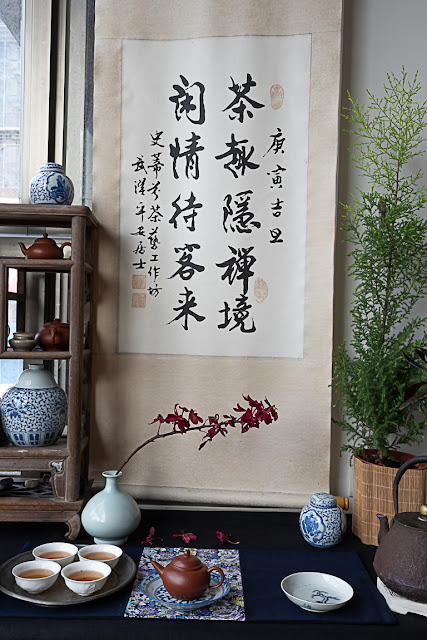
Le Chaxi ressemble à une scène de thé hivernal. La chaleur du thé contraste avec la porcelaine couleur blanche neige! Des fleurs de prunus rouge sur le tableau et sur le Chabu nous enjoignent à croire au retour prochain du printemps...
This book doesn't mention the word 'tea' once! However, first published in 2017, it provides lots of context and new, more detailed information about this period of time. Most of our new knowledge comes from the archeological research that is studying the tombs of these dynasties. But before we discuss this, I want to give you a brief introduction about these 2 dynasties and why they are so important for China, even today.
Between 230 BC and 221 BC, the kingdom of Qin managed to conquer all the kingdoms on its east (between brackets is the year of conquest). That's how it ended the Warring States period that started in 475 BC. Now, for the first time, China is a unified empire. Internally, China is mostly at peace. It only has to preserve its north western borders against attacks from the Xiongnu tribes.
To manage this large empire, the advisers of the Emperor Qin ShiHuangdi argued in favor of sending the sons of the emperor to the farthest regions, but he eventually decided against placing his family at the highest levels of power. He wanted to avoid the reformation of competing kingdoms. Instead, he decided to divide the empire in 36 smaller regions and to nominate a trio of loyal and competent public servants to head each region.
This change to previous customs was quite unusual and very much criticized. This criticism upset the emperor and he ruthlessly suppressed any dissent. He went so far as 'burning books and burying advisers' (setting hereby an example later followed by Maozedong's cultural revolution).
Another important aspect of life during this period was death! The first Qin emperor is famous for his mausoleum discovered in 1974. This 2165 m long, 940 m large and 115 m high mausoleum is not just where Qin ShiHuangdi was buried. It also contains 7000 human figurines, 15150 horses and 130 chariots made of terracotta (see the picture on the cover of the book). What is fascinating is that each figurine looks different! And the site is so huge that researchers continue to find Terracota warriors just 2 weeks ago! This work required several years of work and lots of resources.
The aim of such an underground city was to let the emperor continue to rule and live in the afterlife. In those times, life was rather short and the first emperor had spent a great deal of it fighting. He died at the age of 49 like most men of his time.
At that age, the thirst for life is still very high and it explains the quest for immortality and the attempt to continue living like before by bringing your favorite objects with you in your tomb. This custom was not limited to emperors. Rich merchants, powerful generals, court advisers... built tombs as large as they could afford for themselves. Many of these tombs have been looted over time, but archeologists continue to find new ones and their study is the main source of the additional knowledge we gain about this time. It's also interesting to read that there have been backlashes during the Han dynasty against these lavish tombs. Some argued for simpler tombs so that the riches could be inherited by the descendants instead of being buried with the dead.
The first Qin emperor paid so much attention to his afterlife that he botched his own succession in real life. Palace intrigues, murders and high taxes led to popular revolts. Liu Bang, the chief of a horse relay, emerged victorious from this civil war and established the Han dynasty in 206 BC. He took the name of Emperor Gaozu just 15 years after the start of the Qin dynasty and 5 years after the death of its first emperor Qin ShiHuangdi.
The Han dynasty would last much longer than the Qin. The Western Han lasted from 206 BC to 9 AD. Then from 9 to 23 AD, Wang Mang established the short-lived Xin dynasty. In 25, Liu Xiu was able to return the Liu family to power in what would then be called the Eastern Han dynasty, which lasted until 220 AD.
Let's go back to Liu Qi, aka Emperor Jing. He's the fourth official emperor of the Western Han. Born in 188 BC, he reigned from 157 to 141 BC. Like early monarchs, he had a large mausoleum built for himself. Its construction started in 152 BC. It is located near XiAn, Sha Anxi province and is known as the Han Yang Ling mausoleum. It's been studied since the 1990s, but it's only in 2015 that researchers figured out that a brick of plant matter was tea! This is the oldest tea found in China (and most likely in the whole world!) And from the looks of it, we can recognize that this tea is made of lots of buds, the highest quality of leaves.
It's the first time that we have found confirmation of such an old use of tea. Until know, we could only confidently go back to the Tang dynasty (618-907 AD). The Cha Jing (Classic of Tea) by Lu Yu dates back to Tang (around 760 AD). At the end of his book, Lu Yu writes that he knows about tea from the Han dynasty thanks to several people:
- The immortal Dan Qiuzi
- The prince Huangshan
- Sima Xiangru, director of the Academy of literature
- Yang Xiong, grand secretary of the imperial chancellor
What is interesting is that the last 2 persons are mentioned in the book about Han dynasty!
Sima Xiangru (179 - 117 BC) is known for his poems. In one of them, an ambassador ridicules a king thanks to his deep knowledge of the flora and fauna. He seems really likely to have known this fascinating plant that wasn't called 'Cha', yet! Unfortunately, his poems about tea may have survived until the Tang, but not until today...
Yang Xiong (53 BC to 18 AD) is not just know for his rhapsodies (fu) about sacrifices and hunting, but also for 2 books imitating 2 classics. First, there's the 'Book of the supreme mystery' (Taixuan jing), based on the 'Book of Mutations' (Yi Jing). And there's the 'Model conversation' (Fayan) based on 'The Analects of Confucius"'.
The Yi Jing is a book of divination, which is a fancy word for fortune telling. Even if you have not heard of the Yi Jing, I guess that most people have seen such trigrams composed either of a solid line (⚊) for yang a broken line (⚋) for yin. They look like this: ☳ or ☵. One may produce hexagrams by adding three more lines. With trigrams, one has 2^3=8 combinations and with hexagrams, there are 2^6=64 combinations.
Yang Xiong added a third line, broken into 3 parts as a symbol for men. In his book, the solid line is a symbol of heaven and the line broken in 2 is a symbol for earth. By taking 4 occurrences, Yang Xiong obtains 3^4=81 combinations.
This number must have had a spiritual significance even before Yang Xiong's 'Book of the supreme mystery', because Emperor Jing (the one with the tea) was buried in a tomb surrounded by 81 pits (and it's in one of those pits that the tea was found).
Finally, the Han dynasty also had an impact on tea geographically. First, in 109 BC, it conquered and annexed the kingdom of Dian (located in eastern Yunnan). The name of this kingdom remained in the name of this tea: Dianhong, a red tea from Yunnan. Second, a large portion of the Chinese population moved from the northern regions to the south. This is easy to observe when you compare the first map in 221 BC with this map in 108 BC, when the empire was at its peak.
The reason for this southward movement were the never-ending conflicts with the Xiongnu tribes at the northwestern border. The Chinese population wanted to leave this dangerous place of not so peaceful coexistence with these foreign nomadic and barbaric tribes. And since the rest of the empire was mostly at peace, many settled in southern regions. (History would repeat itself during the Song dynasty...) This southern migration had a positive impact on tea, because this plants grows best in warm and humid regions of southern China.


 Cela fait 19 ans que je prends des cours de thé, car je n'étais pas satisfait de la qualité des infusions que je faisais. Si je continue de suivre des cours, c'est que je trouve qu'il y a toujours moyen de s'améliorer et d'en apprendre plus sur le thé. Si vous suivez ce blog, j'imagine que la raison vient de l'inspiration, des connaissances et un exemple de pratique (notamment par le visionnage de mes infusions en vidéo) que vous y trouvez. Le but de mon blog est de partager ce que j'apprends afin de vous aider à progresser. Ce n'est qu'avec une bonne maitrise de la technique qu'on arrive à bien infuser son thé et donc à en tirer toute sa valeur.








 Posts
Posts


