Tuesday, September 13, 2005

Weather and tea

Yesterday, I once again tasted my 1985 wild Tuocha. But instead of drinking it on a chair, I decided to get in a more traditional gongfu cha position: on a pillow on the floor and the tea set on a small table in front of me. I know I am still behind with detailed tasting notes on this tea, but I wanted to enjoy it, not study it. I even put some old Chinese music on my stereo. Then I was gone, flying through time and distance, embracing the world from my small apartment. My mind was clear, I could see what matters in my life and felt uplifted.

Yeah, a great moment of tea! The only drawback, and here comes the link to my title, is that this wild pu-er has such a strong qi (chi) that I was sweating like in a sauna! My tee-shirt was completely wet and I had to change it (the shower followed soon!) At 28-30 degrees and high humidity, we are already cooler than at the height of summer. But best will be to wait for another couple of months that the temperature comes down to 20 to enjoy all the characteristics of this very strong pu-er!

Monday, September 12, 2005

3 Pu-ers de la Maison des 3T

J'ai eu la chance de pouvoir les goûter et voilà ce que j'en pense:
-Pu Er Yuen Neun Chi Tse Pin Cha "n°24" 1994
Vue: Des feuilles assez entières, sèches, légères, de couleur noir brun donne un thé brun foncé rougeâtre, bien transparent. Mais les feuilles ouvertes indiquent un thé cuit.
Odeur: Sec: foin. Le couvercle sent un peu le camphre et le moisi et les feuilles chades me rappellent les noids et la cave de chez mon grand-père (!)
Goût: Léger moelleux, un peu de frais, il est très court en bouche, mais ne présente aucune acidité ou amertume. Juste un petit peu écoeurant au début.
C'est un pu-er noir qui se boit facilement et qui ne présente pas de vrais défauts à part celui d'être un court.

-Pu Er Fu Zi Zhuan 1987
Egalement un pu-er cuit, celui-ci est assez comparable à la galette ci-dessus, mais est plus long en bouche et plus moelleux également. Se tient bien sur de nombreuses infusions. Et comme la galette, il n'a pas vraiment de défaut à part d'être un peu monotone à la longue.

-Pu Er en vrac "n°11" 1970
Vue: Grandes, entières feuilles brun noir donne un thé brun rouge orange (Je ne me mouille pas!) de bonne clarté et avec très peu de résidus. C'est un thé cru, mais la date me semble un peu exagéré (J'irai demander son avis à un maitre)
Odeur: Sec: écorce d'arbre sec. Mouillé: sous-bois chaud dans une forêt parfumée.
Goût: Bien moelleux, mais avec un tout petit goût d'eau et une bonne longueur. Il n'est ni amer, ni acide et la gorge est bien sèche et se transforme en moelleux de manière calme et plaisante.

Il m'a (également, comme l'ami qui me l'a envoyé) fait pensé au Jiang Cheng sauvage de 1990. Peut-être s'agit-il du même terroir? Dommâge que le nom ne nous l'apprenne pas. Mais ce pu-er en vrac est plus moelleux, plus doux mais aussi moins puissant et moins frais que le Jiang Cheng sauvage.

En conclusion, ces 3 échantillons sont bien meilleurs que ceux reçus de Singapour. Ces 8 échantillons venaient de 8 producteurs différents et montraient la variété des pu ers bas-moyen de gamme. Les échantillons de la maison des 3T montrent une grande unité de goût et un grand soin dans la sélection. Ils ont été choisi pour un public curieux, mais qu'il ne faut pas choquer.

Friday, September 09, 2005

To brew tea in a bowl

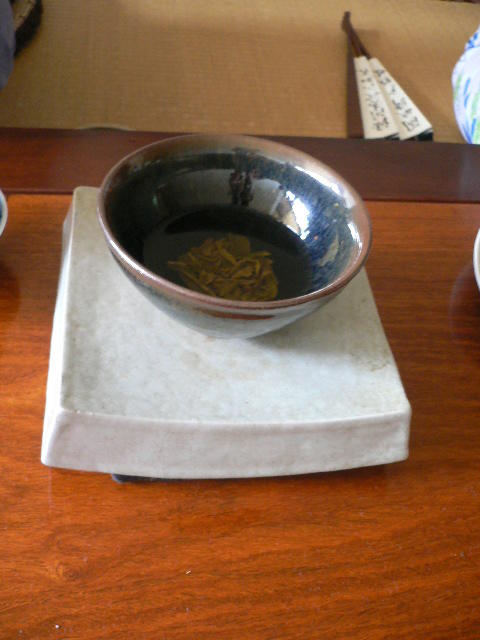
The color of the bowl is one of the important criteria. The goal is to find the right color to make the tea 'soup' beautiful.

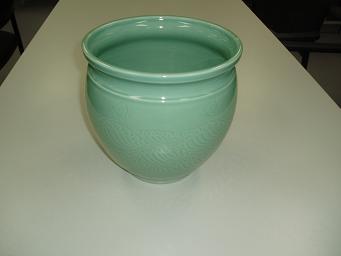
During the Tang dynasty (618-907), Lu Yu was the first one to study this point. At that time, the tea was cooked and of a transparent green. For Lu Yu, green bowls (see pictures in my article in French and in Teaparker's article) would make the tea look more vivid. This experience can easily be done with white and green tea cups.

During the Song dynasty (960-1279), green powdered tea was more common. It is known as matcha in Japan nowadays. Also green, but hardly transparent, this tea will shine its splendor in a black bowl. Hence, the beautiful Tian Mu bowls crafted in China during that time.

A second criteria is to choose a rather thick and glazed bowl. This will help to keep the temperature high.

A third criteria to succeed brewing tea in a bowl is to choose quality leaves that don't turn bitter too quickly.

The brewing method follows the general principles of gongfu cha:
- preheat the bowl (hold it in your hands to feel that the heat is well distributed,
- make a first brew with a rather quick, 10 cm over the bowl high. Then turn the water around the bowl and let it hit the edges instead of the tea.
- use a chinese soup spoon to take the foam away. Use it also to fill the tea cups and smell the fragrance of the tea.
- hold the water closer to the bowl and let it flow slowlier for the following brews.

This 'tea bowl' method can be quite convenient when the guests are more than 4. It will give them a tea show: the sight of the tea leaves slowing unfurling!

Thursday, September 08, 2005

Tea Masters blog vu sur le net

Encore un fan de thé avec un blog et un excellent fournisseur!

Perfect brewing by Teaparker

I have shot a short Quicktime video (50 seconds) of Teaparker brewing the Bai Ji Guan mentioned recently. The video is here for you to watch the master and learn!

Wednesday, September 07, 2005

Smoky pu-erh from Singapore (2)

I'm done with my first round of tasting these 8 tea samples:

a. Hong Tai Chang Cooked Pu'er, 1980s(?), Cooked - Hong Tai Chang Tea Company
b. Xia Guan Iron Pu'er Cake, 2002, Uncooked - Xia Guan Tea Factory
c. Chongqing Tuocha, early 90s, Mix(?) - Sichuan
d. Xishuangbanna Pu'er Cake, 2003, Uncooked - Chang Tai Tea Company
e. YiWu region Wild Grown Pu'er, 2003, Uncooked - Xinghai Tea Factory
f. Long Yuan Label Pu'er, 2002, Uncooked - Dadugang Tea Factory
g. Dayi Label 7542 Pu'er, 2000, Uncooked - Menghai Tea Factory
h. Jingmai Region, wild Grown Pu'er, 2003, Uncooked - 6 Famous Tea Mountain Co Ltd

Some fellow taster has suggested a form to evaluate each brew. I have used the one designed by Teaparker. I will write one in detail and be more brief for the others.

a. Tea name: Hong Tai Chang Cooked Pu'er
Harvest: 1980s(?)
Place: Border of Yunnan, Hong Tai Chang Tea Company
Price: ?
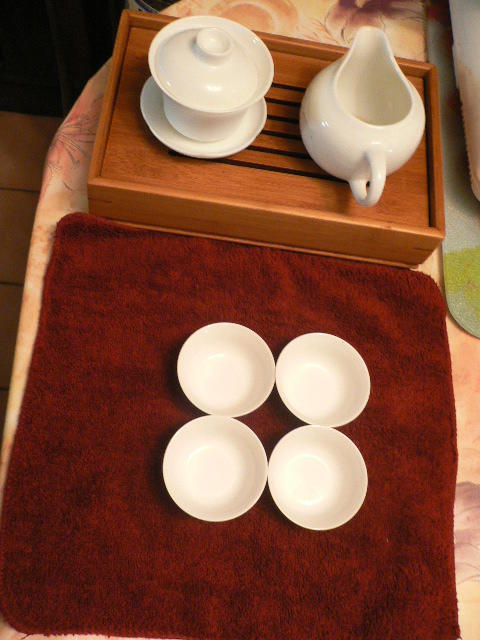
Accessories: a white, thin gaiwan and white cups (see picture)
Water Quantity: 10 cl.
Water: Mineral water Yes, Taiwan.

(I have used the same water and tea set for all my tastings. Here is why.)

A. View
- Dry leaves: big, whole, well flaked
- Color of dry leaves: brownish, a few white spots
- Color of the tea: brown, some shine
- Clarity: Good
- Wet leaves: closed, didn't unfold flat
B. Smell
- Dry leaves: old, moldy
- The cover of the gaiwan: attacks the nose, like pepper
- Tea: small dried fishes
- Wet leaves: mold and wood
- Empty glass: flat, little smell

C. Taste
- Sweetness: A little
- Persistance: No
- Bitter/sour: a little nauseating.
- In the throat: I realize it upsets my stomach
- Dryness: Yes, a little

Other observations/conclusion: this cooked pu-er is not a pleasant tea for me. The well falked leaves made it round, but the smells were not pleasant and the taste a little nauseating.

Let's continue with the other teas:

b. Xia Guan Iron Pu'er Cake, 2002, Uncooked - Xia Guan Tea Factory
A. View: broken, reddish dry leaves resulting in a darker orange brew,
B. Smell: dry straw turns to sweet cigarette butt and ashtray. Deep smoky.
C. A little sweetness at the end, very bitter and concentrated. Slowly turns dry and sweet after a minute or 2.
Not a pleasure.

c. Chongqing Tuocha, early 90s, Mix(?) - Sichuan
A. Small, blurred leaves with mold and very dark. Gives a dark brown brew.
B. Dry wood becomes wet, mellow wood with smell of underground storage.
C. Little sweetness, average persistance, but bitter at the back of the tongue. Unpleasant dryness, but long finish.
The smokiness due to fry pan drying has receded, but still not very pleasant. Plus: has a strong cha chi and long finish.

d. Xishuangbanna Pu'er Cake, 2003, Uncooked - Chang Tai Tea Company
A. Light dry leaves of darker color give a brown orange, clear and shiny brew
B. Dry it smells sweet, but brewed there are then smells of amonia, cigarette butt, earth & mud
C. This undrinkable Sh.t feels watery and overly bitter with no dryness.
Horrible!

e. YiWu region Wild Grown Pu'er, 2003, Uncooked - Xinghai Tea Factory
A. Heavy, greenish leaves bive a yellow orange brew
B. Dry straw smell becomes cheesy, and displays its YiWu origin. Light smells
C. Little, quickly disappearing sweetness. Somewhat sour, but not bitter. Flowery and long finish.
Got more lucky with the Yi Wu region. Has some potential to get better.

f. Long Yuan Label Pu'er, 2002, Uncooked - Dadugang Tea Factory
A. Long, solid and sharp, greenish and shiny leaves brew orange with residues.
B. Grass and light cigarette/wet pipe smell
C. Little sweetness. bitter sour. Turns sweet in the finish.
The smoky smells were not overwehlming and was almost drinkable.

g. Dayi Label 7542 Pu'er, 2000, Uncooked - Menghai Tea Factory
A. Shiny small buds on the outside and older leaves below gives a shiny and clear brew.
B. Smoky, pipe and mushrooms. Light nice smell that turns cheesy (good for me, I'm French!)
C. Light sweet taste without bitterness. Turns dry under the tongue.
Sweet and smooth pu-er, just too bad it has also this smoky, cigarette smell, albeit lighter than the other samples.

h. Jingmai Region, wild Grown Pu'er, 2003, Uncooked - 6 Famous Tea Mountain Co Ltd
A. Small buds of light color give a light yellow/orange brew
B. A little straw and mellow, light, humid forrest and sweet light smokiness
C. A little sweet in the beginning and then again during the finish. A little sour in the back of the mouth and bitter above the tongue. Dry, long and sweet.
This is the best pu er of this sampling and by far! And it's a wild grown pu er from a famous mountain. Well, good trees in old producting regions make good teas! The world is sane after all!

Let me again thank this friend in Singapore who made this tasting possible. I am actually glad to have tasted so many bad pu erhs (for free!) Only one out of these eight puer (already selected by a very experienced connaisseur) would have made it to my selection. That says a lot, I think, about the difficulty to find really good pu-erh. And it also shows that age is not a fool proof criteria either! Even 'wild grown' is not a sure thing (see e.). The only thing you can trust are your senses!

Now, I guess some will find that I am too harsh on some of the teas. They may think that I didn't appretiate their character. Maybe. Smokers may find them appealing and give them fancy names like "camel breath"! But my senses tell me it doesn't taste right and I just say so.

Tuesday, September 06, 2005

Mes coupes de thé


Elles ont des parois fines, pour goûter à la finesse du thé. Cela suit la même logique que les verres en cristal par rapport aux verres à moutarde.

Wu Yi Mountain Tea: Bai Ji Guan

Wu Yi Mountain is not only the home to the famous Da Hong Pao, but also to other great teas like the bai ji guan (white chicken). The leaves of the bai ji guan are green/yellow. And the soil of Wu Yi has big rocks from an ancient volcano, which gives the tea its unique character.

Teaparker gave us the opportunity 9 days ago to drink real bai ji guan. I add 'real', because there are so many copies of these legendary teas. Even Teaparker got fooled more than once. 20 years ago, he recalled, he bought what he thought was Bai Ji Guan, but it was just plain Tie Guan Yin. This time, this tea was given to him by the manager of the tea field in the Wu Yi mountain.

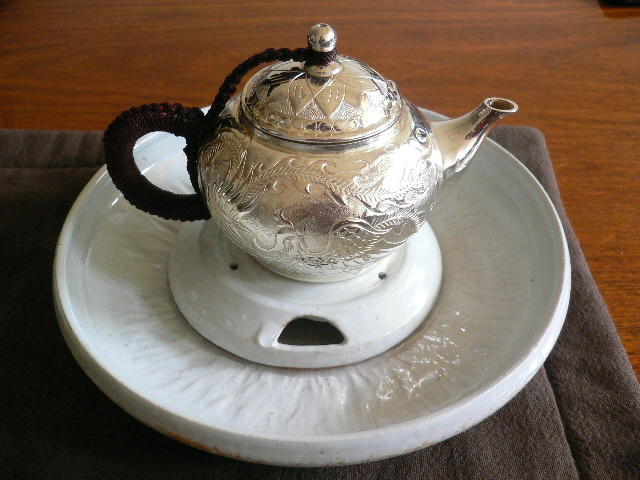
We used quite a large amount of leaves and filled the silver teapot about half way. Guess how many tasty, mind blowing, interesting brews we made? 11!

Tasty: not a strong taste at all, but a very delicate after taste and a sense of sweetness, like english toffee.

Mind blowing: each of us had the opportunity to brew the tea. Teaparker proved once again why he is a real tea master: he could decribe the taste of the tea before we drank it, just by watching how we brewed it! He said that one brew would taste kind of watery (unsufficiently concentrated) and with a little astringent feel in the mouth. And that's just how it tasted! The reason was that the student had abruptly cut of the arrival of water in the teapot, and then let the tea flow out too quickly from the pot.

Interesting: we then all practiced the best way to pour the water in and the tea out to get the best result. The flow of water must be steady and even over all the leaves (in circle). And to get a concentrated tea, the tea must be poured out of the teapot as slowly as possible, but always in a steady pace.

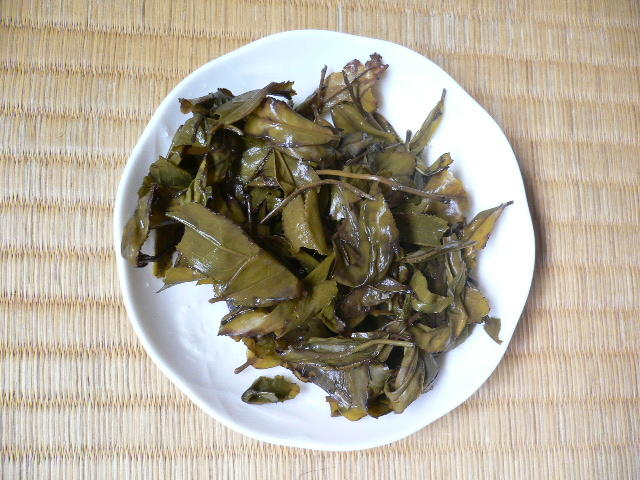
Here are the remaining leaves after our 11 brews. They look quite common, but they contain one of the very finest teas of China.

Monday, September 05, 2005

J'ai fini le pavé de l'été...

... juste à temps pour la rentrée. J'ai avalé les 2 tomes de 'Au bord de l'eau', un roman fleuve chinois. C'est, en deux mots, l'histoire de 108 brigands malgré eux. Ceux qui aiment les films de Lelouche qui fait se croiser des vies, des gens sans rapports, trouveront là le maitre du genre. C'est parfois un peu répétitif: deux gentilhommes se rencontrent, accomplissent un exploit et vont faire ripaille. Il y a certaines lenteurs durant le livre, mais il se termine sur les chapeaux de roue et donne un bon apperçu de la culture chinoise.

Concernant le thé, on voit qu'il fait parti de la vie courante. Les brigands vont souvent en boire, mais pas autant que l'alcool. On apprend que le patron de la maison de thé s'appelle le "Cha Bo Shi", docteur en thé. Cela montre que le thé n'est pas qu'une simple boisson, mais aussi un objet de longues études. (Je confirme.) Mais à part ça, on n'entre pas plus dans le détail des thés bus ou des ustensiles utilisés. Ceux qui veulent apprendre d'anciennes coutumes de thé resteront sur leur faim.

Thursday, September 01, 2005

Faire du thé dans un bol

La couleur du bol est un des critères les plus importants. Il faut savoir comment combiner la couleur du bol avec celle du thé pour rendre le tout harmonieux.

Durant la dynastie Tang (618-907), Lu Yu fut le premier à étudier la question. A l'époque, le thé était cuit et de couleur verte, transparent. Pour Lu Yu, les bols verts (voir la photo du réceptacle d'eau ci-contre) sont ceux qui rendent la couleur du thé la plus éclatante. Faites l'expérience avec un bol blanc aussi, et vous verrez que le blanc enlève son éclat au thé.

Durant la période Song (960-1279), on buvait surtout du thé vert en poudre, le matcha japonais actuel. C'est un thé de couleur verte, mais pas transparent. La meilleure couleur est le noir. C'est pourquoi on utilisait les bols Tianmu noirs à l'époque et aujourd'hui encore.
La photo est celle d'un bol vide, mais il est aisé de s'imaginer comment le matcha, thé en poudre vert battu avec un fouet en bambou, ressort bien sur ce fond noir. Les thés transparents eux, sont difficiles à voir.

Deuxième critère pour réussir son thé: choisir des feuilles de qualité qui ne vont pas devenir amères ou acides trop rapidement.

La méthode pour infuser le thé suit les principes du gongfu cha:
- préchauffer le bol (le tenir pour sentir si la chaleur est bien absorbée)
- première infusion avec une eau qui coule vite, à 10 cm au-dessus du bol, puis plus haut. On tourne pour mettre de l'eau sur les bords du bol et non sur les feuilles directement.
- Infusions suivantes plus douces et rapprochées.
- Ecrémer les bulles éventuelles avec une cuillère à soupe chinoise en céramique. Elle servira ensuite à remplir les tasses et à sentir l'odeur du thé.

Cette métode 'en bol' convient particulièrement quand les convives sont un peu nombreux. Et elle a aussi l'avantage du spectacle: on peut voir les feuilles s'ouvir peu à peu.